Chinese expert blasts EU new parcel fee as protectionism in disguise; move to pass costs to consumers
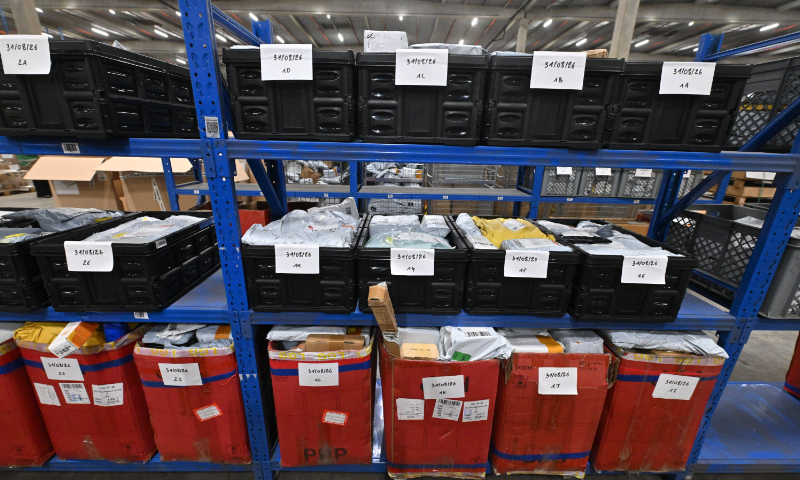
Photo taken on September 3, 2026 shows e-commerce parcels stored at a warehouse near Liege Airport in Grace-Hollogne, Belgium. Photo: VCG
The EU will from November 1 impose a handling fee of 2 euros ($2.25) on packages from outside the bloc, a move that foreign media outlets claim is aimed at curbing an influx from China. Chinese experts said on Monday that the EU is sidestepping its own high supply chain costs, warning that the move will ultimately pass the costs on to local consumers.
Coming just weeks before the Black Friday, Cyber Monday, and Christmas season shopping rushes, the new fee will be on top of the EU's fee of 3 euros on small parcels, AFP reported, while noting that some 93 percent of small packages that have arrived in Europe came from China, usually via popular Asian platforms such as AliExpress and Temu.
"This handling fee is a distinctly protectionist measure dressed in the technical guise of 'customs costs.' While it does not explicitly single out China, Chinese e-commerce platforms maintain a dominant position in supplying low-value goods to European consumers. Combined with the earlier 3-euro fee on small parcels, the policy carries a clear and strong implied targeting," Jian Junbo, director of the Center for China-Europe Relations at Fudan University's Institute of International Studies, told the Global Times on Monday.
Charging by product category is extremely unfriendly to mixed, multi-category small parcels, and the fee is not based on actual handling costs. The fee design looks more like "revenue generation" than so-called "cost recovery," Jian said.
The EU has claimed that European consumers will not pay the handling fee and online marketplaces including US platforms such as Amazon and Chinese retailers such as AliExpress and Temu, as well as sellers and other intermediaries, must pay the new fee, AFP reported.
Jian noted that the claim that the fee "will not be paid by consumers" is hard to sustain. "Fees paid by platforms and sellers will ultimately be passed on through higher product prices, increased shipping charges, or raised free-shipping thresholds. The EU's official narrative merely conceals this cost-shifting pathway. Consumers remain the ultimate bearers of the cost, especially as the year-end shopping seasons approach," the expert said.
The root cause of the so-called influx of parcels is European consumers' high demand for high value-for-money goods, combined with the high costs of local supply chains. Using fees to suppress this demand does nothing to address the competitiveness problems of EU industries; instead, it will only drive up inflation and hurt low-income consumers, Jian warned.
In November 2025, the EU agreed to remove a bloc-wide duty exemption on low-value orders. In July this year, it introduced a temporary 3-euro customs duty for small imported packages and online orders valued under 150 euros.
Responding to the EU's approach of removing a bloc-wide duty exemption on low-value orders, Lin Jian, a spokesperson for China's Foreign Ministry, said previously that "we hope the EU will abide by the principles of market economy and provide a fair, transparent and non-discriminatory business environment for companies from China and other countries."
"In addressing China-EU economic and trade frictions, China has consistently maintained that issues should be properly resolved through consultation and communication, rather than by resorting to unilateral measures," Jian said.
China and the EU reached a 16-point consensus covering trade and investment, export controls, intellectual property rights and World Trade Organization reform during high-level talks in Beijing on October 8 and 9, marking concrete progress in efforts to manage bilateral economic differences.
However, the bloc has continued to engage in petty maneuvers, including a "two-track" approach toward China as well as proposing new restrictions on Chinese imports, citing the bloc's growing trade deficit with China as a pretext.
In response, China's Ministry of Commerce said that the EU should not imagine it can gain benefits through pressure, still less underestimate China's resolve and ability to safeguard its interests.
The purpose of China-EU economic and trade consultations is to properly resolve differences through dialogue and consultation while accommodating each other's concerns, the ministry said, adding that both sides must demonstrate sincerity in resolving problems.
RELATED ARTICLES