EU's 'talk-while-fighting' approach on China trade 'counterproductive'
Brussels' new reported trade tools risk eroding hard-won consensus, focusing on dialogue, co-op right way forward
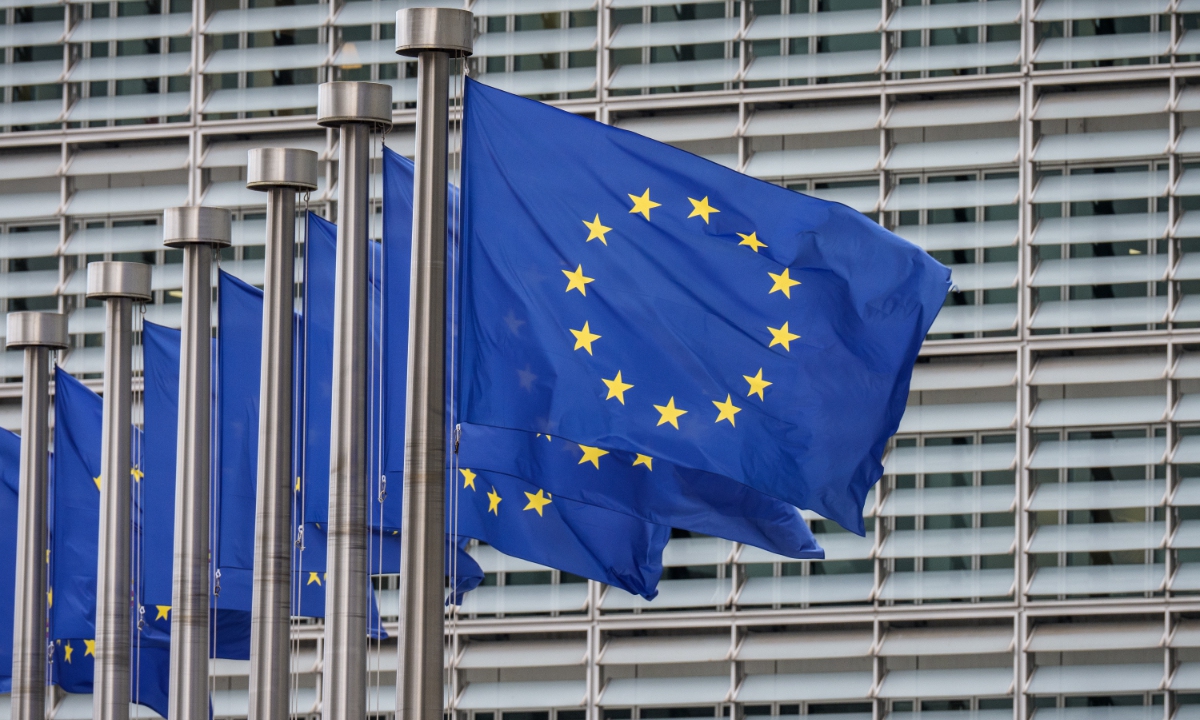
The European Union (EU) flags in front of EU headquarters in Brussels, Belgium. Photo: VCG
Less than a week after China and the EU reached 16-point consensus on areas including trade, investment and export controls, EU leaders reportedly will instruct Brussels to "urgently" develop new tools to counter the so-called China-related economic imbalances at Thursday's summit, a move that Chinese experts called as a counterproductive and confrontational posture that will undermine the spirit of the freshly agreed consensus.
The EU's approach of talking while fighting will only erode China-EU mutual trust instead of alleviating its own structural problems, analysts noted, urging the bloc to cherish the hard-won consultation results, in order to foster a sound cooperative atmosphere for the steady development of China-EU trade ties.
EU leaders are meeting in Brussels on Thursday for a packed two-day summit. Energy prices, trade with China and the budget will dominate Thursday's session, according to Euronews.
Draft conclusions from the summit indicate leaders will request the EU executive, the Commission, to continue its dialogue with Beijing, while also making full use of EU trade defense measures and adding new trade instruments to protect the bloc further, Reuters reported.
Well before the China-EU consultations in Beijing, the EU had been steadily ratcheting up pressure on China, including Germany and France's push for EU rapid-response trade tool with likely focus on China. Even after the consultations concluded, some officials and diplomats in Brussels reportedly made clear that it was not enough and that the EU intends to keep the pressure on China to moderate its exports in other sectors.
The 16-point consensus between China and the EU was the result of multiple rounds of consultations rather than something achieved overnight. It was good news for markets, businesses and stakeholders on both sides, Zhou Mi, a researcher at the Chinese Academy of International Trade and Economic Cooperation, told the Global Times on Thursday.
"Yet the EU reportedly undermines these very principles - a serious blow to both sides that raises doubts: Can the EU be trusted to honor its commitments?" the expert asked.
According to the South China Morning Post, EU leaders are expected to ask the European Commission, which manages trade policy for the 27 member states and which has taken the steer on negotiations with China, to create new instruments by the end of the year.
Two of these have already been announced: a diversification tool to compel companies to broaden their pool of suppliers and a "solidarity mechanism" to compensate firms hurt by Chinese retaliation. But diplomatic sources expect many leaders to back a Franco-German proposal for a kill switch that would quickly kick countries and firms out of the EU market if they use coercive behavior, according to the report.
Chinese experts questioned the feasibility and effectiveness of these reported EU tools, noting that packaging trade tools as a response to "imbalances caused by China's policies" is essentially externalizing internal competitiveness problems and using an "internal illness treated with external medicine" approach to avoid the real reform agenda.
For instance, the so-called diversification tool requires EU companies to diversify their sources of key supplies. "This amounts to substituting regulatory mandates for commercial judgment. Companies know best the costs and risks of their supply chains; forcing them to diversify procurement will only drive up costs and weaken competitiveness," Jian Junbo, director of the Center for China-Europe Relations at Fudan University's Institute of International Studies, told the Global Times on Thursday.
The Franco-German proposal is unlikely to be fully implemented and serves more as a deterrent, Jian added. The reason is that the EU cannot completely sever its market ties with China, as the two economies are inseparable through cooperation. "Moreover, the measure is still under discussion, and there may be internal divisions within the EU over its feasibility," Jian said.
The decline in Europe's competitiveness stems from internal factors including insufficient manufacturing technology, weak innovation capacity, and overly stringent regulations, analysts noted.
Natural gas prices in the EU are four to five times higher than in the US, and electricity prices are several times higher than in both China and the US, while redundant approval and regulatory processes have significantly increased the burden on businesses. When high-energy-consuming industries such as chemicals, energy, and machinery face higher electricity prices and more complex approvals, the relocation of industrial chains is the inevitable result of market rationality, Jian said.
Yet some EU officials have defended the bloc's approach, describing the dual-track strategy of talking with Beijing while preparing new trade tools as effective.
According to the South China Morning Post, multiple well-placed sources said the [China-EU] deal shows that the "two-track" model of talking with China and working behind the scenes on new trade weapons works.
"Some EU politicians have developed a misconception that China and the EU reached consensus only because China was under intense pressure. From a macro perspective, China's active efforts to address mutual concerns with the EU are driven by constructive and strategic considerations aimed at stabilizing bilateral trade ties, rather than being simply forced by pressure. If the EU continues to apply pressure based on this misperception, it may face countermeasures from China in the future," Jian noted.
Joint efforts needed
Chinese Commerce Minister Wang Wentao and European Commissioner for Trade and Economic Security Maros Sefcovic held the second meeting of the China-EU trade and investment consultation mechanism on October 8-9.
They agreed to hold the third meeting in March 2027 and, in the meantime, maintain close communication, including a ministerial-level video meeting in January.
Among the key outcomes, China and the EU reached an understanding on hybrid vehicle trade in a manner consistent with WTO rules following intensive consultations.
"The understanding reached by China and the EU on hybrid vehicles is reciprocal and mutually beneficial," He Yadong, a spokesperson for the MOFCOM, said on Thursday, noting that the consensus has effectively safeguarded the practical interests of Chinese companies and averted an escalation of trade friction between China and the EU.
He also said that China stands ready to continue facilitating the review and approval of rare-earth export licenses to Europe, and hopes the European side will reciprocate by facilitating the resolution of key individual cases concerning licenses for Chinese entities in the dual-use field. "China will work with the European side to keep leveraging the export control dialogue mechanism and promote the growth of bilateral trade in dual-use items," the spokesperson noted.
Zhou noted that the consultation mechanism has produced positive results. It has not only stabilized bilateral trade ties and business expectations, but also demonstrated that equal dialogue can effectively address mutual concerns in the trade field, setting a model for the world, Zhou added.
"If the EU believes dialogue with China is valuable, it should focus on producing more outcomes at the next consultation meeting, rather than stepping up pressure on China," Jian said, adding that Europe should cherish the hard-won consultation results, work with China in the same direction, and foster a stable and sound cooperative atmosphere for the long-term, steady development of China-EU trade ties.
RELATED ARTICLES