Volkswagen secures L3 testing permit as China-Germany auto innovation co-op grows
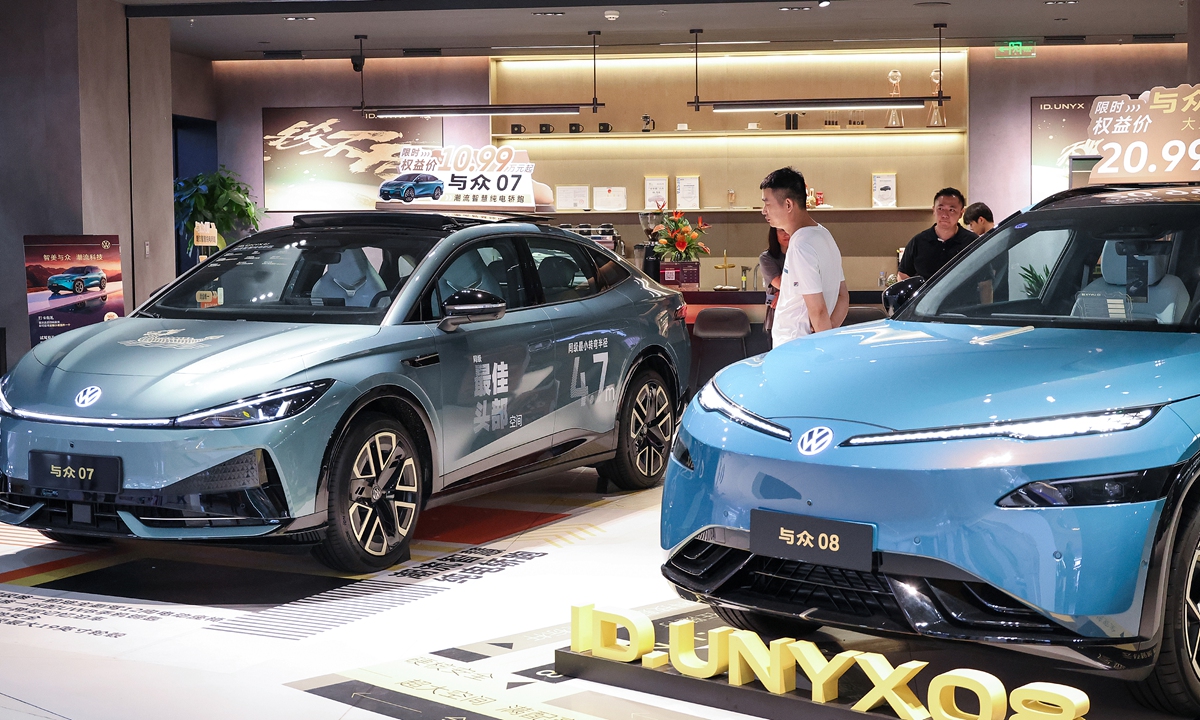
Visitors check out Volkswagen Anhui models during new energy vehicle trade show in Shanghai on June 20, 2026. Photo: VCG
Volkswagen Group China has obtained a Level 3 autonomous driving road-testing permit in Hefei, East China's Anhui Province, enabling it to conduct compliant real-world testing and large-scale data collection, the company told the Global Times in a statement on Monday.
The permit also marks another step in China-Germany automotive cooperation as the two sides expand their cooperation beyond traditional manufacturing into advanced technologies, industry representatives said.
The development comes ahead of German President Frank-Walter Steinmeier's state visit to China from October 27 to 31.
Steinmeier is scheduled to visit Volkswagen Group's technology center in Hefei on Tuesday, according to German media reports.
Volkswagen said that the newly secured permit allows it to conduct L3 autonomous driving tests under China's latest safety requirements, advancing its efforts to achieve technological readiness by 2027.
The company will also showcase its latest innovations at its first Volkswagen Group China Technology Day in Hefei on Wednesday, the company told the Global Times.
In December 2025, China granted its first conditional approvals for L3 autonomous driving vehicles, and work on a second batch of pilot approvals is underway, according to the Ministry of Industry and Information Technology. China has also introduced mandatory safety standards for L3 and L4 driving systems in August, creating a clearer regulatory framework for automakers developing and testing such technologies.
The latest development reflects a broader transformation in China-Germany automotive cooperation, Zhang Xiang, secretary-general of the International Intelligent Vehicle Engineering Association, told the Global Times on Monday.
"In the past, cooperation largely followed a model in which German automakers brought their technologies and brands to China while benefiting from the Chinese market," Zhang said. "Now, we are seeing the relationship move toward joint research and development and technological innovation, with Chinese companies increasingly contributing core technologies."
German automakers have long-established brands, extensive dealership networks and mature industrial operations in China, while Chinese companies have developed competitive strengths in electric vehicles (EVs), intelligent driving and related supply chains, Zhang noted.
These complementary strengths are already leading to concrete partnerships.
In July, Volkswagen announced an expanded partnership with China's Horizon Robotics through their joint venture CARIZON to accelerate the development of L3 and L4 automated driving technologies. Under the agreement, CARIZON will gain access to Horizon's artificial intelligence foundation model, with Volkswagen targeting the delivery of its first L3 capabilities as early as the second half of 2027, according to an official company announcement.
Volkswagen has also deepened its cooperation with XPENG, a Chinese EV maker, on electronic and electrical architecture, while its Audi brand has partnered with SAIC Motor to develop intelligent EVs tailored to Chinese consumers.
Such cooperation is becoming increasingly important as China's automotive market undergoes rapid technological change. New-energy vehicles accounted for a record 67 percent of China's retail passenger car sales in September, while their penetration rate among mainstream joint-venture brands was just 15.9 percent, according to data from the China Passenger Car Association.
Zhang said that the pace of innovation means German automakers need to adapt their development strategies, placing greater emphasis on local research, faster product development and closer cooperation with Chinese technology partners. Autonomous driving is becoming an increasingly important area of cooperation between Chinese and German automakers, as China accelerates the development and real-world application of intelligent driving technologies, Zhang said.
He noted that China's growing strengths in intelligent driving systems, software and supply chains complement German automakers' longstanding expertise in manufacturing and engineering. By combining these advantages and developing technologies tailored to Chinese consumers' needs, the two sides can accelerate innovation while strengthening their competitiveness in both the Chinese and global markets.
RELATED ARTICLES