ARTS / CULTURE & LEISURE
Global tourism forum in Macao highlights Chinese solutions to industry challenges
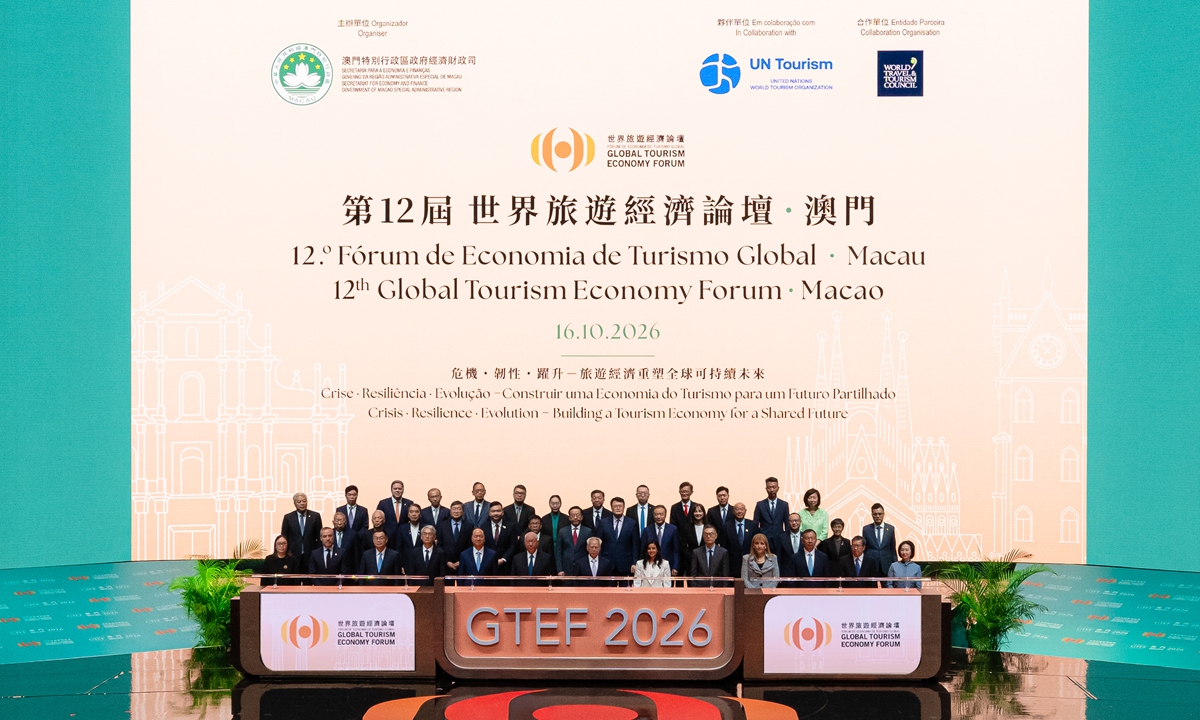
Participants take a group photo at the 12th Global Tourism Economy Forum. Photo: Courtesy of the organizers
During the 12th Global Tourism Economy Forum (GTEF) recently held in China's Macao Special Administrative Region, participants from nearly 30 countries across the world shared valuable insights and experiences, and explored pragmatic solutions rooted in Chinese experience that can help the global tourism industry navigate uncertainties which once again underscored Macao's standing as the World Centre of Tourism and Leisure.Under the theme "Crisis · Resilience · Evolution - Building a Tourism Economy for a Shared Future," the forum brought together around 1,300 government officials, representatives from international organizations, business leaders and experts from around the world. They focused on topics such as building a resilient tourism economy, inbound tourism, cultural tourism integration and sustainability, the organizers of the forum told the Global Times.
Maria Helena, director of Macao Government Tourism Office and vice chairman of GTEF, told reporters at the closing ceremony that bringing together decision-makers, drivers of development and industry leaders over the years, the forum has facilitated sharing of experience and pragmatic cooperation across borders and sectors, developing into an international platform for building consensus and shaping industry trends.
The forum announced that South China's Hainan Province will become the host province for the 13th GTEF in 2027, with Macao and Hainan tourism authorities signing a memorandum of understanding to further deepen Hainan-Macao cooperation in tourism and related fields.
Aligning with the development strategies of the Guangdong-Hong Kong-Macao Greater Bay Area and the Hainan Free Trade Port, both sides will strengthen resource sharing and industry matching to promote the high-quality, synergistic development of their tourism sectors.
Speaking about the key rationale for expanding the forum beyond Macao and bringing it to Chinese mainland cities, Pansy Ho, vice chairman and secretary-general of the GTEF, said the platform was established to help people from around the world visit China, see the country firsthand and gain a deeper understanding of it.
While AI can readily provide travel images and industry data, Ho said that online information alone cannot convey the true charm of a city or region, or fully reveal its development potential. Firsthand experiences and face-to-face exchanges and business connections remain irreplaceable by technology, Ho noted.
Gloria Guevara, president and CEO of the World Travel & Tourism Council, acknowledged China's contributions in global tourism growth and expressed confidence in China's prospects in the industry.
Guevara told reporters at the forum that China, the world's second largest travel and tourism economy, continues to drive regional growth with its booming tourism industry.
"China's continuous investment in infrastructure, destination building, talent training, visa exemption, AI application and other favorable policies will make it a bigger global tourism player, even surpassing the slowing US market," Guevara said.
China's tourism economy is currently growing at a robust annual rate of nearly 10 percent, outpacing the global tourism and cultural industries. As the world's largest consumer market of the future, China is leading innovation in business models and the upgrading of standards across the global tourism industry, according to Ho.
"We uphold the principles of rejecting hegemony and pursuing shared development. Leveraging China's strengths in infrastructure, industry and market scale, we aim to offer Chinese solutions that can serve as reference points and be replicated elsewhere to support global tourism development," Ho noted.
China's infrastructure development over the past decade has been remarkable, from world-class bridges and road networks in Southwest China's Guizhou Province to a nationwide transport system connecting even remote areas. These advances have fundamentally transformed the prospects for tourism and cultural development in regions that were once constrained by limited accessibility, Ho said.
China's growing presence in the global tourism industry can offer valuable lessons that countries and regions around the world are eager to learn, she said. These strengths have also laid a solid foundation for the forum's development into a world-class platform, she added.
Founded in 2012, the GTEF is a premier international platform dedicated to promoting the sustainable development of the global tourism economy. Serving as an essential bridge for exchange and cooperation between China and the international community, the forum convenes leaders from governments, enterprises, academia, and international organizations worldwide to address opportunities and challenges in global tourism, establishing itself as one of the most influential annual events in the global tourism economy sector, according to the organizers.
RELATED ARTICLES