China sends defense attaché to ADMM-Plus; Philippines to blame for participation downgrade: expert
By Guo Yuandan and Published: Oct 28, 2026 07:45 AM

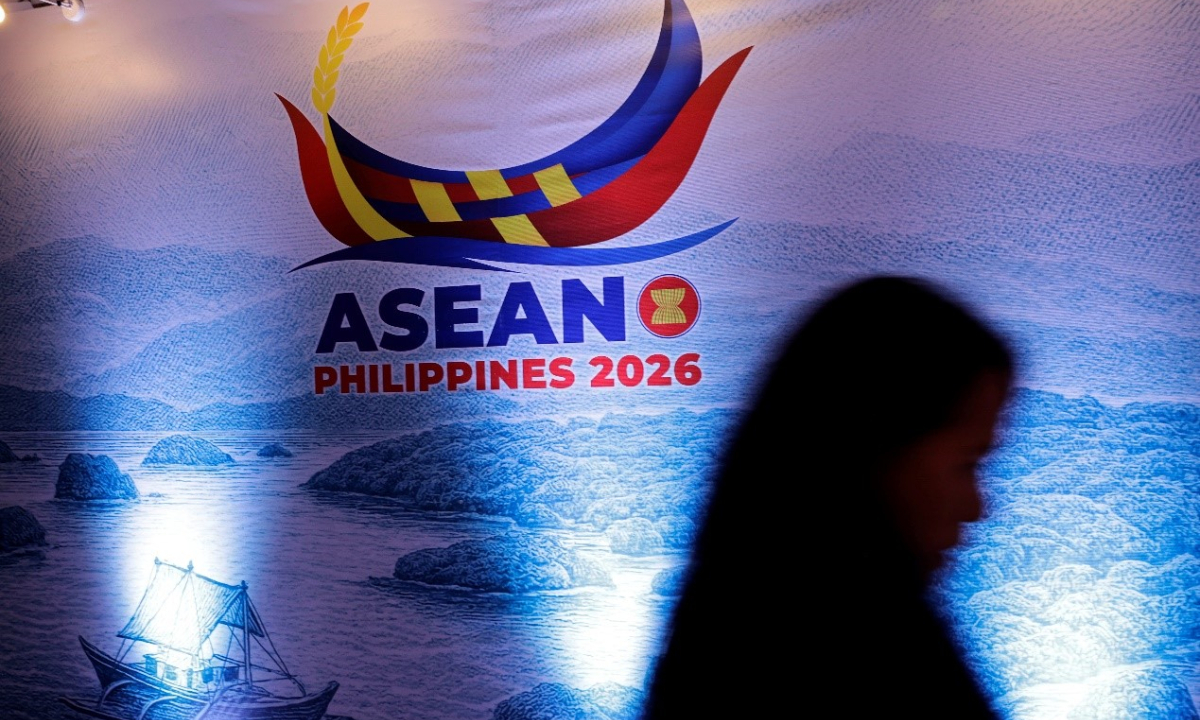
A person walks past a logo of the Association of Southeast Asian Nations (ASEAN) at a hotel serving as the international media center for the 20th ASEAN Defense Ministers’ Meeting (ADMM) and the 13th ADMM-Plus in Cebu City, Philippines, October 27, 2026. Photo: VCG
The Chinese Defense Ministry announced that China will send the defense attaché of the Chinese Embassy in the Philippines to attend the 13th ASEAN Defense Ministers’ Meeting Plus (ADMM-Plus) in Cebu, which marks the lowest-level Chinese representation at the ADMM-Plus since its inaugural session in 2010. Analysts told the Global Times that the downgraded attendance is attributable to the Philippines.The defense attaché of the Chinese Embassy in the Philippines will represent the Chinese side to attend the 13th ADMM-Plus in Cebu on October 29. During the event, the Chinese side will exchange views with other parties on upholding dialogue and enhancing mutual understanding and trust, and reiterate China's firm support to ASEAN centrality in the regional architecture to promote regional defense and security dialogue and cooperation, and safeguard peace and stability in the region, Chinese Ministry of National Defense said in a statement on Tuesday.
According to ASEAN’s official website, the 20th ADMM, the 13th ADMM Plus and associated side meetings will be held in Cebu, the Philippines, on October 28-29. The Philippines holds the ASEAN chairmanship for 2026.
The inaugural ADMM-Plus was held in 2010. As a key component of the regional security architecture, the ADMM-Plus facilitates cooperation between the ASEAN Defense Ministers’ Meeting and its eight dialogue partners to address shared security challenges.
The Global Times has learned from sources that this marks the lowest rank of Chinese representation since 2010. Except for the 10th ADMM-Plus in 2023, which was attended by a delegation from China’s Ministry of National Defense, the other 11 sessions were all attended by the then Chinese minister of national defense.
China’s downgraded attendance at the ADMM-Plus reflects the current state of China-Philippines political, diplomatic and defense ties. The Philippines bears responsibility for this situation, Ding Duo, director of the Research Center for International and Regional Issues at the National Institute for South China Sea Studies, told the Global Times.
Ding said that as the ASEAN chair and host this year, the Philippines should have earnestly fulfilled its chairmanship duties, properly organized the meeting, managed the agenda, and fostered a calm, constructive and cooperation-focused atmosphere for dialogue and consultation among all parties.
Instead, it has done the opposite: turning the multilateral platform into an arena to hype up the South China Sea issue and advance its own narrow interests. Worse still, it should not allow its military and law-enforcement agencies to hijack the agenda, smear China and stoke confrontation, said the expert.
The Chinese Embassy in Manila also said in a post on X on October 19 that “Recently, Philippine military and law enforcement personnel, along with anti-China forces, have been actively undermining China-Philippines relations, engaging in extensive rights violations and provocations at sea in an attempt to create incidents. The number of such incidents has doubled compared with the past.”
“In particular, the Philippines' Defense Secretary Gilberto Teodoro Jr., a representative of anti-China forces within the country’s military and law-enforcement establishment, has repeatedly launched attacks, smears and groundless accusations against China regarding China-related and maritime issues recently, severely undermining the atmosphere necessary for the development of bilateral ties,” Ding said.
The expert noted that Philippine President Marcos Jr. has failed to effectively rein in domestic anti-China forces and has even adopted a laissez-faire stance, taking no action against individuals or remarks that harm China-Philippines ties. “Furthermore, with external countries, including the US and Japan, continuing to meddle in the South China Sea issue and ramping up support for the Philippines, there are no favorable conditions for bilateral relations to improve,” said Ding.
It can be anticipated that as this year’s ASEAN chair, the Philippine military and law-enforcement agencies will seek to hijack dialogue agendas on occasions including China-ASEAN summits, hype up the so-called “South China Sea threat” and smear China’s South China Sea policy through formal meetings or sideline events, said Ding.
“Under such circumstances, by sending a representative to the meeting, China aims to clarify its position and propositions and to firmly respond to the Philippines’ attacks and smears. On the other hand, China will not endorse such activities, much less lend any form of support to them,” Ding said.
During a press conference on Monday, Chinese Foreign Ministry spokesperson Guo Jiakun said that “The ASEAN Defence Ministers’ Meeting Plus is meant to play a positive role in enabling regional countries to step up dialogue, increase trust and promote cooperation. We oppose attempts by anyone to use this platform to seek selfish gains, hijack ASEAN and create trouble.”
