China steps up efforts to boost EU inbound travel
Streamlined entry proved effective in luring overseas visitors
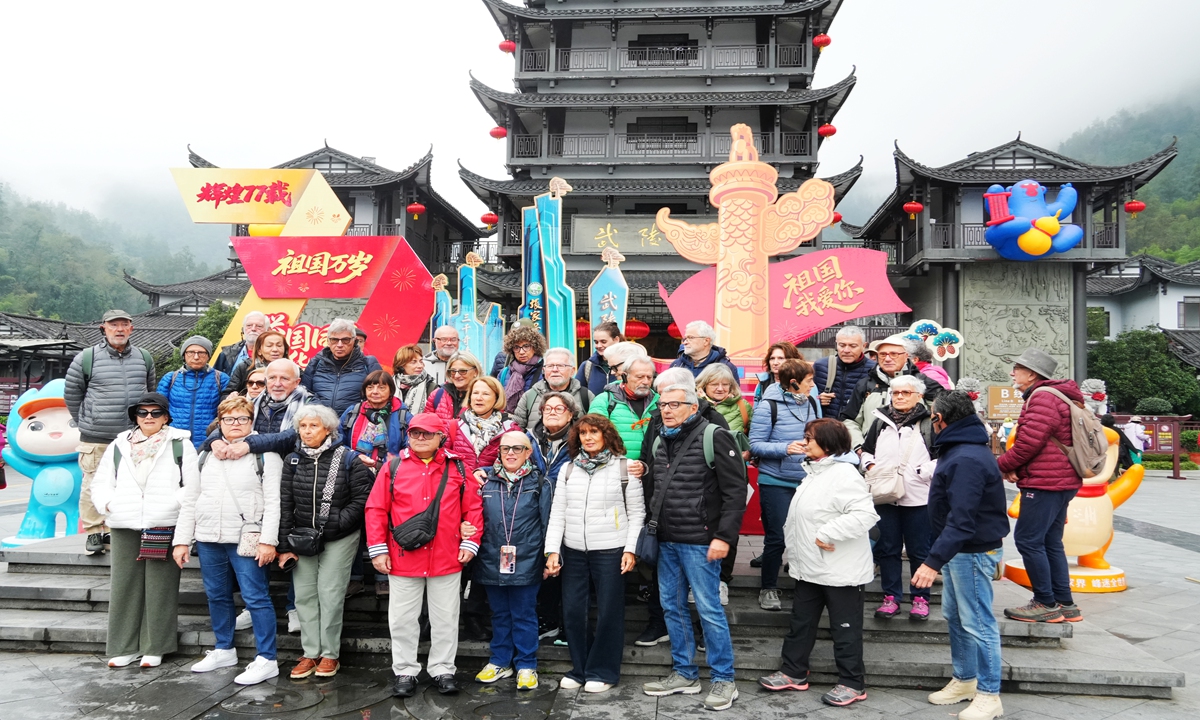
Zhangjiajie National Forest Park in central China's Hunan Province on October 23, 2026, draws a steady stream of visitors from around the world. Overseas ticket purchases for the park have exceeded 1 million so far this year, up more than 40 percent year on year, with visitors coming from 190 countries and regions worldwide—a record high. Photo: VCG
In a fresh bid to reinvigorate inbound tourism from Europe, the Mission of China to the EU unveiled a campaign at Brussels Airport on Tuesday (Belgian time), shining a spotlight on streamlined entry for visitors from 25 EU member states.The move underscores the momentum behind two-way travel between China and Europe - flows that are already substantial in both directions and still gathering pace.
The four-week campaign brings images of China to the airport's departure areas. It puts visa facilitation at the center of efforts to encourage travel and strengthen connections between China and Europe, industry media outlet Travel Tomorrow reported.
Speaking at the inauguration, Eduardo Santander, CEO of the European Travel Commission, said that he hoped China's visa-free policy would encourage more Europeans to visit the country. A regular visitor himself, he highlighted the convenience of the arrangements and expressed hope that Europe would eventually be able to reciprocate by facilitating travel for Chinese visitors, the report said.
European arrivals have grown steadily since China eased its visa-free policy, with year-on-year growth holding at 15-20 percent over the past two years and source markets such as Germany performing especially well, Xu Xiaolei, a marketing manager at CYTS Tours Holding Co, told the Global Times on Wednesday.
"A deeper shift is underway in how they travel. Group tours are losing ground to independent and backpacking trips, and the itineraries now reach well beyond first-tier cities. Increasingly, European visitors want to wander through neighborhood streets and soak up local life, experience traditional Chinese medicine and other heritage practices, and buy Chinese consumer tech," Xu said.
Germany is among the strongest-performing source markets, and cultural ties are being reinforced at the highest level. On Wednesday, German President Frank-Walter Steinmeier visited Hongcun, a UNESCO World Heritage village, and the Huangshan Mountain in East China's Anhui Province. Later in Beijing, he will visit the Summer Palace, the Guardian Art Center and the People's Art Theatre, according to the German President's official website.
"Steinmeier's route through Anhui and Beijing reads like a checklist of shared interests: conserving World Heritage, interpreting it for visitors, marketing destinations abroad and developing experience-driven tourism - a reminder of the considerable potential between China and Germany and even China and the EU in terms of tourism cooperation," Song Wei, a professor at the School of International Relations and Diplomacy at Beijing Foreign Studies University, told the Global Times on Wednesday.
China began introducing its unilateral visa-free initiative in December 2023, initially offering stays of up to 15 days to citizens of France, Germany, Italy, the Netherlands, Spain and Malaysia. The policy subsequently expanded to additional countries, including Switzerland, Hungary and Belgium in March 2024, and the permitted stay increased to 30 days in November 2024.
On October 15 and 16, Peter Tschentscher, mayor of Hamburg, Germany, led a delegation of government, business and academic representatives to Shanghai, as the two cities marked 40 years of friendship, according to the Shanghai government's website.
The two sides conducted exchanges in aspects including green shipping, technological innovation, and culture and tourism. During a visit to China Eastern Airlines, Tschentscher expressed hope that direct flights between Shanghai and Hamburg could be introduced. He said that an air link would facilitate travel and strengthen business, cultural and tourism exchanges.
China and the EU are highly complementary economically with deep convergence of interests, providing practical foundations for the two sides to deepen cooperation in services trade. Meanwhile, strengthening people-to-people exchanges will help enhance mutual understanding and act as a lubricant to resolving China-EU trade conflicts and consolidating the China-EU comprehensive strategic partnership, Song said.
Economic globalization has made the interests of China and the EU increasingly inseparable, weaving their economies into a deeply complementary whole that sustains prosperity for both and for the world at large. In 2025, China-EU trade in goods exceeded $800 billion, with their combined economic output accounting for more than one-third of the global total, bilateral trade volume making up nearly one-quarter of the world's total, and nearly half of bilateral trade consisting of intermediate goods.
RELATED ARTICLES