China's old-age dependency ratio exceeds child dependency ratio for first time in 2025; expert sees challenges, silver economy opportunities
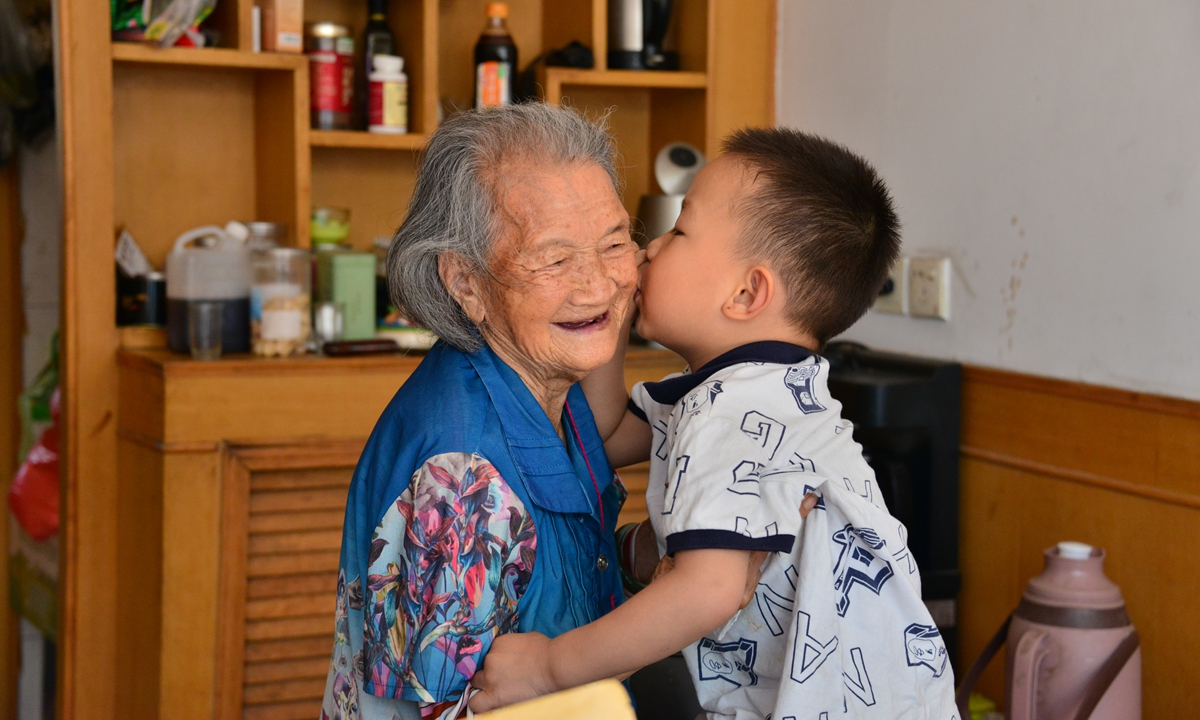
A woman over 100 years old spends time with her 3-year-old great-great-grandson in Zunhua, North China's Hebei Province, on May 31, 2026. Photo: VCG
China's old-age dependency ratio surpassed its child dependency ratio for the first time in 2025, according to the latest official data, marking a significant demographic turning point that poses new challenges for elderly care while creating opportunities for the silver economy, a Chinese demographer said on Wednesday.
Despite China's population aging on a larger scale and at a faster pace than in many developed countries, its comprehensive industrial system, family-based tradition of intergenerational support and broad social security coverage provide advantages in addressing the challenges, the expert noted.
China's old-age dependency ratio surpassed its child dependency ratio for the first time in 2025, reaching 23.1 percent, compared with 22 percent for children, according to the China Statistical Yearbook 2026 compiled and published by the National Bureau of Statistics (NBS), as reported by the Chinese financial news outlet yicai.com.
The data showed that China's population aged 65 and above reached 223.65 million in 2025, accounting for 15.9 percent of the total population, while the population aged 0-14 stood at 212.76 million, or 15.1 percent. The country's total dependency ratio reached 45.1 percent, according to the report.
The dependency ratio, also known as the dependency coefficient, measures the ratio of the non-working-age population to the working-age population, defined here as those aged 15 to 64. China's old-age dependency ratio has risen steadily in recent years, increasing from 15 percent in 2016 to 20.8 percent in 2021 and 22.8 percent in 2024. The child dependency ratio stood at 23 percent that year, according to yicai.com.
The old-age dependency ratio surpassing the child dependency ratio for the first time marks a significant demographic turning point in China, bringing new challenges for elderly care while creating opportunities for the development of elderly care services and the silver economy, He Yafu, an independent demographer, told the Global Times on Wednesday.
Compared with developed countries, China is experiencing population aging on a larger scale and at a faster pace. However, China's highly comprehensive industrial system provides a strong foundation for turning elderly care needs into an industry, He noted.
Second, compared with Western countries, which rely more heavily on individual retirement planning and state welfare systems, China maintains a strong cultural foundation of family responsibility, intergenerational support and mutual assistance in elderly care. Third, China's broad coverage of medical insurance and social security provides a relatively strong safety net for its aging population, the expert said.
The country has also been advancing measures to address population aging. Its 15th Five-Year Plan (2026-2030) calls for improving urban and rural elderly care services, developing the silver economy, expanding elderly education and making better use of the skills and experience of older people.
Earlier this month, the National Development and Reform Commission, the Ministry of Civil Affairs and the National Health Commission jointly issued guidelines aimed at improving pricing mechanisms for elderly care services and expanding the supply of affordable, high-quality care services to meet the diverse needs of older people.
Amid demographic changes, population aging is not simply a burden, but also creates new market demand and opportunities for industrial development. China's silver economy approached 10 trillion yuan ($ 1.5 trillion) in 2025. With around 90 percent of older people receiving care at home, demand for age-friendly home renovations, including elevators, non-slip bathrooms, handrails and emergency call systems, is growing, He said.
To address population aging, China needs to strengthen its multilayered pension system, accelerate the establishment of a long-term care insurance system and address gaps in elderly care in rural areas. Meanwhile, China's fertility rate having fallen to a relatively low level, childcare subsidies and benefits, as well as expanded affordable childcare services, are needed to encourage births, He noted.
RELATED ARTICLES