Unitree's post-IPO results show strong revenue growth
Humanoid robot commercialization gains pace even as quarterly profit drops
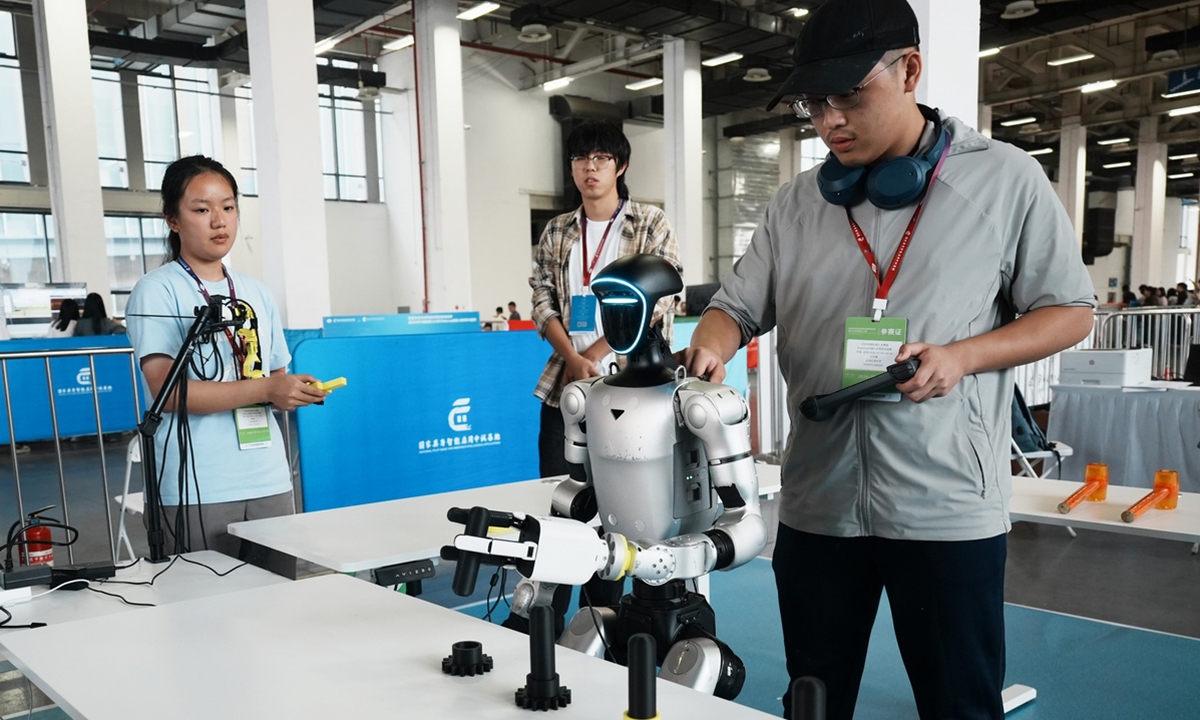
A student remotely controls a Unitree G1 humanoid robot to grasp an object at the inaugural Global Embodied Intelligence Application Innovation Challenge and the 2026 China Robot Competition, which were held in Hangzhou, East China's Zhejiang Province on October 18, 2026. The event drew 2,000 teams and nearly 5,000 university participants, showcasing innovations and skills in embodied intelligence applications. Photo: VCG
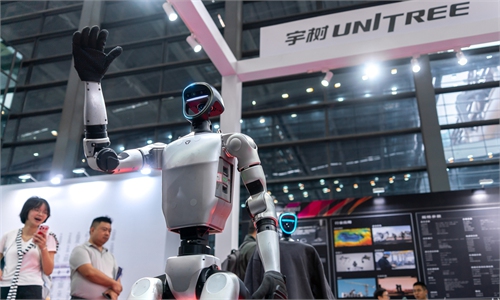
Chinese humanoid robot maker Unitree Robotics posted strong revenue growth and a sharp rise in research and development spending in its first financial report since going public, signaling continued business expansion and investment in innovation, even as quarterly profit dropped amid rising costs.
Chinese analysts said that the results highlight the growth potential of China's humanoid robotics industry, as companies step up efforts to turn technological advances into commercial applications and build sustainable business models.
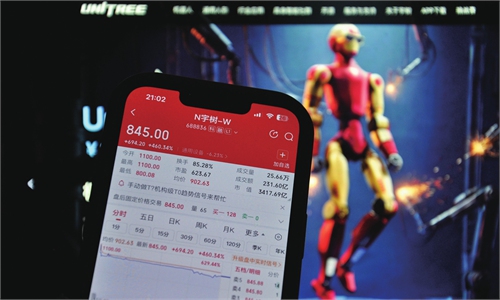
Unitree, which became the first humanoid robot company listed on China's NASDAQ-style STAR Market in Shanghai on August 19, released its third-quarter results on Wednesday evening.
Revenue reached 1.817 billion yuan ($255 million) in the first nine months, up 55.71 percent year-on-year, while net profit attributable to shareholders surged 270.54 percent to 387 million yuan, according to the company's financial report.
Third-quarter revenue rose 69.93 percent to 665 million yuan, up from a growth rate of 48.54 percent in the first half. The figures showed accelerating revenue growth alongside increased investment in innovation and market expansion, industry analysts said.
Unitree's R&D spending jumped 191.48 percent to 263 million yuan in the January-September period, accounting for 14.47 percent of revenue, driven largely by increased investment in embodied AI models and computing power. Sales expenses surged 202.4 percent to 230 million yuan, with the share of revenue rising from 6.51 percent to 12.65 percent.
Zhou Mi, a senior research fellow at the Chinese Academy of International Trade and Economic Cooperation, told the Global Times that Unitree's solid results reflected strong growth momentum in China's humanoid robotics sector and could give the company greater flexibility to expand its business and respond to market changes.
Continued R&D investment remains essential for the industry, as key technological pathways have yet to be fully established. Such investment will help companies refine their technologies, explore new solutions and shape industry standards, Zhou said.
Wang Peng, an associate research fellow at the Beijing Academy of Social Sciences, said that Unitree's first post-listing results provided an important test of the industry's commercialization progress, shifting greater attention toward companies' ability to translate tech advances into revenue.
"As the sector's first listed company, Unitree's financial results provide a concrete basis for assessing its commercial performance and growth potential, while serving as a benchmark for the industry's development," Wang said.
Despite rising revenue, Unitree's net profit excluding non-recurring gains and losses fell 18.78 percent year-on-year to 349 million yuan in the first nine months. The third-quarter net profit was 105 million yuan, down 17.42 percent year-on-year.
The company also attributed a decline in operating cash flow to increased payments for purchases, services, sales and R&D activities as revenue expanded.
Zhou said that Unitree's profit drop could reflect several factors, including changes in revenue and costs as well as expansion across different business segments and markets.
Unitree's August 19 stock market debut drew widespread attention, but its share price subsequently fell by more than half from the peak. Analysts previously told the Global Times that the decline reflected a market repricing following its elevated initial valuation, rather than a deterioration in the company's technological capabilities.
The stock has since staged a strong rebound, rising more than 70 percent from a low of about 404 yuan on October 15 to close on Wednesday at 695.90 yuan, giving Unitree a market capitalization of 281.5 billion yuan.
China's vast domestic market and diverse application scenarios, ranging from household services to industrial manufacturing, provide a strong foundation for robot training, testing and commercial development, Zhou said.
Huatai Securities identified actual shipments, the pace of orders and revenue recognition as key indicators of whether the humanoid robotics industry is moving from prototype validation toward large-scale production.
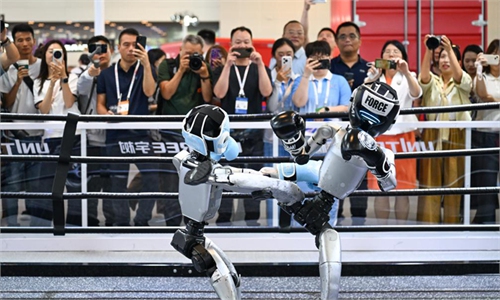
On October 21, Unitree unveiled its H2-X Kung Fu Legend Guardian humanoid robot, drawing attention with a demonstration video showing the robot lifting part of a car, kicking in a car door and recovering from a four-meter drop, highlighting advances in mobility and motion control.
Morgan Stanley raised its 2026 forecast for China's humanoid robot shipments to 50,000 units in June, nearly doubling its previous estimate, as the industry's transition from demonstrations to commercial deployment was progressing faster than expected.
Zhou said that the industry still has considerable room for growth. A wider range of overseas applications and closer cooperation with international partners could provide valuable market feedback, helping Chinese companies refine their technologies and improve robots' performance.
RELATED ARTICLES