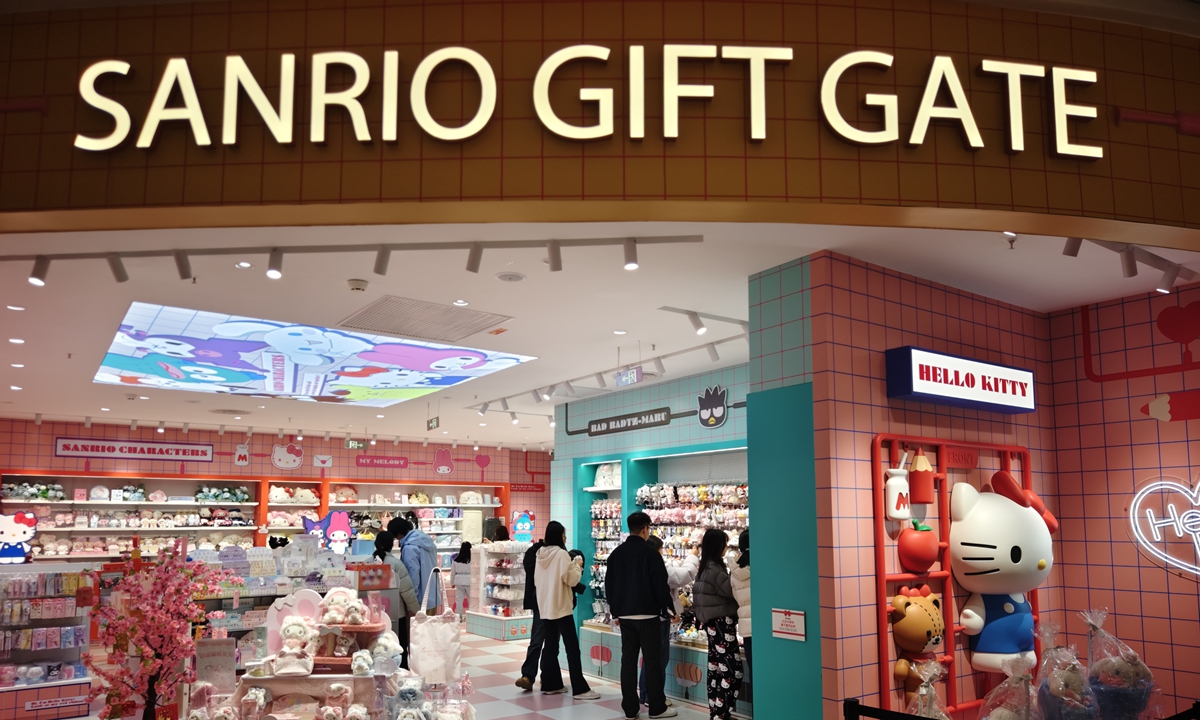
The view of Sanrio Gift Gate, an officially licensed Sanrio merchandise store, in Wuhan, Central China's Hubei Province, on March 2, 2026. Photo: VCG
Pop culture is a key industry in Japan, with manga, TV series, and other works attracting a large international audience. Consequently, it has become a "prime target" for Japan's right-wing forces. Sanrio's core audience includes a large number of adolescents and young consumers. Whether out of its pacifist values or its social responsibility to protect young people, the company must draw a clear line against distorted historical views.News that Sanrio, the Japanese company behind iconic IPs including Hello Kitty, Cinnamoroll, and My Melody, is launching co-branded merchandise tied to VIVANT, a Japanese drama notorious for smearing China, has sparked shock and fierce backlash on social media.
According to official previews for VIVANT, following the "initial release" of plush toys in July this year featuring Hello Kitty, My Melody and other characters dressed as the show's "spy figures," the second batch of products from this collaboration has been approved for release. Details such as the launch date, product lineup and pricing have yet to be disclosed.
VIVANT is no ordinary Japanese drama. Under the guise of a "spy thriller," it deliberately distorts the truth and reverses black and white, portraying the atrocities committed by the invading Japanese army against the Chinese people as actions of the Chinese side. The series was condemned by Chinese media for "packaging aggressive narratives through cognitive and information warfare," drawing widespread criticism. The content and ideology of this series reflect the historical outlook and anti-China narrative of the current conservative Japanese right-wing administration, catering to the trend of right-wing extremism in Japanese society; its motives and objectives are both deeply sinister.
The commercial tie-in of Sanrio, beloved by audiences for its cartoon characters, with this confrontational drama that peddles biased narratives runs starkly counter to the "cute" and "healing" image its IPs have long embodied. It undermines the emotional bond and commercial credibility that its IPs have built among Chinese fans.
The global popularity of Sanrio's IPs is closely tied to its founder's philosophy of peace. Shintaro Tsuji, the company's founder, personally experienced the Kofu Air Raid in World War II. After witnessing the harm inflicted on civilians by the ravages of war, he resolved to make "everyone get along together in harmony" the company's philosophy, aiming to promote cross-cultural peace through small gifts that convey smiles and goodwill.
The company name "Sanrio" is derived from the Spanish phrase meaning "Saint River," expressing the hope that, just as rivers nurture civilization, the company would foster understanding rather than division among people. Hello Kitty's mouthless design symbolizes listening and mutual support and has long been interpreted as a symbol of friendship. It is precisely for this reason that Sanrio's "lapse" is all the more regrettable.
Pop culture is a key industry in Japan, with manga, TV series, and other works attracting a large international audience. Consequently, it has become a "prime target" for Japan's right-wing forces. Japan's "Defense White Paper," released in August, featured a manga-style cover for the first time, linking the expansion of the military-industrial complex to "national prosperity" - a move that drew strong criticism from all quarters for its intent to poison and mislead young people.
Sanrio's core audience includes a large number of adolescents and young consumers. Whether out of its pacifist values or its social responsibility to protect young people, the company must draw a clear line against distorted historical views.
China is an indispensable overseas market for Sanrio. In the first half of 2026, its revenue generated from the Chinese market hit 781 million yuan ($117 million), surging more than 40 percent year-on-year. The group has previously stated its ambition to nurture its next breakout IP, on par with Cinnamoroll, within the Chinese market. If it values the Chinese market, Sanrio must translate respect for China into concrete actions.
After news of this collaboration broke, a huge number of social media users made it clear that they "cannot accept it." Sanrio needs to understand that if the brand "partners with anti-China content," it stands to lose far more than short-term sales. The trust and emotional bond it has built up over a long time will also suffer. When it comes to historical perceptions, Sanrio must not play with fire alongside Japan's right wing.
Even more alarming is the fact that in recent years, Japanese society has seen a surge in popular cultural works that package war crimes as rousing tales.
For example, the film The Eternal Zero, which centers on the Kamikaze special attack units, was widely criticized for romanticizing the image of the kamikaze pilots and downplaying Japan's responsibility as the aggressor. The anime My Hero Academia named one of its villains "Maruta" - a derogatory term used by Unit 731 of the Japanese Imperial Army to refer to victims of human experimentation during the invasion of China - thereby confirming its attempt to sneak in a hidden agenda. The Japanese fashion brand WEGO, which had partnered with the anime, also faced widespread boycotts. Sanrio is not the first to be tainted by this, nor will it be the last.
China has always welcomed foreign brands with an open attitude. Over the years, many multinational companies have established a firm foothold in the Chinese market precisely because of their respect for Chinese consumers and China's history and culture.
We are not asking Sanrio to take sides between China and Japan. Rather, we hope it makes a right choice on a fundamental issue: to partner with works that convey sound values and, above all, uphold a correct understanding of history.
The concept of "everyone getting along together in harmony" cannot remain merely a slogan behind cute cartoon characters. It must be reflected in consistent commitment to peace and a firm refusal to appease or indulge right-wing agitation. Sanrio has both the duty and urgency to make its stance clear.
RELATED ARTICLES