German president's China visit spotlights growing tech innovation opportunities
By Yin Yeping and Published: Oct 29, 2026 01:55 PM

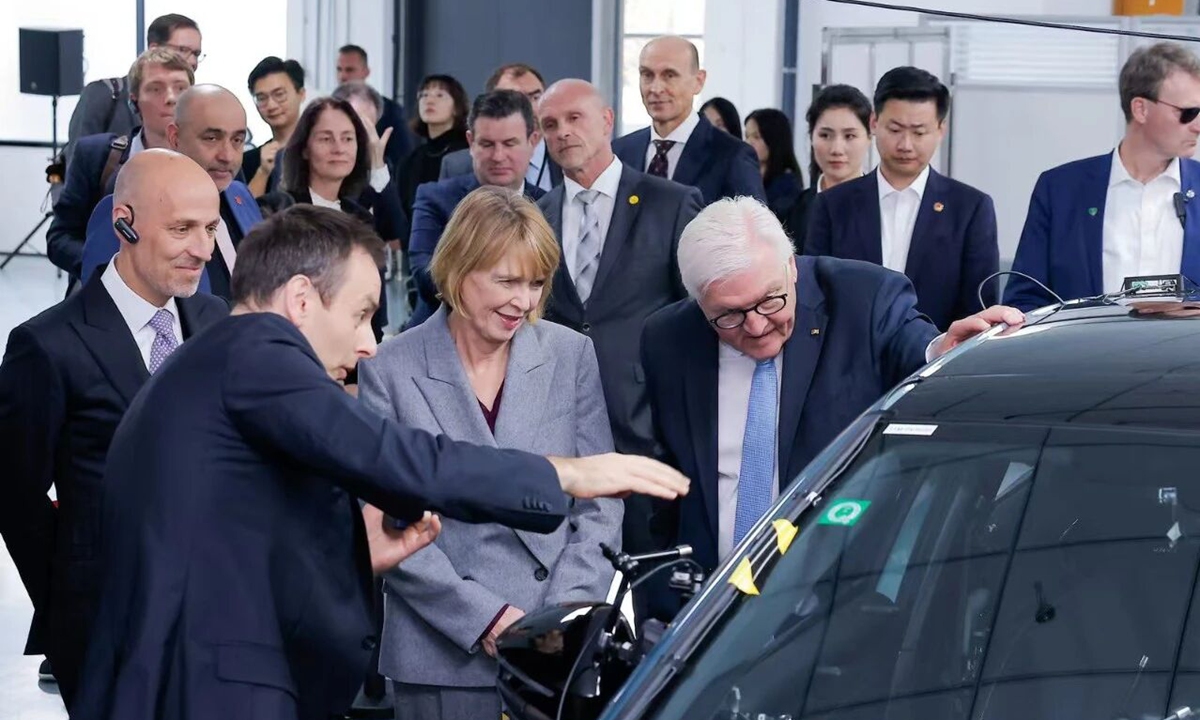
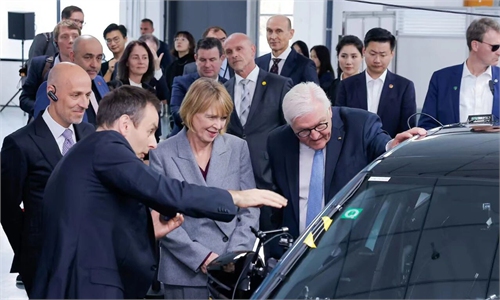
German President Frank-Walter Steinmeier visits a Volkswagen technology center in Hefei, East China's Anhui Province, on October 27, 2026. Photo: Courtesy of Volkswagen Group China
German President Frank-Walter Steinmeier's ongoing state visit to China has highlighted growing opportunities for bilateral cooperation in technological innovation and advanced manufacturing, with Chinese and German business representatives expressing optimism about deeper economic ties and joint innovation in areas ranging from artificial intelligence (AI) to intelligent vehicles.
The visit signals stronger bilateral ties and responds to German businesses' calls for closer cooperation, a Chinese analyst said. Given their complementary economies and intertwined supply chains, Germany should build trust, resolve differences through dialogue rather than restrictions, and foster stable conditions for bilateral cooperation, the analyst noted.
The visit underscores the importance Germany attaches to its relations with China, Hans-Peter Friedrich, former vice president of the German Bundestag and chairman of the Germany-China Parliamentary Group, told the Global Times in an exclusive interview.
"The Federal President's visit is a strong signal that German Chinese relations have a high priority for Germany. And it is an important signal to the companies in China that they are welcome in Germany," Friedrich said.
Friedrich, who is also visiting China and has held exchanges with Chinese government departments and academic institutions on regional and business cooperation, sees considerable potential for further collaboration in emerging technologies.
"The importance of AI will increase. Here at the interface between the digital and the analogue world and in the implementation of AI in industrial production, Germany will play an important role and, together with China, will make significant advances for the benefit of people," Friedrich said.
The healthcare system and the field of energy and environmental technology also have great potential, the former German official added.
The opportunities for bilateral technological cooperation were also in focus during Steinmeier's visit to Hefei, capital of East China's Anhui Province, on Tuesday, where he toured Volkswagen Group China Technology Company and test-drove a new-energy vehicle equipped with a locally developed intelligent driving system, the Xinhua News Agency reported.
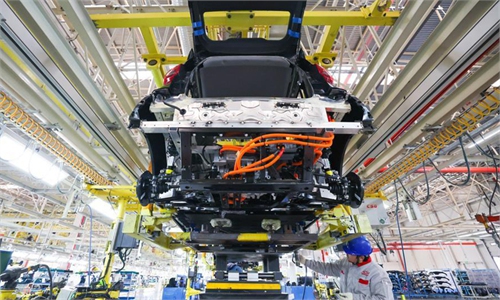
On Wednesday, Volkswagen announced that its China-developed Compact Main Platform and China Electronic Architecture, developed in cooperation with Chinese partners, would be used in next-generation vehicles targeting markets in the Global South. The technologies are expected to be introduced first in South America before the end of the decade.
Volkswagen Group CEO Oliver Blume said in a statement that China is a key innovation engine for the group and increasingly a product and technology hub for its global markets. "We call it in China, and beyond," Blume said, Reuters reported.
Meanwhile, Volkswagen is also deepening its partnership with Chinese intelligent driving technology provider Horizon Robotics.
Horizon Robotics told the Global Times in a statement on Wednesday that its strategic partnership with Volkswagen, established in 2022, has entered a phase of mass production through their joint venture CARIZON this year.
CARIZON's full-scenario advanced driver assistance system is now featured in seven electric vehicle models developed by three Volkswagen joint venture brands in China, according to the company.
Describing the partnership as one that combines complementary strengths and delivers mutual benefits, Horizon Robotics said it would continue working with Volkswagen to integrate China's AI innovation capabilities with Germany's automotive industrial expertise.
The partnership is expanding into more advanced technologies. In July, Volkswagen announced an expanded collaboration with Horizon Robotics through CARIZON to accelerate the development of Level 3 and Level 4 automated driving technologies. Under the agreement, CARIZON will gain access to Horizon's AI foundation model, with Volkswagen targeting the delivery of its first Level 3 capabilities as early as the second half of 2027.
The expanding cooperation between Volkswagen and Chinese companies reflects a broader shift in China-Germany industrial ties, from traditional manufacturing and market access toward joint research, technological innovation and commercialization, Hu Qimu, a Chinese economist, told the Global Times.
"China's strengths in AI applications, intelligent driving technologies and large-scale manufacturing, combined with Germany's expertise in automotive engineering and industrial systems, offer considerable room for complementary cooperation," Hu noted.
Friedrich also acknowledged growing competition in the automotive industry, while emphasizing the increasingly interconnected roles of Chinese and German suppliers in technological development.
He noted that German suppliers are becoming more important to Chinese automakers, while Chinese suppliers are likewise gaining significance for German manufacturers.
Beyond the automotive sector, German businesses also see opportunities arising from China's technological progress.
"China is becoming increasingly important as a global center of technology and innovation. For German companies, China offers enormous opportunities, particularly in advanced manufacturing, AI, green technologies and industrial transformation," Christian Rolf Sommer, a German businessperson, told the Global Times.
Sommer pointed to the changing relationship between Chinese and German companies, as technological development creates new forms of cooperation alongside competition.
Chinese companies are no longer just customers or suppliers; they are increasingly important innovation partners and technological competitors, Sommer said.
"For German businesses, understanding the Chinese market and building strong local partnerships will be essential for long-term success. I believe that maintaining a strong economic presence in China is strategically important for Germany's future competitiveness," Sommer added.
The growing emphasis on technological cooperation comes amid broader discussions in Germany and the EU about economic relations with China and the resilience of global supply chains.
During a visit to Singapore on Tuesday, German Chancellor Friedrich Merz warned against full economic decoupling from China, while calling for a reduction in what he described as "unhealthy, one-sided dependencies" in supply chains, technologies and raw materials, Reuters reported.
Responding to the remarks on Wednesday, Chinese Foreign Ministry spokesperson Guo Jiakun said China stands for openness and cooperation and remains committed to maintaining the stability and security of global industrial and supply chains.
"Between China and Germany and between China and Europe, there is a high degree of economic complementarity. Our industries are mutually embedded and our practical cooperation is mutually beneficial," Guo said.
"It is hoped that Germany and the EU will stay objective and rational, and work in the same direction with China, so that we can be each other's trustworthy and predictable partners, resolve differences and disputes through dialogue and consultation, keep the global industrial and supply chains stable and unimpeded, and provide more certainty for cooperation between our business communities," Guo said.
German business representatives also emphasized the importance of maintaining stable bilateral relations and strengthening economic engagement.
"China has been one of Germany's most important trading partners for many years, and our economic relationship remains essential for both countries," Sommer said.
In an increasingly uncertain global environment, China remains an important economic anchor in Asia. At the same time, China's rapid technological progress is creating new opportunities for cooperation, innovation and investment, the German businessperson said.
"We should focus on our shared economic interests while addressing existing challenges through constructive dialogue," Sommer added.
RELATED ARTICLES