IN-DEPTH / IN-DEPTH
What did Japan do to Singapore during WWII? Decades on, Japan still owes the state an answer for its brutal history
Never forget
By Published: Oct 29, 2026 02:23 PM

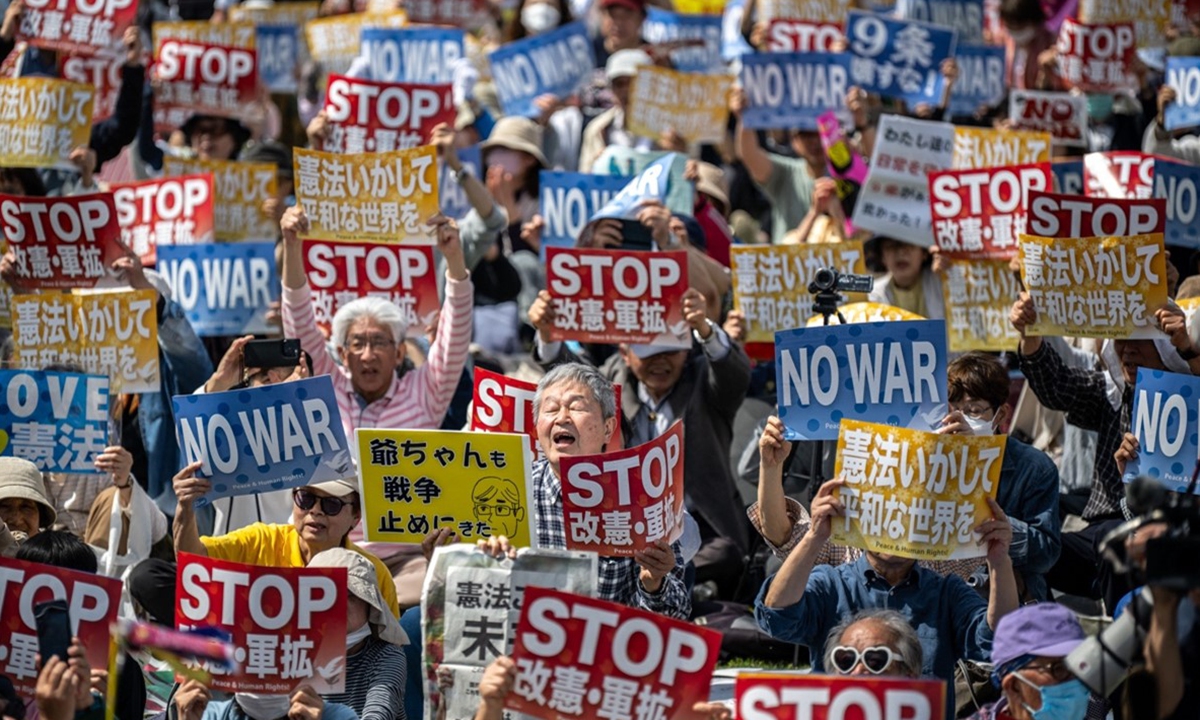
People hold placards reading “No war” and “Stop constitutional revision, military expansion” during the Grand Constitution Rally 2026 to mark Constitution Memorial Day in Tokyo on May 3, 2026. Photo: VCG
This year marks the 80th anniversary of the opening of the Tokyo Trial. Eight decades on, the suffering Japan inflicted on victims across Asia is far from something that can simply be forgotten.
Former Japanese prime minister Shigeru Ishiba in August mentioned an episode from 23 years ago during an interview with Nikkei Asia. In 2003, Ishiba, then serving as the head of Japan’s defense agency, met Singapore’s former leader Lee Kuan Yew in the state. When Lee asked him what Japan had done during World War II (WWII), Ishiba, answering in line with textbook formulations, replied: “Japan...occupied Singapore and renamed it Shonanto. It became the base for the occupation of Southeast Asia,” reported Nikkei Asia on August 16.
Lee, according to Nikkei Asia, responded, “Is that it? You only know that?” “You must properly understand what Japan did to Singapore, otherwise it is impossible to establish true trust between the two countries.”
Two decades on, Ishiba has turned that rebuke inward – into Japan’s own argument over how to remember the war. In a speech on August 21 this year, Ishiba reflected on his use of the word “remorse” at Japan’s National Memorial Ceremony for the War Dead on August 15, 2025 – the first time in 13 years a Japanese prime minister had used the term. Ishiba questioned whether it is possible to truly learn from one’s mistakes without reflecting on them, reported Nippon TV.
Japan’s current Prime Minister Sanae Takaichi, however, “...eschewed ‘remorse’ or ‘pledge never to wage war’ in her war anniversary speech a year after her predecessor revived those terms for the first time in 13 years over the nation’s responsibility as an aggressor,” reported The Asahi Shimbun on August 17.
What exactly did Japan do to Singapore more than 80 years ago? How does Japan itself view this history? And as a former victim of Japanese aggression, and today, one of Japan’s important partners, how does Singapore reckon with this past?
A bloody history
To answer Lee’s questions to Ishiba, one must begin with February 15, 1942.
On that day, British forces surrendered to the Japanese, and Singapore fell. It was soon renamed “Syonan-to,” and placed under Japanese military rule for three and a half years.
What followed was one of the darkest chapters of that occupation: Operation Sook Ching. Operation Sook Ching was a Japanese military operation aimed at purging or eliminating anti-Japanese elements from the Chinese community in Singapore. From February 21 to March 4, 1942, Chinese males between the ages of 18 and 50 were summoned to various mass screening centers and those suspected of being anti-Japanese were executed, according to the website of Singapore’s National Library Board.
Two sites speak most starkly to what happened. On February 28, 1942, “some 400 Chinese Civilians, victims of the Sook Ching purge, were killed by the Japanese on this northeastern shore;” on February 20, 1942, “66 Chinese male civilians were killed by Japanese hojo kempei (auxiliary military police) firing squads at the water’s edge on this stretch of Changi Beach,” according to Singapore’s National Heritage Board (NHB) website.
Another little-known chapter concerns the system of military brothels known as “comfort stations.”
Kevin Blackburn, a historian teaching at the National Institute of Education at Nanyang Technological University in Singapore, whose research focuses on war memory and oral history, published The Comfort Women of Singapore in History and Memory, which won the Singapore Book Award for Best Non-Fiction Title 2023. Drawing on oral testimony and archival sources, the book shows that women from Singapore were also victims of this inhumane system.
“Singapore ‘comfort women’ kept their silence like most ‘comfort women’ in Asia,” Blackburn told the Global Times. He said that for history, however, keeping silence was not the right decision, as some deniers could say that local Singaporean “comfort women” did not exist as none came forward.
In an interview with Bloomberg in February 2023, Blackburn said Singapore’s “comfort station” network was “quite extensive,” with both military-run and privately owned brothels heavily influenced by the military. “There is substantial evidence from the memoirs of Japanese veterans that there were a variety of women and it’s likely there were locals,” he said.
“That is why I had to write the book to prove they did exist, [and also] to protect the privacy and silence they wanted,” he told the Global Times.
Various voices within Japan
The facts are there, but how does Japan itself view this history?
At the official level, the differences are first reflected in the language used. In Ishiba’s speech at the 2025 National Memorial Ceremony for the War Dead, he restored the terms “remorse” and “resolute pledge never to wage war,” The Asahi Shimbun reported on August 15.
Those expressions were not carried over in this year’s address by Takaichi. This seems to suggest that in Japanese politics, “remorse” remains a variable rather than a consensus – especially now, under a right-wing administration, some observers have pointed out.
Japanese textbooks reportedly only contain a brief record of Japan’s occupation of Singapore. Japan’s news website nippon.com once commented in a May 2012 story that Japanese high school textbooks “tend to dryly present a chronology of historical facts, with little interpretive narrative added.”
Worse still, there is usually a gap between recording history and confronting it. “Recording history can be the beginning of reconciliation. But that is unlikely given the power of the Japanese right wing in Japan and especially their influence within the LDP (Liberal Democratic Party),” Blackburn told the Global Times.
He gave an example that the “comfort women” appeared in the Japanese textbooks in the late 1990s, then quickly removed as the LDP regained power. “The Japanese left reminds Japan of the war atrocities. But it has seldom had the power to use the state [machinery] to lead public opinion or change textbooks.”
Nonetheless, Japan does not speak with one voice. For instance, NHK World on March 6 featured Singaporean historian Lim Shao Bin, who has spent decades tracing the victims and records of Japan’s occupation of Singapore. NHK described his work as “deeply personal, driven by a conviction that confronting painful truths is essential to building lasting peace” – and headlined its piece with his own words: “Forgive, but never forget.”
A few Japanese scholars have worked the same ground. Hirofumi Hayashi, a historian at Kanto Gakuin University, documented Operation Sook Ching in his 2007 book Singapore Chinese Massacre: What the Japanese Military Did in Singapore.
A memory that has not moved on
If Japan’s view of the history of the occupation of Singapore can be described as “divided,” then in Singapore, the understanding of that period has been more complex. Overall, for many people there, the memory has not moved on.
For the generations that did not personally live through the Japanese occupation, Singaporeans’ collective memory of that period is now constructed through the narratives found in history textbooks and museum exhibitions, said Blackburn. That memory is also transmitted within families across generations, he added.
Sim Ann, then Singapore’s Senior Minister of State for Foreign Affairs and Home Affairs, had a similar note on March 6. “Singapore believes it would benefit the region if Japan deepens cooperation with more Asian partners and contributes more to peace, stability and prosperity in APAC (Asia-Pacific),” said Sim, reported Channel News Asia (CNA) on the same day.
“At the same time, we recognize that the severity of the damage and suffering caused by Japan during WWII continues to create difficult historical issues in parts of Asia,” she said.
Singapore has not stopped remembering. Every year on February 15, the anniversary of the Fall of Singapore in 1942, an inter-religious memorial service is held at the Civilian War Memorial, said the NHB website. This year’s service drew about 500 people including government, military and business representatives, diplomats, veterans, victim’s relatives and students, reported Xinhua on February 16.
The memorial’s four columns, completed in January 1967 and unveiled by Lee Kuan Yew on the 25th anniversary of the surrender, each represent one of Singapore’s four main ethnic groups – Chinese, Malays, Indians and Eurasians – who perished under the Japanese Occupation. Locals call it the “Four Chopsticks,” according to the NHB website.
An unsettled debt
The historical debt has by no means been settled. Japan’s attitude and actions, as well as the international community’s probing questions, are all issues that Japan and the victims of its former wars must now face together.
“Meaningful Japanese engagement [with its history of aggression] would entail reconciliation both internationally and within Japan itself,” Blackburn said. “The region knows about the brutalities of the Japanese occupation. It is only the right wing in Japanese politics that denies them.”
Some of Japan’s neighbors have plainly expressed what they want from Tokyo: a reckoning with the war, before anything else can move forward.
In March, Japan’s education ministry approved high school textbooks for use from 2027. South Korea’s Ministry of Foreign Affairs said it “strongly protests against the Japanese government’s authorization... of high school textbooks that distort historical facts according to Japan’s self-centered view of history,” and called for “an immediate correction.” It expressed “strong regret” that the books describe forced labor and the “comfort women” of the Imperial Japanese Army “in a manner that dilutes their coercive nature,” and urged Japan to “pursue history education based on the spirit of apology and remorse that the Japanese government has itself expressed,” according to a March 24 press release by the ministry.
Blackburn found most of the mainstream Japanese opinion would acknowledge that there were atrocities carried out by the Japanese military, and the Japanese left wing continues to remind the public about the atrocities. “The Japanese right wing is only fooling itself, if it thinks that the countries occupied by Japan will forget them or that the atrocities did not occur.”
Zheng Yongnian, a Chinese scholar who previously worked at the National University of Singapore’s East Asian Institute, sees the impulse behind today’s revisionism as anything but new. “Japan’s colonial complex has never gone away,” he said in an interview with the Beijing Daily in March. What some describe as a “new militarism” under Prime Minister Takaichi is, in his view, the old one.
The year 2026 marks the 60th anniversary of diplomatic relations between Japan and Singapore, and on April 26, the two sides exchanged letters of congratulations.
However, for those who suffered during the war and for their descendants, the willingness to move forward is not the same as Japan’s having settled the past. The question Lee asked in 2003 probably still has no answer, and it is Tokyo, not Singapore, that owes one.
“We must once again reflect on the war that ended in Japan’s defeat 81 years ago. If Japan continues to build up its military, countries across Southeast Asia will become deeply concerned,” Shigemitsu Tanaka, a co-chairperson of The Japan Confederation of A- and H-Bomb Sufferers Organizations, said in an exclusive interview with the Global Times. “The people of Asia will never forget what Japan did in those years.”
RELATED ARTICLES