SCI-TECH / OTHERS
Chinese scientists create ultra-narrow carbon material that conducts electricity efficiently
Screenshot
Chinese scientists have synthesized a metallic carbon nanoribbon made up of five- and seven-membered carbon rings that has demonstrated the efficient electron transport in the one-dimensional structure, the Xinhua News Agency reported Thursday.The findings, led by a team from the University of Science and Technology of China (USTC), which is based in Hefei, East China's Anhui Province, were published online in the journal Nature on Wednesday.
The material, known as a carbon pentaheptite nanoribbon, is less than 1 nanometer wide and consists of carbon atoms linked into five- and seven-membered rings. The research team demonstrated that it exhibits metallic properties and allows the electrons to travel through it with relatively little scattering.
The findings provide a new material platform for studying the relationship between atomic structure and electrical properties, while pointing to potential applications in atomic-scale wires and interconnects for future carbon-based electronics.
Carbon atoms can form materials with dramatically different properties depending on how they bond and arrange themselves. Diamond and graphite, for example, are both made of carbon but have distinct structures and physical characteristics.
Graphene, another carbon material, consists of atoms arranged in a honeycomb pattern of six-membered rings. Scientists have long been interested in what happens when carbon atoms are arranged in other patterns.
In 1996, theoretical researchers predicted that a carbon structure made of five- and seven-membered rings could behave like a metal and conduct electricity, Xinhua reported. However, making the material in a controlled way and verifying its properties experimentally proved challenging, the Xinhua report noted.
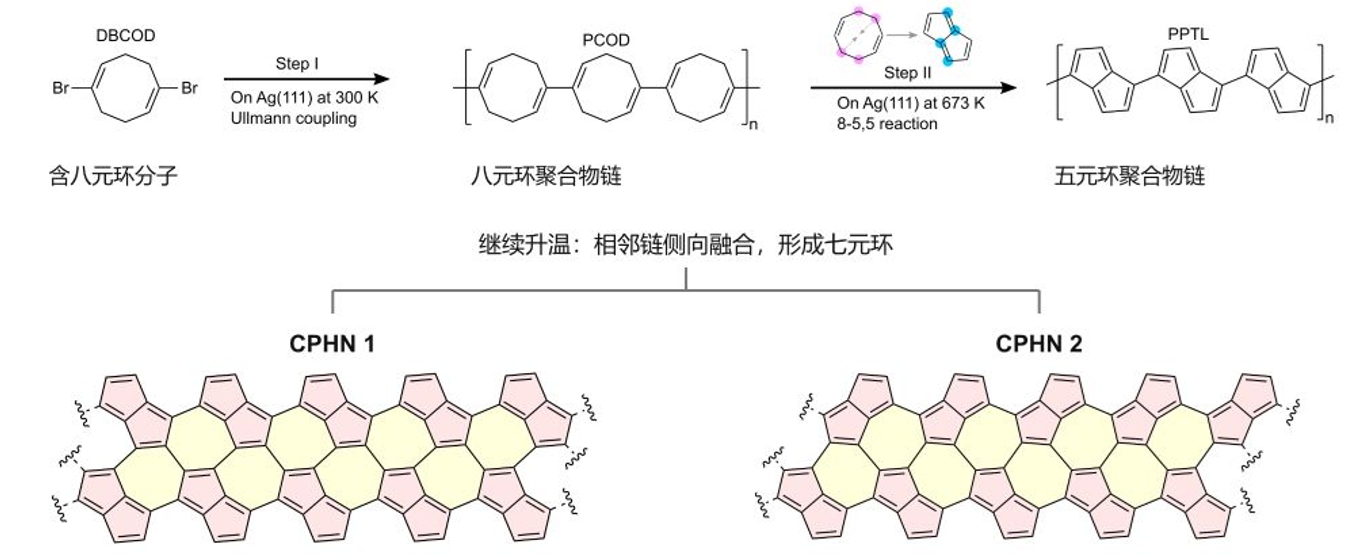
The USTC team, led by professors Wang Bing and Fan Qitang and their collaborators, developed a stepwise synthesis method on a silver surface to produce the carbon pentaheptite nanoribbons.
The researchers used relatively stable molecules containing eight-membered carbon rings, which they connected into chains on the silver surface. Heating transformed the eight-membered rings into pairs of five-membered rings, producing polypentalene chains.
The team then raised the temperature further, causing neighboring chains to fuse laterally in a process resembling the closing of a zipper. This created seven-membered rings between the chains and yielded the targeted carbon nanoribbons containing both five- and seven-membered rings.
According to the Nature paper, the team obtained two distinct types of pentaheptite nanoribbons with similar underlying structures but different arrangements of the carbon chains along their edges.
One type, designated CPHN 1, exhibited intrinsic metallic behavior, while the other, CPHN 2, was a semiconductor with a narrow bandgap.
Measurements showed that CPHN 1 achieved conductance approaching one conductance quantum, a fundamental unit of electrical conductance, and displayed near-ballistic transport.
The result is comparable to the conductance behavior sought in metallic carbon nanotubes, according to the researchers.
The findings demonstrate that changing the arrangement of carbon rings within an extremely narrow structure can produce markedly different electronic properties, offering researchers a way to investigate how atomic-scale architecture governs electrical behavior.
The study also points to possible applications in future all-carbon electronics, including carbon-based electrodes and interconnects that link electronic components. Such materials could eventually help researchers explore electrical connections at atomic scales as electronic devices continue to shrink.
However, the researchers noted that further optimization of the synthesis process will be necessary before the material can be integrated into practical devices. The findings establish a new experimental system for investigating carbon-based conductors rather than demonstrating a commercially ready alternative to existing chip materials.
RELATED ARTICLES