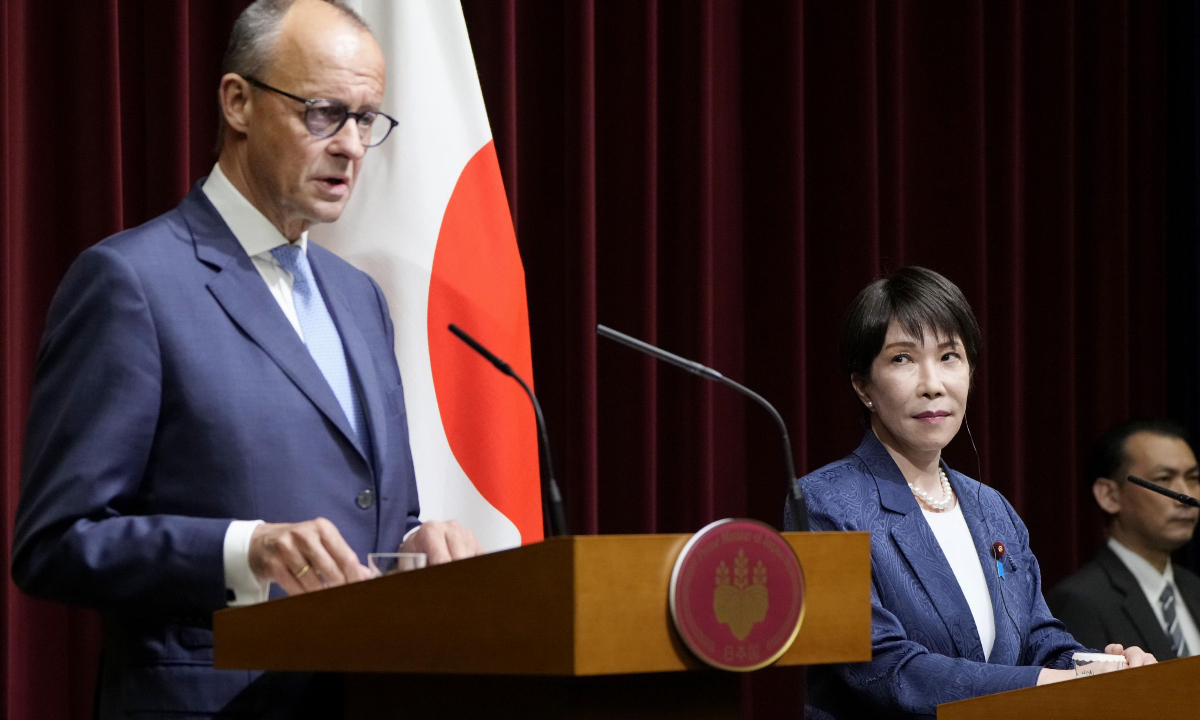
Japanese Prime Minister Sanae Takaichi (R) and German Chancellor Friedrich Merz hold a joint press conference after their talks at the prime minister's office in Tokyo on October 28, 2026. Photo: VCG
During his visit to Japan, German Chancellor Friedrich Merz stated that despite the geographical distance between the two countries, calling each other neighbors would not be an overstatement. He also described Germany and Japan as "Premium Partners,” emphasizing that the two sides share similar interests and values. While expressing a sense of closeness is not unusual in diplomatic settings, characterizing two countries separated by 9,000 kilometers as "neighbors" – and using "shared values" as a pretext to advance a series of security and economic arrangements with clear, targeted objectives – goes well beyond mere rhetoric.By framing Germany and Japan as "neighbors," Merz is not truly referring to geography, but rather to political alignment. As developed economies, Germany and Japan share common interests in upholding multilateral trade and addressing climate change. However, these interests can be addressed through established bilateral and multilateral channels, without drawing lines based on "shared values."
It is worth noting that Germany’s postwar reflection on its own history has left a deep impression on nations across Asia. In contrast, since the current Japanese administration took office, there have been clear signs of a distorted view of history and moves toward "remilitarization," prompting neighboring countries to remain vigilant. By emphasizing "shared values" with Japan at this particular moment, how does Merz expect Asian countries to view Germany?
In fact, Merz is doing more than just signaling closer ties with Japan; he has explicitly called for stronger military cooperation between the two countries. Germany has also expressed interest in joining the Global Combat Air Program – a joint initiative involving Japan, the UK, and Italy. The fact that two nations defeated in World War II are so eagerly moving to the forefront of military cooperation, while selectively emphasizing "shared values" and deliberately sidestepping the postwar international order’s constraints on military activities, is in itself enough to warrant vigilance from the international community.
On the Taiwan question, Merz also remarked that Germany will decide how to implement the one-China policy, an attempt to create a "gray area" on a matter of principle. Such attempts to test the boundaries are in no way constructive for China-Germany relations.
Merz’s flattery toward Takaichi goes beyond mere "cozying up" – it is a clear display of political frivolity. China has never opposed other nations developing normal relations; however, any cooperation implicitly directed against China deviates from the proper course of state-to-state relations. The German business community had generally hoped that Merz’s trip to Asia would help secure orders and improve supply-chain links. Yet Merz has clearly failed to demonstrate the rationality expected of a mature political figure during this visit. The Chinese foreign ministry has previously expressed the hope that Germany and the EU will remain objective and rational, work with China in the same direction, and become reliable and predictable partners for each other. Merz would do well to heed this advice. One might attempt to "claim" a neighbor from 9,000 kilometers away, but genuine partnership requires sincerity and mutual respect.
