ARTS / CULTURE & LEISURE
Beijing discovers first Sui Dynasty Great Wall remains, along with 1,800-year-old shipwrecks
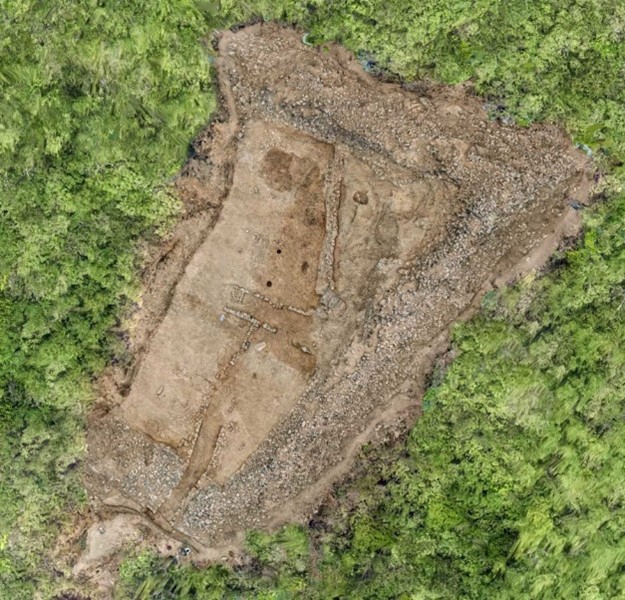
An aerial view of the Dalinggou site in Beijing. Photos: Courtesy of Beijing Institute of Archaeology
Chinese archaeologists have uncovered the first known Sui Dynasty (581-618) section of the Great Wall in Beijing's Changping district, along with three ancient shipwrecks dating back about 1,800 years in Fengtai district, according to Beijing Institute of Archaeology (BIA).
The discoveries were among the major archaeological findings announced on Saturday at the closing event of the 2026 Beijing Public Archaeology Season.
Archaeologists from the BIA excavated the Dalinggou garrison, an early Great Wall site in Changping, from August 16 to October 9, after it was discovered during surveys of early Great Wall sections in 2022 and 2023.
The excavated area covered 800 square meters and revealed a military outpost built against the Great Wall. Its northern wall was built in the existing Great Wall structure, and inside, archaeologists found remains of buildings and retaining walls.
The walls at the site were built mainly with roughly hewn stones bonded and filled with loess and an earth-and-tone core, in contrast to the more sophisticated construction techniques used in the Ming Dynasty (1368-1644).
Among the most significant finds were Sui-era celadon pottery and coins, which provided key evidence for dating the site, according to Shang Heng, an associate research fellow at the BIA.
The section had been classified as part of the Northern Qi (550-577) Great Wall. Drawing on newly unearthed artifacts, historical records and expert analysis, archaeologists concluded that the garrison site was primarily used during the Northern Qi and Sui dynasties, with evidence of continued use during the Jin Dynasty (1115-1234).
"This is the first discovery of Sui-era Great Wall remains in Beijing," Shang said.
The finding provides important evidence for dating the early Great Wall in Beijing, pinpointing its location and tracing its routes, and for understanding the region's ancient military defense system. It could also help researchers trace Sui-era sections of the Great Wall in neighboring Hebei and Shanxi provinces, noted Shang.
Earlier discoveries of inscribed stones and beacon towers in Hebei and Shanxi had offered clues to the existence of the Sui Great Wall, he said, adding that their distribution along routes previously identified as sections of the Northern Qi Great Wall suggests that the Sui Dynasty may have reused extensive parts of the earlier fortification.
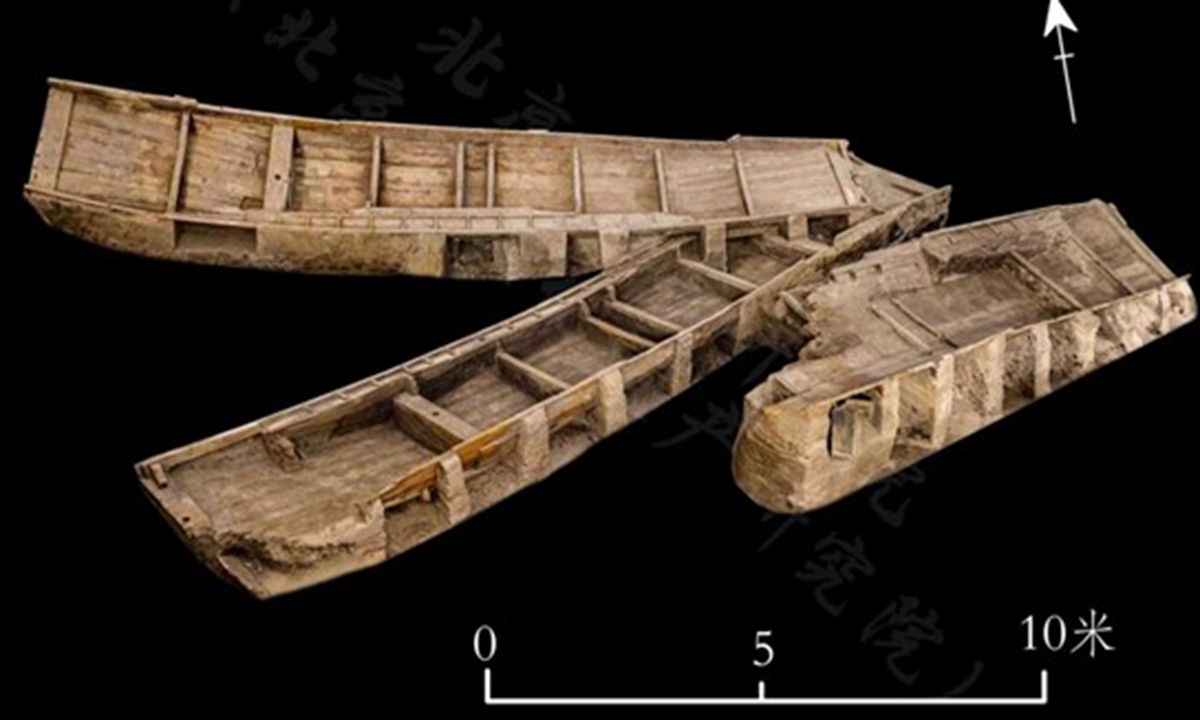
Three shipwrecks unearthed from Beijing's Fengtai district
Meanwhile, in Fengtai district, archaeologists unearthed three ancient wooden ships dating to about 1,800 years ago to the Han and Jin dynasties, roughly 7 meters underground near the ruins of Jinzhongdu, an ancient city.
The vessels - named Yongding River No. 1, No. 2 and No. 3, are the largest group of same-period inland waterway vessels ever found in northern China, according to the archaeological institute.
One of the most significant clues was the Chinese character guan (meaning official), stamped onto the upper parts of the ships' compartment walls. The mark indicates that the vessels were either built or operated under official authority, offering rare physical evidence of official involvement in shipbuilding and water transport at that time.
The ships also feature a sophisticated compartment system incorporating beams, bottom supports, vertical braces and partition boards.
Ding Lina, a research fellow at the BIA, noted that the discovery points to the existence of an important waterway in the area that could accommodate official vessels.
The excavation site is now part of Beijing's Lize Financial Business District, but the discovery suggests that the area was once an important transportation route linking communities through inland waterways.
Ding also noted the extensive use of mortise-and-tenon joints in the construction of the vessels. Some joints were reinforced with small wooden pegs, creating a combined fastening technique.
The construction methods bear strong similarities to those found on the "Silk Road No. 1" shipwreck discovered in Xi'an, Shaanxi Province. Scholars suggested that the techniques may have connections to shipbuilding traditions in the Mediterranean during the Roman period, offering new materials for research into ancient technological exchanges between China and the West.
Artifacts found inside and around the vessels also offer clues to daily life at the time. Inside the ships, archaeologists found a wooden model of a paddle, what appeared to be woven matting and the remains of a headless woman. Two human skulls and large quantities of animal bones, including those of horses, cattle, sheep, pigs and dogs, were unearthed around the vessels.
Archaeologists had preliminarily concluded, based on the condition of the vessels, the course of the ancient river and surrounding archaeological remains, that the three ships may have been damaged and brought together in a bend of the river to await repairs before being buried by a sudden flood, according to Ding.
The human remains found on the ships may belong to those who drowned in the flood or another incident somewhat later than the period when the vessels were in use, she said.
"The Han-Jin period shipwrecks in Fengtai provide the first physical evidence of ancient inland water transport in Beijing and represent a major breakthrough in the archaeology of water transportation in northern China during that period," Ding said.
The three wooden vessels are the largest and most structurally intact inland waterway ships of their period discovered in northern China, she said. Their discovery offers new insights into shipbuilding techniques during the Han-Jin period and provides further evidence of technological and cultural exchanges between China and the West.
RELATED ARTICLES