Quad's economic coercion claims slammed for double standards
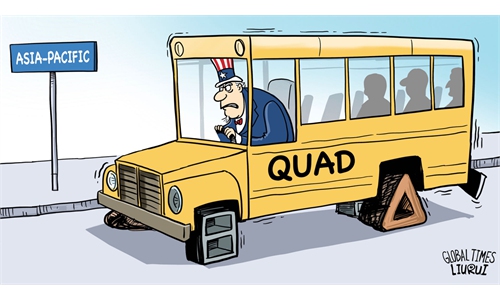
Diverging interests among Quad members cast doubt on bloc's economic security agenda: experts
By and Published: Nov 01, 2026 07:19 PM


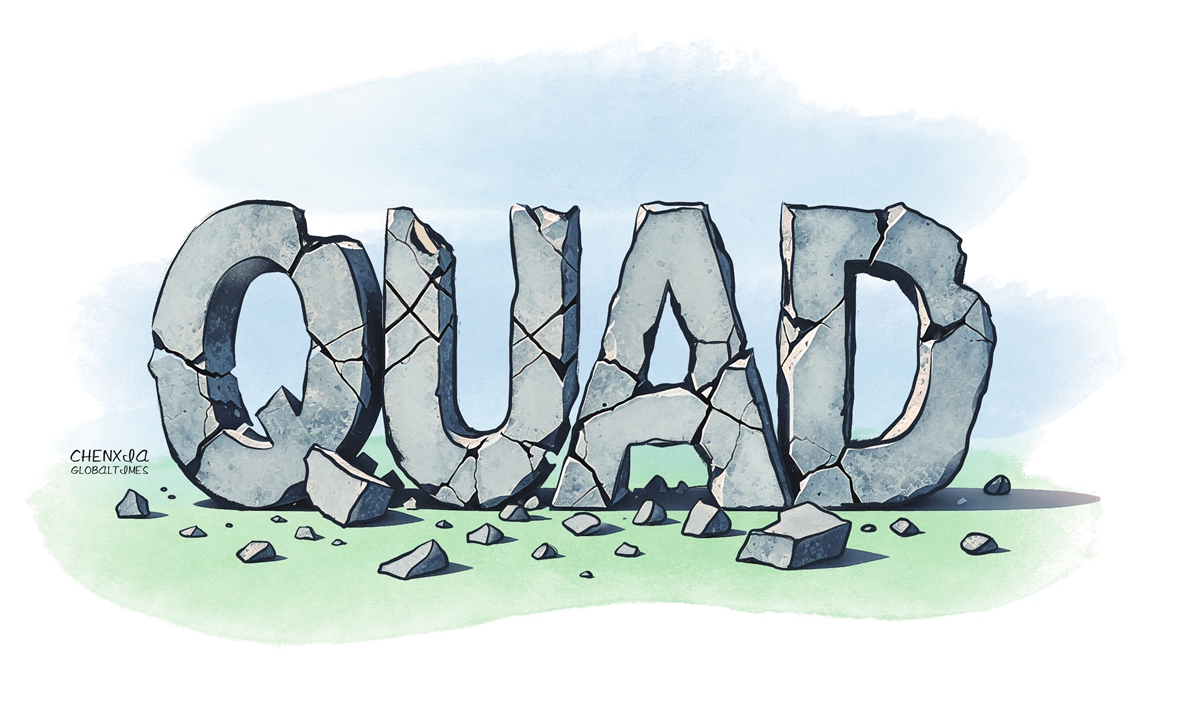
Illustration: Chen Xia/GT
The Quad foreign ministers' latest joint statement, which raises concerns over "economic coercion," arbitrary export restrictions and non-market policies without naming China, has drawn criticism from Chinese experts, who questioned the grouping's economic security agenda and warned against turning normal trade and industrial cooperation into instruments of geopolitical competition.
Although US Secretary of State Marco Rubio claimed that the Quad is "not an anti-China coalition," the grouping's latest economic rhetoric and expanding focus on supply chains have raised questions about whether its actions match that declaration, analysts said.
The statement, released following a meeting of the four foreign ministers in Atlanta on the sidelines of the G20 Foreign Ministers' Meeting, reiterates their commitment to building reliable and open global supply chains while criticizing policies and practices that they claimed could disrupt critical industries.
Although China was not mentioned in the statement, Reuters reported on Saturday that the statement came as Japan had been highly critical of Beijing's restrictions on critical mineral exports, while Washington had been seeking to rally countries concerned about China's dominance in rare earths and other critical minerals.
Asked by Reuters whether the statement's criticism is directed at China, Rubio said the Quad was not established to oppose any particular country. He claimed the Quad was not "an anti-China or anti-anybody coalition," adding that the joint statement is raising concerns about behaviors and activities that he said were "coming repetitively from one country."
"If Washington insists that the Quad is not directed against China, then China should not become the unnamed central subject of every meeting," Chen Hong, director of the Institute of Region and Country Studies at East China Normal University, told the Global Times on Sunday.
Xin Qiang, deputy director of the Center for American Studies at Fudan University, told the Global Times that although the statement avoids explicitly naming China, its criticism of economic coercion, overcapacity and non-market practices is clearly directed at Beijing.
Xin described the rhetoric as a familiar attempt to politicize economic and trade issues and increasingly frame them as matters of national security.
Chen said Rubio's remarks could be viewed positively, but Washington needs to demonstrate its intentions through concrete actions.
"The nature of the Quad is determined not by how an American official describes it, but by what the grouping actually does," Chen said.
Double standards
The Quad statement expressed grave concerns over economic coercion, including arbitrary export restrictions, as well as non-market policies and practices that result in overcapacity and disrupt critical industries.
However, Xin argued that the accusations reflect growing competitive anxiety over China's manufacturing and technological capabilities.
China's export controls involving critical minerals have exposed vulnerabilities in some countries' supply chains, while the competitiveness of Chinese manufacturing has intensified pressure on foreign industries, he said.
The US has maintained tariffs on Chinese products and restrictions on exports of certain advanced semiconductor technologies to China, citing national security concerns. Washington has also provided substantial government support for domestic semiconductor manufacturing through the CHIPS and Science Act.
Xin argued that such policies illustrate the contradictions in Washington's criticism of China's industrial practices.
He said the US had pursued semiconductor restrictions, industrial subsidies and efforts to shift production toward preferred partners while accusing China of undermining market rules.
Chen similarly questioned what he described as Washington's double standards.
"When the US imposes export controls, it calls them measures to safeguard national security. Yet when China implements export controls in accordance with its laws, Washington labels them economic coercion," Chen said.
He argued that Washington is attempting to present its protectionist policies as collective economic security initiatives through the Quad.
Zhou Mi, a senior researcher at the Chinese Academy of International Trade and Economic Cooperation, told the Global Times that the Quad's accusations largely repeat familiar rhetoric and lack convincing evidence.
Whether the four countries agreed on these claims is less important than whether they reflect economic realities, Zhou said.
"Some countries have interfered with global supply chains and undermined their stability, creating additional risks and forcing others to adjust their trade measures," Zhou said.
"The question that needs to be clarified is who disrupted these supply chains in the first place."
Diverging interests within Quad
Despite the common language of the joint statement, the Quad's four members have different economic priorities and relationships with China, according to Chinese experts.
The Japanese Foreign Ministry said Saturday's meeting was the third Quad foreign ministers' gathering this year, following meetings in May and July.
Japanese Foreign Minister Toshimitsu Motegi emphasized the importance of demonstrating practical cooperation, particularly in the economic field. The four ministers also discussed regional developments, including the East China Sea and South China Sea, according to the ministry.
Chen argued that Japan was increasingly seeking to turn its bilateral concerns about China into a broader multilateral agenda through the Quad.
He warned that efforts to promote exclusionary supply chain arrangements could undermine Japan's own economic interests, given its extensive industrial and commercial ties with China.
Other Quad members, however, have different calculations.
India emphasizes strategic autonomy and seeks opportunities to advance domestic industrial development rather than automatically following Washington's approach, Chen said, adding that Australia also has strong economic incentives to maintain stable relations with China, an important market for its exports.
Chen argued that the improvement in China-Australia relations was hard-won and that Canberra had little reason to sacrifice its economic interests to accommodate the strategic concerns of other countries.
Rubio's denial of an "anti-China" agenda also reflects Washington's need to accommodate differences among Quad members. For the US, Chen said, the grouping could become a difficult balancing act between coordinating regional partners and maintaining stable relations with China.
Supply chain resilience or fragmentation?
Beyond its criticism of economic practices, the latest Quad statement outlines several initiatives aimed at strengthening cooperation in critical minerals, semiconductors and emerging technologies.
Under the Quad Critical Minerals Initiative Framework announced in May, the four countries pledged to strengthen cooperation on recovering critical minerals from electronic waste and scrap materials.
The statement welcomed a US commitment of $10 million to support critical mineral recovery facilities in India and ASEAN countries, while encouraging private investment in processing plants and refineries.
The ministers also announced plans to identify potential bottlenecks in semiconductor and advanced computing hardware supply chains before disruptions occur.
Additionally, the grouping expressed its intention to provide more than $85 million in technical and financial assistance to support access to trusted artificial intelligence technologies across the so-called "Indo-Pacific."
Xin said these initiatives reflect a broader shift in the Quad's agenda from maritime security toward economic, industrial and technological cooperation.
He argued that the grouping is increasingly linking supply chain resilience with manufacturing competitiveness and national security, extending geopolitical competition into economic cooperation.
However, He Weiwen, a senior fellow at the Center for China and Globalization, said Australia possesses significant mineral resources, but developing integrated supply chains requires processing capacity, infrastructure and sustained investment.
Xin warned that export controls, technology restrictions and efforts to shift production toward selected partners could further fragment global industrial networks.
The consequences, he argued, extended beyond immediate economic costs, potentially weakening countries' confidence in the stability of international economic arrangements.
Chen stressed that efforts to stabilize China-US relations required consistent policies across different areas of Washington's foreign policy, including implementation of understandings reached between the two countries' leaders.
"If the Quad wants to demonstrate its value, it should prove that it can deliver genuine public goods to the region, rather than relying on the creation of a common adversary to maintain internal cohesion," Chen said.
RELATED ARTICLES