IN-DEPTH / IN-DEPTH
Japanese delegation visits formal Unit 731 site, vows to carry Murayama spirit against historical denial
Facing truth
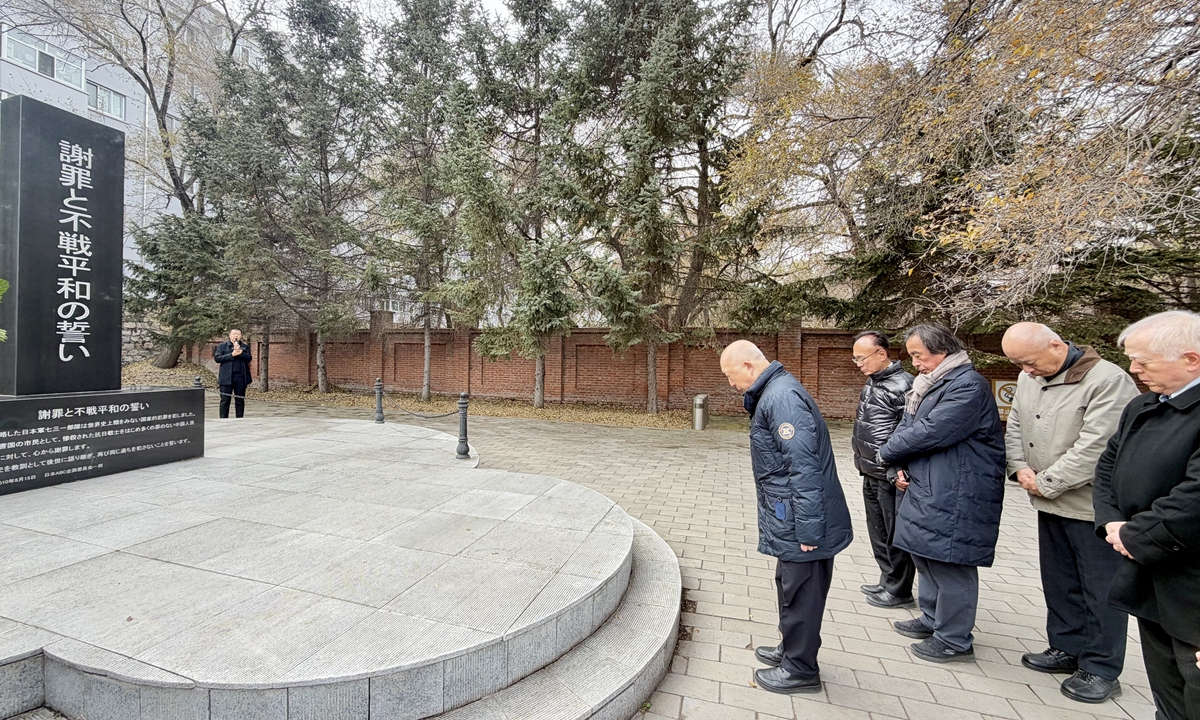
Members of the Japanese delegation observe a moment of silence and lay flowers before the monument dedicated to "apology and the commitment to peace without war." Photo: Xing Xiaojing/Global Times
In late autumn, the weather in Harbin is turning colder. A delegation from Japan's Association for Inheriting and Propagating the Murayama Statement comprising journalists, scholars, lawyers and civic activists, recently visited the Exhibition Hall of Evidences of Crime Committed by Unit 731 of the Japanese Imperial Army, known as Unit 731. Standing in solemn formation before the monument dedicated to "apology and the commitment to peace without war," they observed a moment of silence for the victims of Japan's biological warfare.
Global Times reporters accompanied the delegation throughout the visit, documenting its members' journey as they confronted evidence of biological warfare and sought the historical truth. From offering apologies at the monument and touring the ruins to calling on younger generations in Japan to face the country's history of aggression, the interviewees reflected on Japan's wartime responsibility with heavy hearts. They said that, as right-wing forces in Japan attempt to downplay the country's history of aggression, it is all the more important to carry forward the spirit of the Murayama Statement and convey the historical truth to Japanese society.
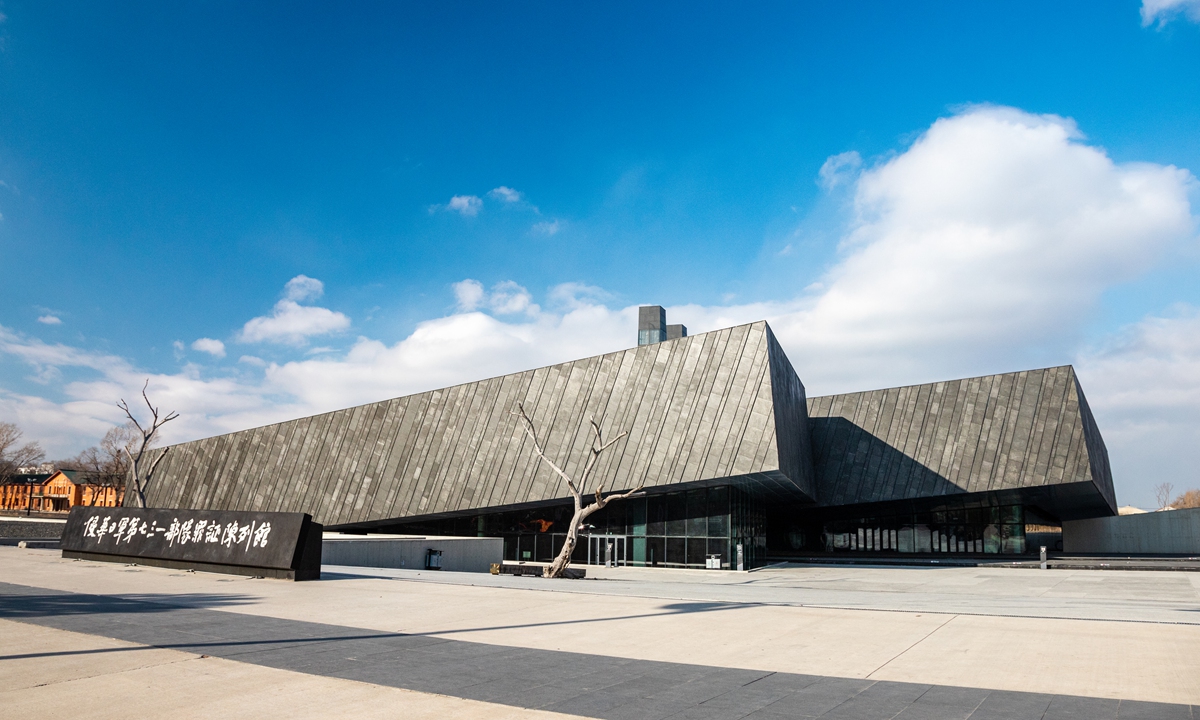
Outside view of the Exhibition Hall of Evidences of Crime Committed by Unit 731 of the Japanese Imperial Army Photo: VCG
A heartfelt apology to the Chinese people"From the bottom of our hearts, we apologize to the Chinese people who were massacred amid the devilish atrocities committed by Japanese militarism and the invading Japanese army. We are determined never again to wage a war of aggression. Let us observe a moment of silence for them," delegation head Takakage Fujita read aloud before the monument dedicated to "apology and the commitment to peace without war."
Together, the delegation members lowered their heads and bowed deeply in the biting wind. Several elderly members remained bent over for a long time. When they finally lifted up their heads, their expressions were grave, and they remained silent for quite some time. After the moment of silence, two members walked side by side to the monument, carrying flowers together and gently placing them at its base.
"Returning here after 10 years has once again compelled me to reflect from the depths of my heart on the atrocities committed by the invading Japanese army. It is deeply painful," Fujita said. "They were living human beings! The invading Japanese army injected them with bacteria, tortured them and killed them. It sends a chill down one's spine. Such acts can only be described as 'devilish.' We must ask: Why did they commit such brutal atrocities? As a Japanese person, I offer my heartfelt apology and ask forgiveness from the Chinese people who died in the war."
"What must also be said is that the Japanese soldiers and academics who committed these devilish atrocities did not receive the punishment they deserved after the war. Instead, they lived undisturbed in Japanese society - some became university administrators, while some rose to senior positions at pharmaceutical companies. Those who should have faced severe punishment were allowed to live out their lives as they pleased. It fills me with anger from the bottom of my heart!" Fujita said.
The exhibition hall stands in the core area of what was once the Unit 731 compound. Concealing its true designation from the public, the unit secretly established a biological warfare base in Pingfang district, Harbin, where it cultivated large quantities of pathogens responsible for plague, cholera, typhoid, anthrax and dysentery to develop biological weapons. It also subjected anti-Japanese resistance fighters and civilians to horrific human experiments involving frostbite, electric shocks, water deprivation, dry heat and vivisection, killing and maiming large numbers of innocent people.
On the eve of Japan's defeat, Unit 731 blew up its facilities, destroyed documents and killed the surviving "experimental subjects" in an attempt to bury its crimes beneath the ruins. Yet the chain of evidence - comprising the ruins, archival documents, testimony from former unit members and accounts from victims - was never severed. The exhibition hall has collected oral histories from former Unit 731 members. These testimonies reveal the process through which the unit secretly developed biological weapons, conducted biological warfare and carried out experiments on living human beings. They provide proof that Japan's biological warfare program was a top-down, organized and premeditated state crime.
It was the first visit to the exhibition hall for Hiroshi Hoshino, a board member of Japan's Association for Inheriting and Propagating the Murayama Statement. While touring the ruins of the weasel breeding facility, he took the Global Times reporter by the arm and said, "I had previously learned from books and other materials about the many crimes committed by the invading Japanese army. But visiting the site allowed me to experience more directly what actually happened here. The impact was so overwhelming that I could not hold back my tears."
"What pains me most is that they [the invading Japanese army] did not treat people as human beings at all. They regarded them merely as experimental materials and even studied how to kill them like animals. How could anyone be so cruel?" Hoshino said. "After returning to Japan, we plan to hold briefing sessions. We must tell people the truth about this history and let more Japanese people know what actually happened."
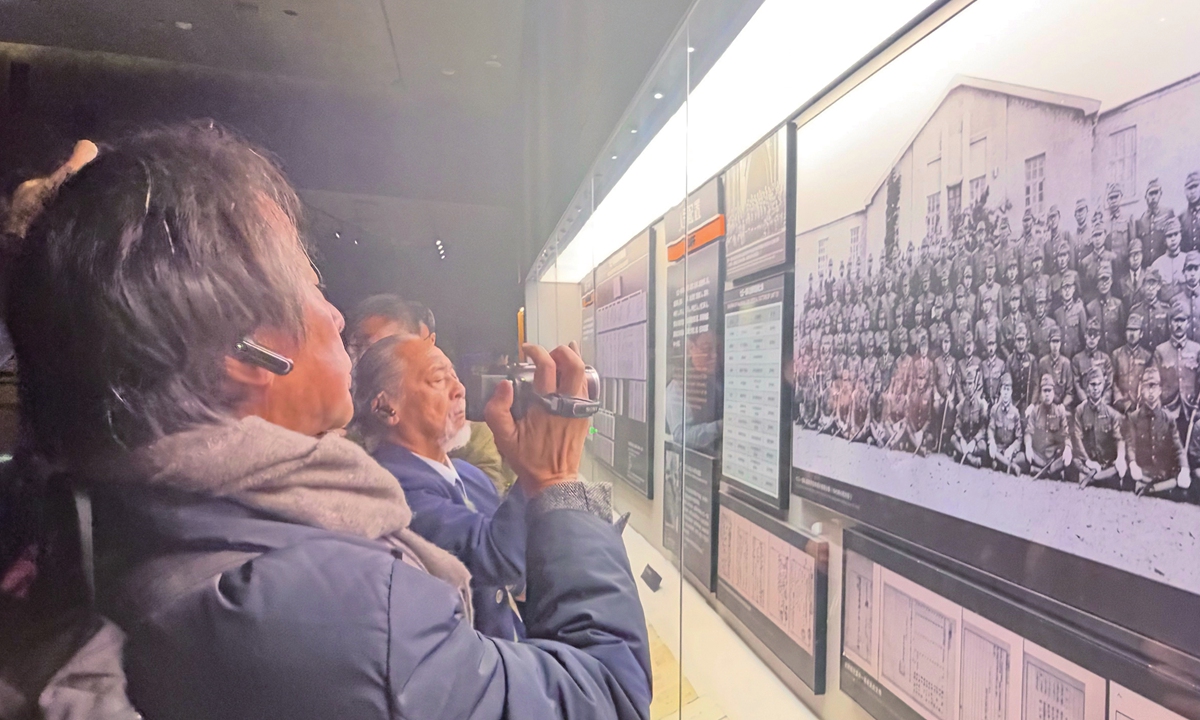
A delegation from Japan's Association for Inheriting and Propagating the Murayama Statement visits the Exhibition Hall of Evidences of the Crimes Committed by Unit 731 of the Japanese Invading Army. Photo: Xing Xiaojing/Global Times
Recording the truth, passing on history
On the journey from downtown Harbin to the exhibition hall, Japanese journalist Shigenori Kanehira showed Global Times reporters two valuable pieces of footage. As early as 1985, Kanehira had traveled to Pingfang in Harbin to record the original state of the Unit 731 ruins and survivors' accounts.
Kanehira said that his senior colleague Haruko Yoshinaga had reported on the Unit 731 ruins in Japan in 1976. He had loved the program since his student days and resolved that, if the opportunity arose, he too would report from the site. In October 1985, Kanehira traveled to Harbin via Beijing and visited Anda and other locations during a stay of about one week. After returning to Japan, he tracked down surviving former Unit 731 members, preserving their invaluable testimony.
The two-part documentary was broadcast in Japan in November 1985 and drew widespread attention. Notably, near the end of the second installment, the presenter said, "After yesterday's broadcast, we received numerous calls from viewers demanding to know why we had aired this shameful chapter of Japan's past. But we believe that Unit 731 must not be treated merely as a sealed-off episode from history. It has dimensions that persist to this day and remain connected to the present."
Returning to this land 41 years later, Kanehira told the Global Times, "Back then, I entered the general affairs building. I clearly remember seeing hypodermic needles scattered across the basement floor and traces of where animals had been kept. This time, seeing the exhibition hall newly completed in 2015, with its more systematic displays and much richer historical documentation, I felt an overwhelming responsibility to ensure that these historical facts are never erased."
Throughout the visit, Kanehira listened attentively to the guide while filming with a DV camera, occasionally adding notes of his own. "I am a journalist. It is my duty to investigate facts and present them. It is extremely important to convey these historical truths faithfully. The Japanese public should have a fuller understanding of historical facts, especially the younger generation. They spend a great deal of time on anime and video games, but I hope they will also study history seriously," he said.
It was also the first visit to the exhibition hall for Mitsuhisa Fukutomi, a professor at Hitotsubashi University. "Never before have I learned about this history in such concrete detail. It is so cold here that merely surviving in this environment would have been extremely difficult. It is unimaginable what pain and despair those subjected to 'human experiments' must have endured," he said with emotion.
Fukutomi told the Global Times that he teaches his students about Japan's wartime crimes of aggression, explaining that wars are decisions made by politicians, yet politicians themselves do not personally go to the battlefield - it is always ordinary people who are sacrificed. His students are often astonished, as they know very little about this side of history. "Many do not know about the 9/11 terrorist attacks, nor do they know that Unit 731 existed."
"Occasionally, students ask: Japan's war of aggression against China has nothing to do with our generation, so why should we still apologize? I always tell them that the prosperous and convenient lives they enjoy today are the 'positive assets' inherited from previous generations. But does that mean they do not also inherit the 'negative assets' left by Japan's history?" Fukutomi said.
"I have always believed that only by studying history and understanding the past can we build the future. Japan still falls far short in this regard. As a scholar, I have a responsibility to bring back to Japan everything I have seen and heard here, so that more Japanese people can learn the truth about this history," he stressed.
Carrying forward spirit of Murayama Statement
For some time, certain Japanese prime ministers and cabinet ministers have repeatedly made ritual offerings to the notorious Yasukuni Shrine, diluted references to atrocities including the Nanjing Massacre, tolerated textbook distortions of wartime history and attempted to overturn the historical verdict on Japan's aggression. Against this backdrop, how can a correct understanding of history be upheld? In the interview with the Global Times, Fujita stressed the importance of carrying forward the spirit of the Murayama Statement.
"The Murayama Statement was issued in 1995 by then Japanese prime minister Tomiichi Murayama and embodied a firm commitment to peace," he said. "Murayama reflected on why Japan had launched such a wrongful war of aggression against China and why it had failed to stop it. Guided by the determination that Japan must never again wage a war of aggression, he conscientiously reviewed the country's past mistakes, acknowledged that it had been a war of aggression and stated that Japan would never repeat them."
Fujita said that Japan is currently moving backward not only on historical issues but also accelerating recklessly along the path of military expansion. "In recent years, the Japanese government has sharply increased its defense budget, breached the principle of an exclusively defense-oriented policy and sought to acquire 'counterstrike capabilities.' This runs directly counter to the spirit of the Murayama Statement. We must recognize with clarity that the pacifist constitution is being hollowed out step by step and that Japan is sliding toward an extremely dangerous path."
Fujita stressed that this is precisely why carrying forward the spirit of the Murayama Statement and upholding a correct understanding of World War II history have become particularly urgent. "We carry forward former prime minister Murayama's determination and seek to guide Japan toward becoming a peaceful country that does not repeat its mistakes, based on peace and a correct understanding of history."
At the end of the visit, members of the delegation purchased a large amount of reference material from the exhibition hall. Hoshino told the Global Times, "I will take these materials back to Japan, promote a correct understanding of history among the Japanese people and ensure that the facts of what happened during this war of aggression are told and passed down permanently."
"Japan launched a war of aggression, took the lives of countless Chinese people and inflicted profound suffering on people across Asia. I believe that China-Japan friendship, as well as friendship between Japan and other Asian countries, can only be built on a correct understanding of history. Any 'friendship' that refuses to face historical facts simply cannot stand," Fujita said.
"Turning warhorses loose and putting oxen back to pasture" and "separated only by a narrow strip of water" - these were the words Fukutomi wrote in the exhibition hall's visitors' book. "The ancient Chinese expression 'turning warhorses loose and putting oxen back to pasture' means that, after a war ends, the horses are released into the mountains and the oxen are returned to farming. It embodies a profound longing for peace. The phrase 'separated only by a narrow strip of water' shows that China and Japan are neighboring countries that cannot move away from each other. Japan should therefore cherish its neighboring countries, including China, and learn to respect them so that peace can be built through dialogue," he told the Global Times.
RELATED ARTICLES