Illustration: Liu Xiangya/Global Times
Canada is reportedly searching for more trading partners beyond the US. Canadian Foreign Minister Anita Anand said that the country is moving rapidly to diversify its trade and security relationships, aiming to double trade with markets outside the US over the next decade, Reuters reported on Saturday.
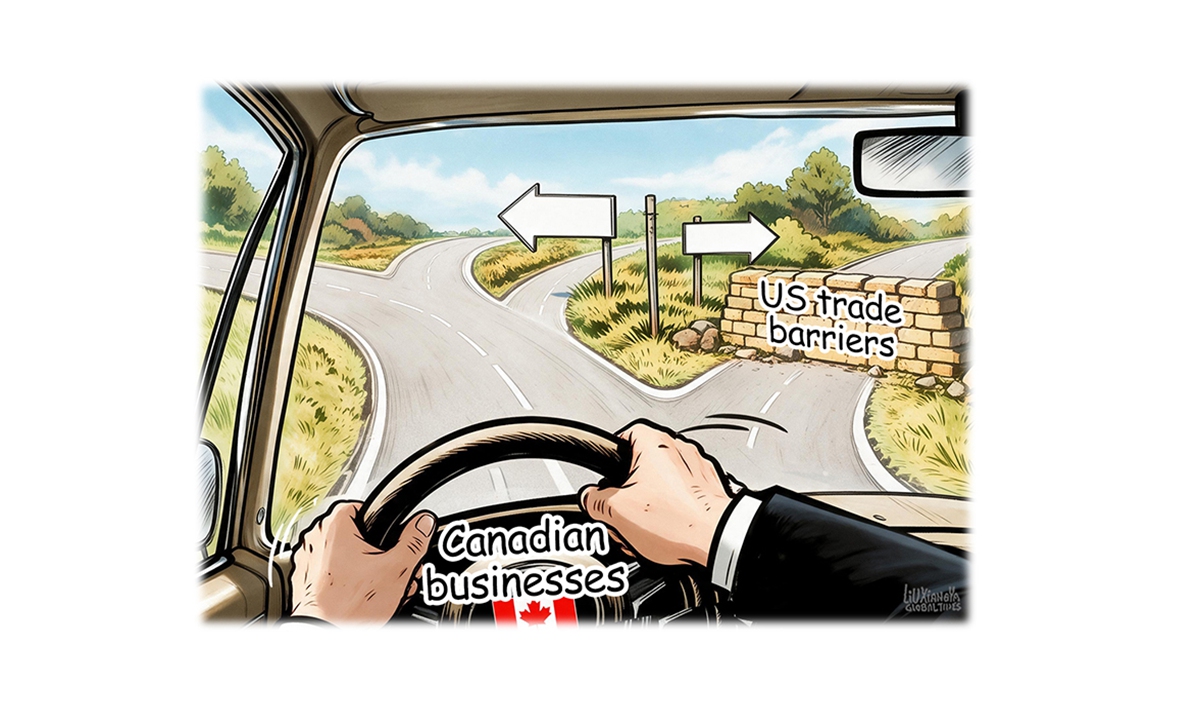
As US tariffs strain Canada's economy and trade talks with Washington make limited progress, Ottawa's ambition reflects a broader reality: When a country's largest trading partner becomes increasingly unpredictable, trade diversification becomes an economic necessity.
The importance of the US market to Canada is undeniable. Geographic proximity and decades of economic integration have created deeply intertwined supply chains, in automobile, energy and other sectors. However, the close ties also leave Canadian businesses particularly exposed to changes in Washington's trade policies.
Statistics Canada showed that Canadian merchandise exports to the US fell 5.8 percent in 2025, while the US share of Canada's merchandise exports dropped from 75.9 percent in 2024 to 71.7 percent. Meanwhile, exports to non-US markets rose 17.2 percent. The figures suggest that while the US remains Canada's dominant export destination, Canadian businesses are looking elsewhere for growth opportunities.
Behind the shift lies a growing concern over the risks of relying too heavily on a single trading partner. For decades, predictable access to the US market allowed Canadian businesses to plan investments, manage production and build cross-border supply chains with confidence. But as Washington increasingly uses tariffs as a bargaining chip, the stability that once underpinned their economic ties is loosened. Seeking alternative markets has become a matter of economic prudence.
Ottawa's diversification push sends a clear message: Protectionism always hurts trade ties, but open markets benefit free trade and create more opportunities.
Ottawa is translating that thinking into diplomatic and economic initiatives. According to Reuters, Canada has concluded 20 new agreements covering trade and security and trade. It is also seeking to conclude a trade agreement with ASEAN and deepen economic engagement with the EU.
However, signing trade agreements is only the beginning. Expanding into new markets requires Canadian businesses to adapt to different regulatory standards, establish distribution networks and build relationships with local buyers - investments that take time to pay off. Turning its strength in energy, critical minerals, agriculture and manufacturing into lasting export growth will require Canada to find a place in new regional supply chains and build reliable commercial partnerships.
Asia stands out in this regard. Its vast consumer market and extensive manufacturing networks create substantial demand for resources, food and industrial inputs. For Canadian exporters, deeper engagement with Asian economies could open new avenues for growth.
China provides a compelling example of this potential. According to Global Affairs Canada, Canadian merchandise exports to China reached $3.05 billion in August 2026, up 55.5 percent year-on-year, while cumulative exports to China in the first eight months rose 39.3 percent from a year earlier.
During Canadian Prime Minister Mark Carney's visit to China in January, the two countries agreed to advance their new strategic partnership, expand bilateral trade and investment, and deepen cooperation in areas including energy and agriculture. Canada also expressed its expectation of increasing exports to China by 50 percent by 2030.
These developments highlight Canada's growing interest in tapping into the opportunities offered by China's vast market. China's extensive industrial system and diverse import demand offer considerable scope for mutually beneficial cooperation, particularly in sectors where Canadian resources and products can meet the needs of Chinese industries and consumers.
Trade diversification is a two-way process. Canada's recent move to ease trade restrictions on Chinese goods is a positive step. Building on this momentum, further improving market access and ensuring a stable, predictable business environment would help unlock more opportunities for companies on both sides.
Anand also stressed the importance of "trust" in building new relationships beyond North America, according to Reuters. For businesses, trust is earned through consistent policies and mutually beneficial dealings, not simply through promises. Canada's experience with Washington's tariff policies has brought home the importance of such trust, a lesson that should guide Ottawa as it builds ties with other trade partners.
Whether Canada can withstand pressure and turn its diversification drive into a lasting commitment to open trade will shape its economic landscape over the next decade. It will also offer a telling test of whether multilateralism and open markets can remain a viable path forward amid mounting protectionism and de-globalization pressures in the world.
The author is a reporter with the Global Times. bizopinion@globaltimes.com.cn
RELATED ARTICLES