South Korea's exports to China surge 133.6% in October amid AI chip boom
Strong growth underscores complementary industrial strengths, cooperation potential: expert
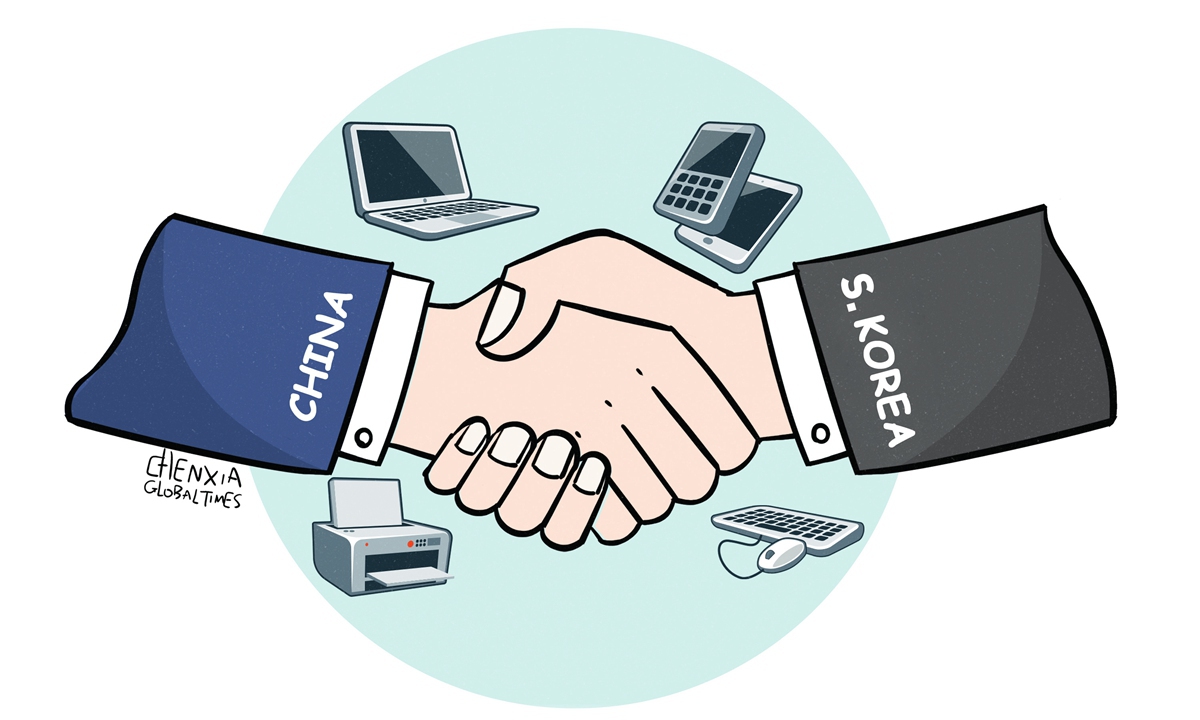
Illustration: Chen Xia/GT
South Korea's exports to China surged 133.6 percent year-on-year to $26.98 billion in October, exceeding $20 billion for the fifth consecutive month, the Yonhap News Agency reported on Sunday, citing official data. A Chinese analyst said that the sharp increase, driven largely by semiconductor shipments, highlights the deep integration of the two countries' industrial supply chains amid booming global demand for artificial intelligence (AI).
China remained South Korea's largest export destination in October, with shipments reaching $26.98 billion, compared with $24.9 billion to the US. Strong shipments of semiconductors and wireless communications equipment helped drive the growth, according to South Korea's Ministry of Trade, Industry and Resources. Notably, semiconductor exports to China surged 331 percent year-on-year to $14.8 billion during the first 25 days of October.
South Korea's overall exports jumped 93.7 percent year-on-year to $115.3 billion in October, the second-highest monthly total on record, driven by strong semiconductor demand and continued investment in AI infrastructure by major technology companies. Semiconductor exports alone surged 259 percent to $56.4 billion, accounting for nearly half of total shipments, while automobile and cosmetics exports rose 18.1 percent and 57.5 percent, respectively, according to Yonhap.
Wang Peng, a Chinese industry analyst, told the Global Times on Sunday that South Korea's export surge reflects a new phase of growth in the global semiconductor industry, driven by expanding AI infrastructure investment and surging demand for memory chips. However, he noted that the growth is concentrated in AI-related chips rather than spread evenly across the industry, making South Korea's export performance increasingly dependent on continued capital spending by major global technology companies.
Regarding the sharp increase in exports to China, Wang said that it reflects both strong demand from the Chinese market and the deep integration of the two countries' industrial supply chains. China's expanding AI infrastructure and digital economy have generated substantial demand for semiconductors, while the long-established division of labor between Chinese and South Korean manufacturers has facilitated the movement of intermediate goods and components across their borders, he said.
The latest figures also highlight the scale of bilateral economic ties. According to the South Korean Embassy in China, two-way trade reached $263.1 billion in the first eight months of 2026, with South Korean exports to China totaling $145.4 billion. China remained South Korea's largest trading partner, export market and source of imports. Integrated circuits and semiconductor-related components were among South Korea's major exports to China.
Wang noted that South Korea's strengths in memory chips complement China's advantages in electronics manufacturing, end-product applications and market scale, making the two economies closely interconnected across the semiconductor value chain. The two countries are no longer simply buyers and sellers, but are deeply embedded in each other's supply chains, he said.
The two countries have also been seeking to strengthen economic ties through policy coordination. From October 12 to 16, China and South Korea held the 17th round of negotiations on the second phase of their free trade agreement (FTA) in Seoul, focusing on market access for cross-border services trade and investment under a negative-list approach. Both sides agreed to accelerate the negotiations and work toward their early conclusion, according to China's Ministry of Commerce (MOFCOM).
Earlier this year, the MOFCOM said that China and South Korea had signed memorandums of understanding on establishing a bilateral economic and trade cooperation dialogue mechanism and deepening cooperation between industrial parks. The ministry also identified high-end manufacturing, AI and green industries as areas with considerable potential for further cooperation.
Wang said that while Chinese and South Korean semiconductor companies face competition in some memory-chip segments, considerable potential remains for cooperation in semiconductor equipment and materials, advanced packaging and AI infrastructure. Emerging sectors such as intelligent vehicles, industrial semiconductors and data centers could offer further opportunities, particularly as the two countries advance their FTA negotiations.
Despite adjustments in global supply chains and intensifying technological competition, maintaining stable industrial supply chains and expanding practical cooperation serve the common interests of both countries, he added.
RELATED ARTICLES