'The Quad is not an anti-China coalition' – The US should walk the talk: Global Times editorial
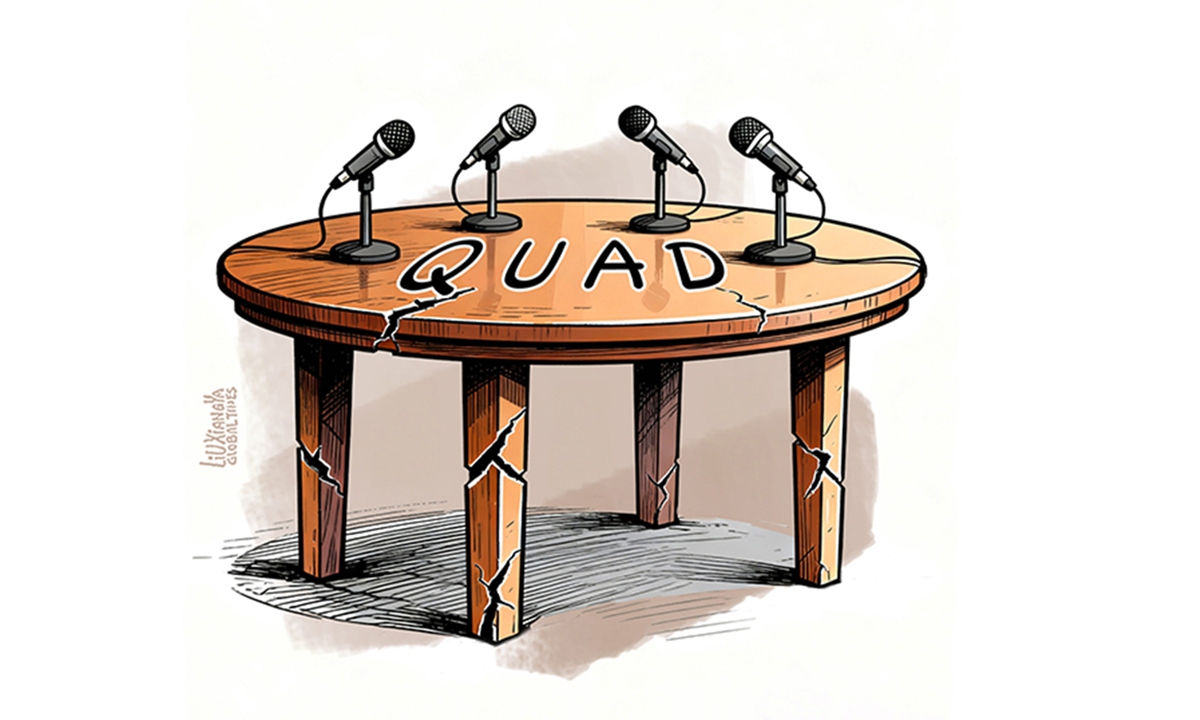
Illustration: Liu Xiangya/GT
The Quad's nature should not be determined by how US officials describe it, but by what it actually does. If it uses supply chain security as a pretext to exclude Chinese industries and impose technological restrictions on China, no amount of diplomatic rhetoric can disguise its true nature as a tool of containment against China.
On Saturday, the US-Japan-India-Australia (Quad) foreign ministers' meeting issued a joint statement expressing concerns over so-called "economic coercion," "arbitrary export restrictions" and "overcapacity." Although the statement did not name China, its references clearly pointed to it. Interestingly, US Secretary of State Marco Rubio stressed that the Quad was not an "anti-China alliance" and was not aimed at any country.
We are willing to take Rubio at his word, but more importantly, hope Washington will back its words with actions. The Quad's nature should not be determined by how US officials describe it, but by what it actually does. If its cooperation aims to maintain regional stability and promote industrial development, there is nothing wrong with that. But if it uses supply chain security as a pretext to exclude Chinese industries and impose technological restrictions on China, no amount of diplomatic rhetoric can disguise its true nature as a tool of containment against China.
China-US relations are at a crucial stage, as the two sides work to build a "constructive relationship of strategic stability based on respect, fairness, reciprocity." The consensus reached by the two heads of state must be translated into concrete actions at all levels of government. Washington cannot call for managing differences and stabilizing bilateral ties while allowing exclusive blocs targeting China to pursue increasingly confrontational agendas.
Japan's role within the Quad warrants particular vigilance. In recent years, some Japanese political forces have become increasingly keen to use US-led multilateral mechanisms to present their strategic anxieties about China as shared regional concerns. During this meeting, Japan's Foreign Minister Toshimitsu Motegi highlighted so-called opposition to "coercion" in the East China Sea and South China Sea.
He also raised export restrictions and alleged "overcapacity" during G20 discussions on supply chains. Japan appears to be using collective statements to legitimize its own positions. Such deliberate attempts to tie these issues together not only politicize the Quad's economic security agenda, but also raise further doubts among regional countries about its strategic intentions.
India and Australia, meanwhile, each have their own interests and priorities. India emphasizes strategic autonomy and hopes to use multilateral cooperation to create opportunities for industrial development, rather than simply fall in line with an economic containment strategy against China designed by other countries.
Australia, for its part, understands that the hard-won stabilization of China-Australia relations in recent years should not be taken for granted. Canberra has little reason to once again place economic and trade cooperation under the shadow of political confrontation just to accommodate the strategic anxieties of certain countries. The differing interests of Quad members make it impossible to forge a united economic front against China through a joint statement alone.
In this sense, the Quad could become a hot potato for the US. Since its inception, the grouping has maintained an unmistakably exclusive character, often serving as a platform for containing and pressuring third parties. It has also been used by certain countries to smuggle in their own agendas and turn the grouping into a strategic springboard. This clearly runs counter to regional needs and the broader trend in China-US relations. Washington may hope to use the Quad to coordinate regional resources, but if it allows the grouping to become a megaphone for amplifying disputes with China, it will ultimately have to bear the risks and consequences. Since the US has publicly denied that the Quad is anti-China, it should rein in attempts within the grouping to promote confrontation under the guise of cooperation.
Supply chain security matters. But security does not mean exclusion, and resilience does not mean "decoupling." China's position in global manufacturing and critical minerals processing has been built through years of market competition, technological advancement and industrial cooperation. Trying to redraw supply chains by forming exclusive cliques and pursuing bloc politics will not magically create alternative capabilities out of thin air. Instead, it will raise costs for businesses and undermine the region's overall economic vitality and competitiveness.
The real test for the Quad is whether it can move beyond the inertia of bloc politics and find areas of cooperation that serve the common interests of the region. Rubio's statement that the Quad is not an "anti-China coalition" could be a positive starting point, but it must not remain mere rhetoric. Washington should value the positive momentum in China-US relations and prevent divisive and confrontational tendencies within regional mechanisms from undermining stability. What the Asia-Pacific needs is cooperation, not division and confrontation.
RELATED ARTICLES