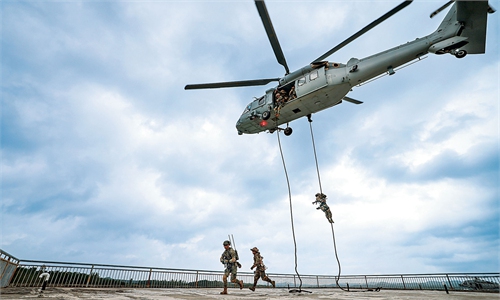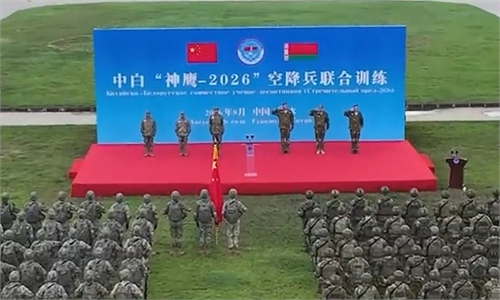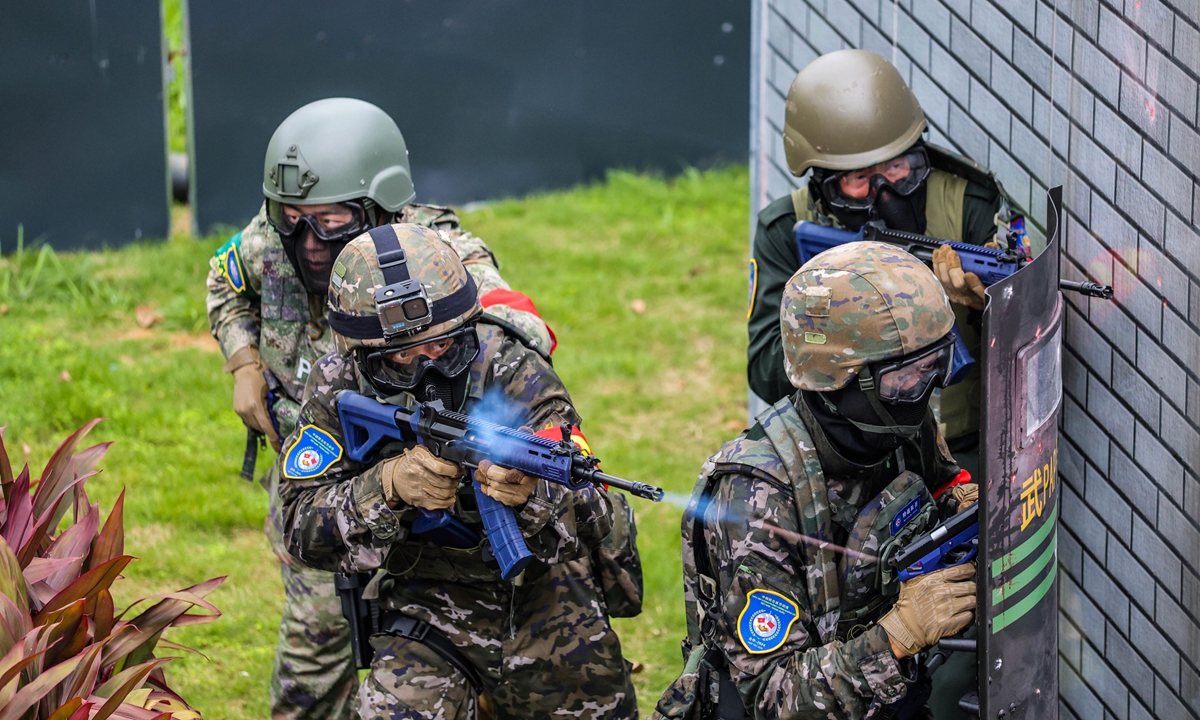
The China-Vietnam joint counter-terrorism training is underway, in Nanning, South China's Guangxi Zhuang Autonomous Region on July 27, 2024. File photo: Xinhua
The Chinese People's Armed Police Force and the mobile police force under the Vietnamese Ministry of Public Security are set to conduct a joint counter-terrorism exercise, codded "Cooperation-2026," in Hanoi, Vietnam, in early to mid-November, China's Ministry of National Defense announced on Monday.
The exercise, themed around joint efforts to "combat violent terrorist crimes," will cover a range of training subjects, including explosive ordnance detection and disposal, ground maneuvering and assaults on high-rise buildings, according to the announcement.
This will be the second exercise of its kind between the two countries and is expected to deepen exchanges and cooperation in counter-terrorism while enhancing their capabilities for joint operations, the ministry said. The inaugural exercise, held in 2024 in Southwest China's Guangxi Zhuang Autonomous Region, was aimed at addressing shared concerns over terrorist threats and focused on joint efforts to combat violent terrorist activities, according to the Xinhua News Agency.
During the two-week exercise, Chinese and Vietnamese personnel conducted training across seven categories and 27 subjects, including exchanges and discussions, command, skills, water-based operations, tactical coordination, specialized counterterrorism drills and comprehensive counterterrorism exercises. The program also featured sports competitions and cultural performances.
Compared with the inaugural exercise, this year's training will take place in Vietnam and focus on several key urban counter-terrorism operations, Wang Yunfei, a Chinese military affairs expert, told the Global Times on Monday.
The first exercise covered a relatively broad range of subjects, including water-based training and comprehensive tactical drills across different scenarios. The upcoming exercise places greater emphasis on explosive ordnance disposal, ground maneuvering and building-entry operations, which are particularly relevant to counter-terrorism missions in complex urban environments, Wang said.
The change of venue is also significant, as conducting the exercise in Hanoi will allow personnel from both sides to become more familiar with the operational environment in Vietnam and practice coordination under conditions closer to those they may encounter during actual counter-terrorism missions there, he noted.
"The move also demonstrates growing mutual trust between the two sides," Wang said, adding that "training will also help improve coordination in command procedures, tactical cooperation and joint responses to security threats."
"The two countries could also explore further cooperation in the application of unmanned equipment," Wang said.
The program in 2024 featured a number of unmanned systems, including robotic dogs, biomimetic robotic birds and wall-climbing robots, which were used in coordinated operations. Virtual reality (VR) and mixed reality (MR) technologies were also employed to create simulated confrontation scenarios, according to the China Youth Daily.
Such technologies have increasingly become important tools in counter-terrorism training, allowing personnel to practice responding to complex scenarios while improving coordination between human operators and unmanned platforms, said Wang, adding that the upcoming exercise could feature further technological upgrades, although its specific equipment and arrangements have yet to be announced.
In his view, the selection of training subjects for the 2026 exercise also reflects the challenges posed by terrorist activities in densely populated urban areas, where high-rise buildings, complicated structures and potential explosive threats can make operations particularly difficult.
Explosive ordnance disposal, rapid ground maneuvering and assaults on high-rise buildings address several key challenges in such scenarios, requiring participating personnel to improve their ability to respond quickly, coordinate movements and carry out precise operations in complex environments, he noted.
Beyond the military and operational aspects, the exercise also carries broader significance for bilateral security cooperation.
Against a backdrop of complex and evolving regional security challenges, closer counter-terrorism coordination between China and Vietnam will help the two countries strengthen their ability to address cross-border terrorist threats and transnational crimes, while contributing to security and stability in the region, Wang said.
Looking ahead, the two sides could explore expanding cooperation into areas such as intelligence sharing, cross-border law enforcement operations, joint training involving unmanned equipment and emergency rescue, he added.
RELATED ARTICLES