ARTS / CULTURE & LEISURE
Dai drum beats carry cultural memory across Lancang-Mekong region
Echoes across borders
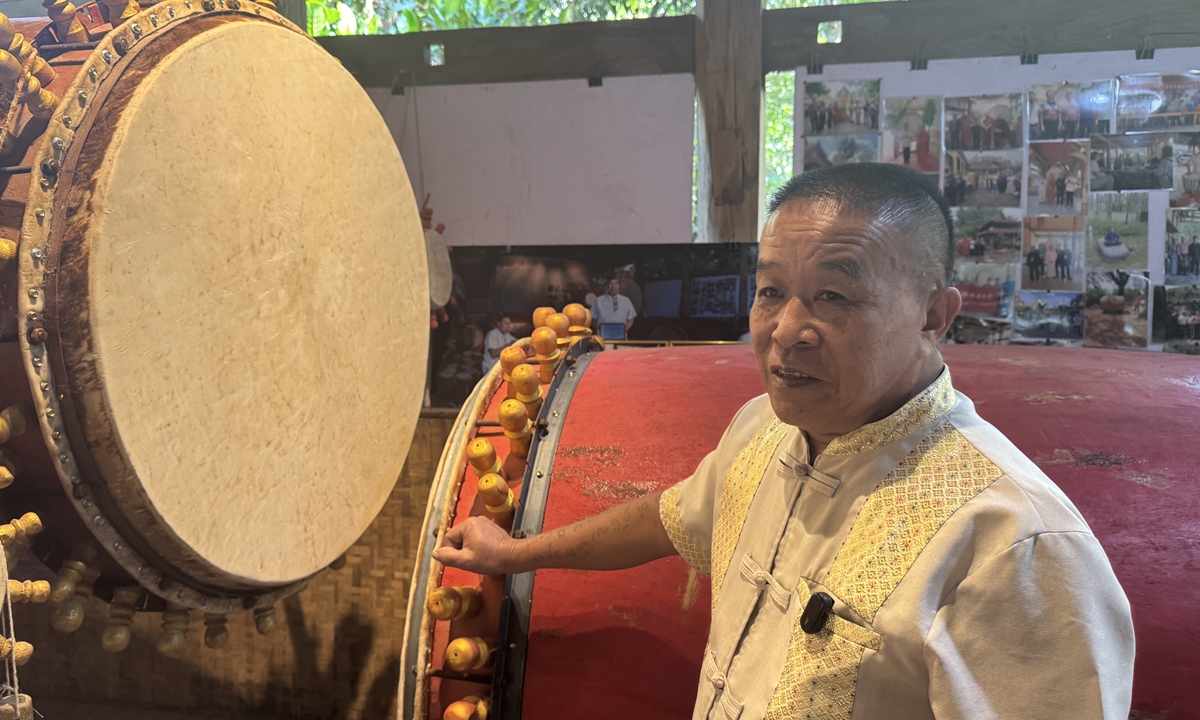
Bo Yingguang, a recognized inheritor of the Dai elephant-foot drum craft Photo: Jiang Li/Global Times
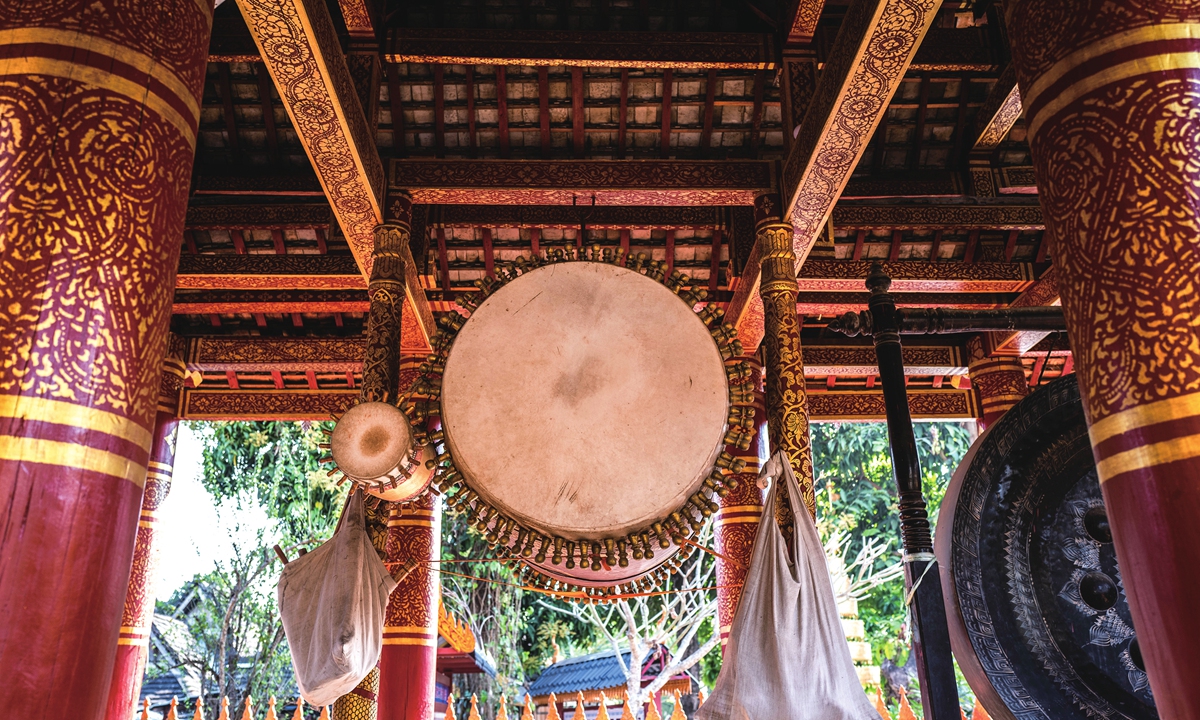
A Dai elephant-foot drum in Xishuangbanna, Southwest China's Yunnan Province Photo: VCG
In Xishuangbanna, Southwest China's Yunnan Province, the Dai elephant-foot drum once served as an important means of communication between villages. Today, while high-technology has filled that communication niche, the drum remains a distinctive symbol of Dai culture. The Dai, an ethnic group of 1.33 million in China, have a drum-making craft as a national-level intangible cultural heritage, one that draws visitors from neighboring countries such as Myanmar and Laos.At the 14th Lancang-Mekong River Basin Countries Culture and Arts Festival in Xishuangbanna, which concluded on Sunday, artists from China, Cambodia, Laos, Myanmar, Thailand and Vietnam performed traditional dances and music and showcased other forms of intangible cultural heritage. Among the performances was the Dai drum dance, whose distinctive rhythms are rooted in a traditional craft passed down through generations and still closely tied to local daily life.
"In the past, transportation between villages was inconvenient, and communicating was not as easy as it is today. When something important happened and villagers needed to gather for a meeting, people would beat the drum," Bo Yingguang, a recognized inheritor of the Dai elephant-foot drum craft, told the Global Times.
When villagers heard the drum, they knew that something was happening and that they needed to come together.
"With better transport and communications, the drum is no longer used for daily messaging. But memories of village life, and the craftsmanship it embodies, have been passed down. It remains a distinctive symbol of Dai culture," Bo said.
A tradition of craftsmanship
Bo explained that the drum body is carved from a single piece of wood, with the interior hollowed out to create two connected chambers.
"The drumhead is made from yellow cattle hide. After it is stretched over the body, pulled tight and secured, its tension is adjusted repeatedly. Tension directly affects the sound the drum produces when struck," he said. "Sometimes a smaller drum, locally known as a zigu, is placed alongside the drum and used for tuning."
The craft demands both time and experience. Bo said a large drum usually takes at least six months to make, while smaller ones may take two to three months. The largest drums can exceed one meter in length. Once assembled, the drums are struck repeatedly to fine-tune their sound.
Access to suitable wood also poses a challenge. Bo said that local regulations prohibit people from freely cutting down the trees used to make the drums.
"Harvesting requires going through necessary procedures and getting permits, so some of the wood has to be imported from neighbor countries like Myanmar," he said.
Festive rhythm
The survival of this traditional craftsmanship is closely tied to the drum's enduring place in Dai people's daily life.
Bo said the musical instrument plays an important role in traditional celebrations, including the Dai New Year, the Closing-the-Door Festival and the Opening-the-Door Festival. During these occasions, Dai people visit Buddhist temples to take part in activities and pay their respects to their parents, grandparents and other elders. The drum is an important part of these ceremonies and gatherings.
"Some drums have a special object inside known as a 'drum core,' which contains items associated with Dai beliefs," he said. "Drums with a core must be kept in the village Buddhist temple and cannot be placed just anywhere in someone's home. Drums without one, by contrast, can be kept and used at home."
The objects inside the drum core carry special symbolic meanings. For local people, they are not merely decorations, but part of the beliefs and cultural memories embodied by the drum, he said.
The drum's rhythms have also become part of Dai dance and physical expression. Bo said the Dai people have different types of drums, including long, short and small ones. The elephant-foot drum dance is a familiar feature of traditional celebrations.
Male dancers strap the drums to their bodies and play them as they dance. Boys often begin learning from family members and village elders at a young age, he said.
"The connections between drums, dance and cultural symbols in everyday Dai life make a single drum a tangible way to understand Dai traditions," he added.
A shared culture
The cultural traditions embodied by the Dai drum have also attracted interest from people in neighboring countries. Bo told the Global Times that visitors from countries such as Myanmar and Laos regularly visit the area for cultural exchanges.
A former Thai leader once visited Xishuangbanna and, after watching a local drum performance, remarked on the similarities between Thai and Chinese musical traditions, Bo said.
"The experience made me realize that countries along the Mekong River share certain features in their drum traditions while retaining their own distinctive characteristics," he said.
Such cultural connections provide a foundation for people-to-people exchanges across the Lancang-Mekong region. Zeyar Myo Myint, consul general of Myanmar in Kunming, told the Global Times that China and Myanmar have increasingly held cultural and artistic exchanges in recent years, including mutual visits by delegations and performances featuring artists from both countries.
"I hope the two sides will further strengthen ties among young people at performing arts institutions. Through mutual visits, training and exchange programs, younger generations in both countries can gain a deeper understanding of each other's cultures and carry forward this tradition of mutual learning," he said.
For many people across the Lancang-Mekong region, the rhythms of the drum preserve their respective cultural traditions while offering a shared language through which they can come to understand one another.
RELATED ARTICLES