China to launch third stock market swap operation as demand exceeds 100b yuan, signaling fresh efforts to bolster market stability: experts
Move signals continued efforts to bolster capital market stability: expert
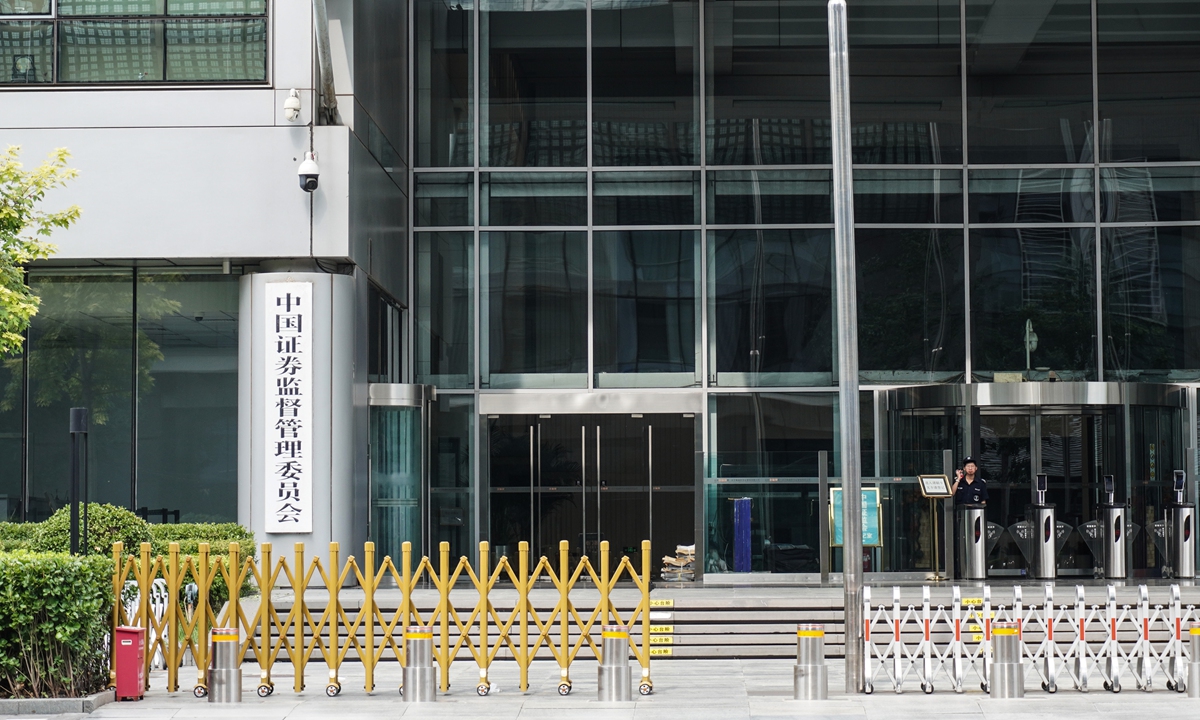
The building of the China Securities Regulatory Commission in Beijing. Photo: VCG
China's central bank announced on Monday that it will launch a third round of its stock market swap facility on Tuesday, a fresh move to support the stable and healthy development of the country's capital market.
The latest operation is expected to channel more funds into the stock market by helping financial institutions expand their investment capacity, while broader participation by institutional investors could help strengthen market confidence, a Chinese expert said.
The move came as the People's Bank of China (PBC), together with the National Financial Regulatory Administration (NFRA) and the China Securities Regulatory Commission (CSRC), announced further measures to optimize two policy tools supporting the capital market, including making the stock repurchase and shareholding increase relending program a long-term institutional arrangement and lowering its relending interest rate.
According to an official announcement by the PBC on Monday, the third operation of the Securities, Funds and Insurance Companies Swap Facility (SFISF) will have a one-year term, which may be extended depending on circumstances.
A total of 31 securities firms and fund management companies have submitted requests for the facility, with the total amount requested exceeding 100 billion yuan ($15 billion).
The strong interest from financial institutions shows that the swap facility has gained broad recognition among market participants, Xi Junyang, a professor at the Shanghai University of Finance and Economics, told the Global Times on Monday. By allowing institutions to exchange eligible assets for highly liquid assets that can be used to obtain financing, the facility could bring additional funds into the stock market. Greater participation could also help strengthen market confidence, the Shanghai-based industry analyst said.
The PBC, together with the NFRA and the CSRC, held two separate meetings on Monday with securities, fund and insurance companies and banks to review progress in implementing the two policy tools, hear financial institutions' opinions and suggestions, and discuss how to make fuller use of the tools to support capital market stability.
The PBC said that the SFISF had been extended multiple times since its launch in October 2024, with its outstanding balance currently standing at 105 billion yuan. The facility has helped leverage the professional investment capabilities of securities, fund and insurance institutions and generated a broader demonstration effect, according to the central bank.
The stock repurchase and shareholding increase relending program has also made important progress. According to the PBC, loan agreements signed under the policy have reached about 440 billion yuan, while cumulative loan disbursements have exceeded 280 billion yuan, helping meet listed companies' financing needs for managing their market capitalization.
In a significant policy adjustment, the stock repurchase and shareholding increase relending program will be shifted from a temporary arrangement to a long-term institutional arrangement, while the relending interest rate will be lowered from 1.25 percent to 1 percent. Financial institutions are expected to adhere to market-oriented pricing principles, apply reasonable lending margins on top of the relending rate and expand loan disbursements under the program.
For the SFISF, the authorities said that they would conduct operations at appropriate times, expand the number of participating institutions, appropriately lower swap fees and optimize collateral and operational arrangements.
The PBC said that the two policy tools had gradually demonstrated their role in the capital market's internal stabilization, while financial institutions' awareness and capabilities in supporting market stability and listed companies' market capitalization management had continued to improve.
The PBC previously conducted two SFISF operations, in October 2024 and January 2025, with transaction sizes of 50 billion yuan and 55 billion yuan. Each operation attracted bids from 20 institutions, according to the Securities Times.
The latest operation comes against a backdrop of recent fluctuations in China's stock market.
Chinese stocks rebounded on Monday, with the Shanghai Composite Index gaining 1.08 percent, the Shenzhen Component Index rising 1.63 percent and the ChiNext Index climbing 1.87 percent, according to Xinhua Finance.
The upcoming operation reflects China's continued efforts to support a stable stock market, Li Chang'an, a professor at the Academy of China Open Economy Studies at the University of International Business and Economics, told the Global Times on Monday.
"By encouraging institutions to invest more quickly and potentially lowering financing costs, the policy could bring more funds into the market, help reduce market volatility and boost investor confidence," said Li.
Over the longer term, however, sustained capital market performance will still depend on improvements in the fundamentals of listed companies and stronger investor confidence, added Li.
RELATED ARTICLES