Cyberattacks disrupt supermarket refrigeration systems across Europe; Chinese expert urges stronger safeguards for essential services
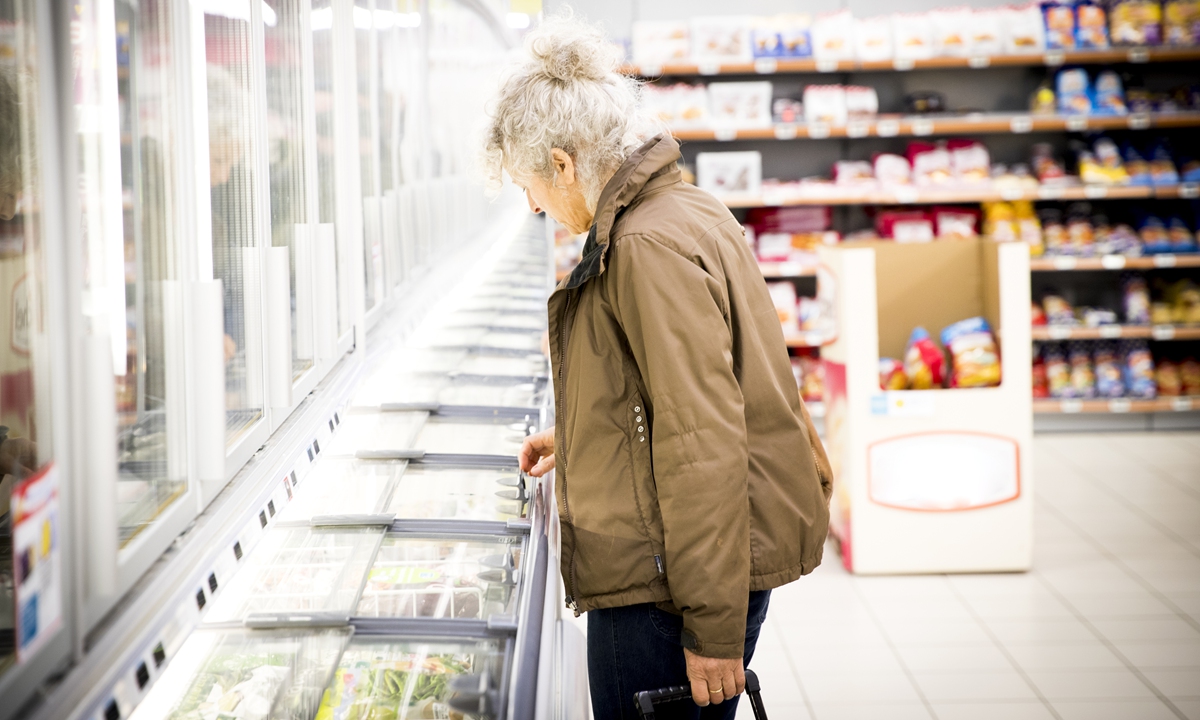
A woman browses frozen food at a supermarket in France. Photo: VCG
Cyber hackers have reportedly targeted fridges and freezers in supermarkets in several European countries, including France, Ireland and Sweden, causing temperatures to rise and food to spoil. A cybersecurity expert told the Global Times that such attacks are relatively easy to carry out, warning that temperature control systems at many supermarkets and cold storage facilities in China are also exposed to the public internet, highlighting the need to strengthen cybersecurity safeguards for essential services.
Ireland's third-largest supermarket chain, SuperValu, said its refrigeration systems limited to a specific model in 13 of its 223 stores had been affected by a cyber incident. On Monday, one Swedish store said in a social media post that the temperature of its refrigerators and freezers had been set to 50C - echoing the incident in France, Sky News reported.
Fridges and freezers in dozens of stores across Belgium and Luxembourg operated by Ahold Delhaize were also hit by a cyberattack, the Belga news agency reported. An unspecified supermarket chain in Estonia was also affected, with temperatures set to 50C, technology supplier Kitman Coldtech told public broadcaster ERR.
What could be the motive behind such destructive cyberattacks, which damage physical goods rather than steal data or demand ransom?
Song Qiang, a cybersecurity expert at Qi An Xin, a technological firm, told the Global Times on Tuesday that no group has publicly claimed responsibility for the attacks so far. Judging by the nature of the attacks, which involved neither ransom demands nor data theft but instead directly caused widespread damage to goods, they appear more likely to be aimed at demonstrating capabilities or creating disruption than at making money through conventional cybercrime, said Song.
However, the Chinese expert noted the possibility of subsequent extortion cannot be ruled out, with attackers potentially seeking to demonstrate their ability to inflict financial losses before making demands.
According to Song, supermarket refrigeration systems typically operate through a combination of local controllers and cloud-based or remote management platforms. Each refrigerated cabinet or group of cabinets has a temperature controller responsible for local operations, while an internet-connected gateway allows manufacturers or maintenance providers to remotely monitor temperatures, defrosting operations and alarms.
"This model prioritizes operational efficiency at the expense of security, with temperature control systems often directly exposed to the public internet," Song said.
As a result, carrying out such attacks is relatively easy, Song explained. Attackers can scan the internet for exposed control devices, bypass authentication by exploiting weak login mechanisms or default passwords, and then issue control commands.
"The entire process requires no sophisticated exploitation of security vulnerabilities, as the systems are essentially left inadequately secured," the expert noted.
Similar attacks occurred in France last month, when hackers raised the temperature of refrigerators and freezers at hundreds of supermarkets to as high as 50C, causing fires and spoiling food, Reuters reported on October 12, citing the Paris prosecutor's office.
Such attacks also serve as a warning for supermarkets and cold-chain storage operators in China. Song said domestic companies should take five key precautions: identify temperature control devices exposed to the public internet, restrict unnecessary remote access, strengthen password and account management, promptly patch security vulnerabilities and isolate outdated equipment.
Most importantly, companies should install alert systems to flag abnormal temperatures and unauthorized remote access, while ensuring that temperature settings cannot exceed safe limits, even when commands come from legitimate accounts, Song said.
These relatively low-cost measures could prevent most large-scale automated attacks, he added.
From refrigerated cabinets and heating systems to surveillance cameras and alarm networks, more devices that once relied primarily on mechanical controls can now be monitored and operated remotely, creating new opportunities for cybercriminals and bringing cyber threats increasingly into everyday life.
"In the past, attention focused on major infrastructure such as power grids, nuclear plants and transport hubs. Now, systems closely tied to people's daily lives, including supermarket cold chains, community heating and building elevators, are becoming new weak points due to their high connectivity and limited cybersecurity investment," Song said.
The growing targeting of smaller systems that support essential daily services has been a recurring trend in recent years, he added, noting that the risks are evolving, as a single vulnerability in centrally managed systems can be exploited to attack numerous devices, as seen in the simultaneous attacks on hundreds of stores.
Automated tools and AI are lowering the barriers to cyberattacks, allowing individuals or small groups to carry out attacks that once required professional teams, Song said.
He noted that systems supporting essential daily services must remain operational offline, have safeguards against abnormalities and trigger alerts when compromised, ensuring that attacks do not directly threaten people's daily lives and safety.
RELATED ARTICLES