ARTS / CULTURE & LEISURE
ICC wants China to become a competitive cricketing nation, CEO tells GT
Beyond the fanbase

Sanjog Gupta Photo: Courtesy of ICC
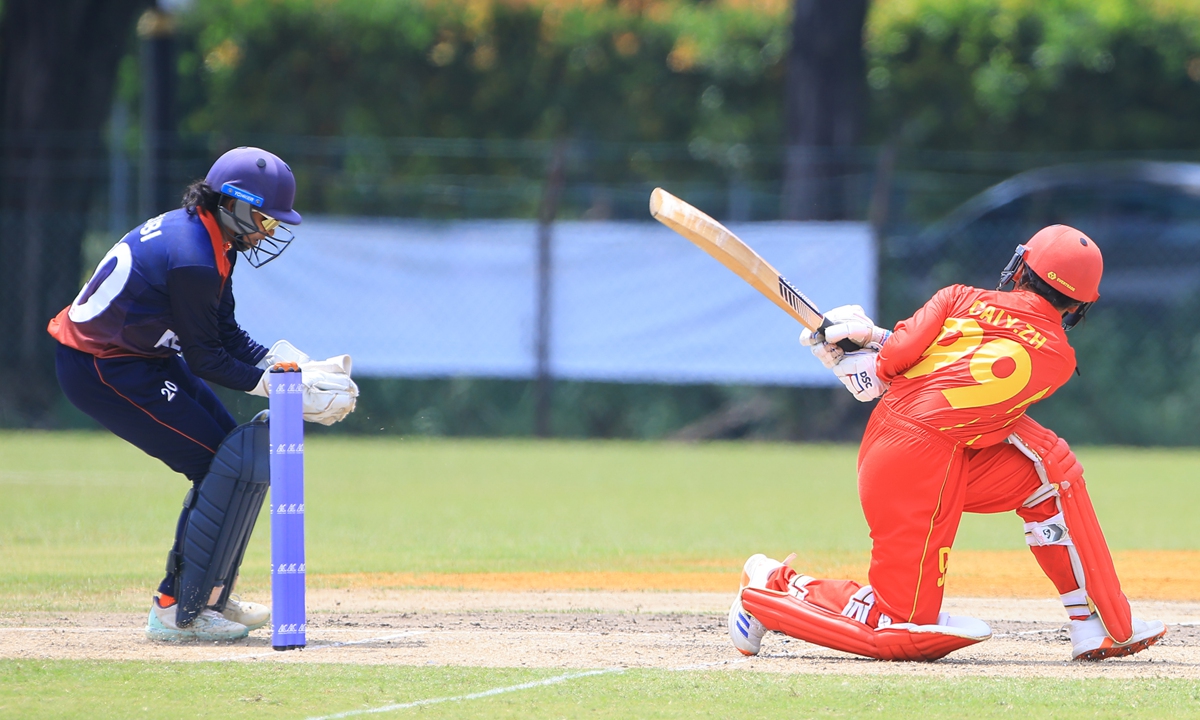
A Chinese cricket player (right) in action during an Asian Games qualifier against Nepal on May 31, 2026 Photo: Courtesy of the Chinese Cricket Association
Cricket has a formidable following across Asia, with particularly deep roots in the Indian subcontinent and Southeast Asia. Now, as the sport prepares to return to the 2028 Olympics in Los Angeles, the International Cricket Council (ICC) sees an opportunity to expand its reach in China.For the ICC, however, the ambition goes beyond attracting Chinese viewers or tapping into a new commercial market. It wants China to become a competitive cricketing nation.
"Our ambition is not just to create an audience or a commercial market for the sport, but to see China become a competitive cricketing nation in the global ecosystem," ICC CEO Sanjog Gupta told the Global Times in an interview.
China's population, regional position and influence in the global sporting landscape make it an important market for cricket's future, Gupta said, noting that he believes the majority of the next 500 million cricket fans can come from China.
The ambition is significant given the cricketing strength of China's neighbor India, one of the world's established cricket powerhouses.
India has a deep-rooted cricket culture and sustained success at the highest level, whereas China is still working to build a wider base of players, fans and competitive opportunities.
Gupta, however, sees China's potential as extending beyond its role as a new audience for the game. The priority is to develop an ecosystem that can produce players and sustain international competition. "We want to see a sustainable cricket ecosystem develop, with participation, performance and visibility reinforcing each other over time," he said.
Positive developments
There have been some positive developments. China's women's team has made progress in recent years, climbing 10 places in the ICC T20I rankings over the past two years, Gupta said.
The Chinese women's cricket team experienced the importance of meaningful international competition. At the 2026 Asian Games, its quarterfinal against Bangladesh was abandoned due to waterlogged ground, with the outcome determined by the teams' world rankings under tournament rules. The Chinese team thus saw its campaign end without taking the field in the knockout match.
Zhu Mingyue, captain of the Chinese women's cricket team at the Asian Games, saw it as a valuable test of their abilities against a strong international opponent.
"It was a real shame that the match could not go ahead, but this is also part of our growth, and we have to accept it. We will return to training hard and look forward to playing against strong teams again in the future," she said in a TV interview.
Gupta also stressed that international opportunities are essential for emerging cricket nations.
"Meaningful international competition is both a milestone and an accelerator for any cricketing nation," he told the Global Times, noting such competition can help unlock institutional support, raise a country's profile, improve performance standards and attract investment.
However, he cautioned against treating international matches as a solution in themselves.
"Meaningful international competition cannot exist in isolation. It must be supported by grassroots participation, coaching resources, infrastructure, talent identification and high-performance pathways," he said.
"These are not competing priorities, nor should they be seen as an either-or choice. China's cricket development needs to be built on a multidimensional strategy."
Olympic opportunity
The growth of the Chinese women's cricket team has made Gupta believe the team has a strong opportunity to gain recognition through ICC competitions and regional and sub-regional multi-sport events.
"China's women's team is already at a level where it can compete in important regional events," he said. He encouraged the Chinese Cricket Association (CCA) to focus on national teams and high-performance programs to help the players secure results on the international stage.
The planned 2027 tour of China by the Marylebone Cricket Club women's team could provide another opportunity.
"An international tour is not just a competitive opportunity. It also brings knowledge exchanges and helps raise local visibility and interest in the sport," he said.
For China, he said, the timing is particularly relevant as the women's team makes progress, facilities develop and cricket receives greater attention within the country's sporting system.
Cricket's return to the Olympics after a 128-year absence is another important factor in the ICC's China strategy.
"Olympic inclusion gives cricket greater relevance within institutional sporting systems," he said. "It can open the door to greater attention, investment, infrastructure and player development."
The ICC is also working with the CCA to push for cricket's inclusion in the 2029 National Games, Gupta revealed. "We have been working with the CCA to push for cricket's inclusion in the National Games in 2029. With cricket being considered for the sports program in Brisbane 2032, we are confident this could become a reality," he said.
The proposal has not yet been confirmed. However, Gupta said inclusion would raise the sport's national profile, encourage more provinces to participate and create incentives for investment in venues, coaching and player development.
Sustainable ecosystem
The ICC has also sought to make cricket more accessible to Chinese audiences by providing Chinese-language broadcasts of the 2026 men's and women's T20 World Cups on local digital platforms, Gupta said.
Meanwhile, the CCA is upgrading facilities in cities including Hangzhou and Taicang and has expressed interest in hosting an ICC Tier 2 event. The ICC and the CCA have also discussed establishing a center of excellence in China, with training programs for coaches, umpires and master educators.
Despite these steps, China still has a considerable gap to bridge with established cricket nations such as neighboring India. Gupta said success over the next five to 10 years would mean embedding cricket more deeply in China's sporting ecosystem, developing a stronger competitive structure and eventually hosting ICC global events.
"Our goal is to see China become a strong competitive force in the global cricket ecosystem," he said.
RELATED ARTICLES