ARTS / CULTURE & LEISURE
Two sections of Beijing’s Mutianyu Great Wall reopen after restoration
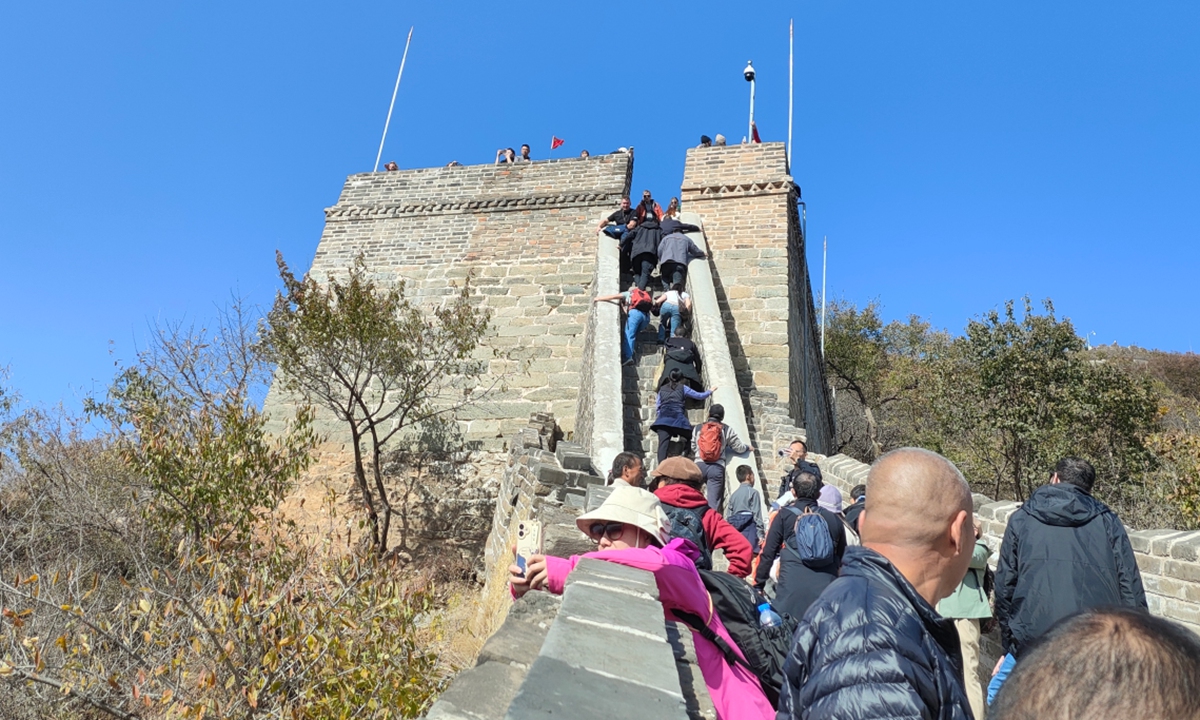
The Hero Platform of the Mutianyu section of the Great Wall in Beijing reopens to the visitors. Photo Courtesy of Cheng Yongmao
Two of the steepest and most structurally complex areas of the Mutianyu section of the Great Wall in Beijing's Huairou district reopened to visitors recently thanks to traditional restoration techniques.The reopening of the "Haohan Slope" and "Hero Platform" marks the completion of the third phase of a restoration project along the Mutianyu section that started in 2022.
Cheng Yongmao, a Huairou district-level intangible cultural heritage inheritor of Great Wall restoration techniques and technical adviser to the project, told the Global Times on Tuesday that the project was implemented in adherence with the principle of "minimum intervention" to ensure maximum authenticity and integrity of the Great Wall.
Traditional restoration techniques were used to repair various structural damage, including bulging sections of the wall and damaged steps, according to Cheng.
When steps are broken or uneven, rainwater seeps through the gaps and penetrates the base and core of the wall. Over time, this softens the structure, causing the wall to gradually bulge and loosen. This is one of the main reasons why sections of the Great Wall repeatedly develop structural problems, Cheng noted.
"Some sections of the wall have bulged outward and become misaligned, but we cannot simply force them back into place," said the 70-year-old engineer. "We first number each individual stone block before dismantling the section. We then remove the waterlogged and crumbling fill material inside, reinforce and secure the hollow foundations beneath, and finally put every stone back in its original position. This allows the wall to regain its structural integrity and properly bear the load."
The project adhered to the principle of reusing original materials wherever possible rather than replacing them, he explained. Intact bricks removed during the dismantling process were prioritized for reuse, while damaged components that had to be replaced were substituted with new bricks made using traditional firing techniques and closely matching the originals in shape and color.
These replacement bricks were concentrated in less conspicuous areas, such as the outer side of the wall, to avoid large-scale patchwork that could detract from the Great Wall's overall historic appearance, said Cheng.
All masonry joints were repointed using traditional pure white lime mortar, with no modern rigid materials such as cement, allowing the restoration work to blend seamlessly into the Great Wall's historic fabric, he added.
More than 1,200 meters of the Mutianyu section's side walls were restored during the three-phase project, the Media Convergence Center of the Huairou district reported on Monday.
The two reopened areas are iconic tourist spots, with the Hero Platform located at Watchtower 20, the highest watchtower along the Mutianyu section of the Great Wall.
Located 70 kilometers away from the center of Beijing, Mutianyu is one of the famous sections of the Great Wall in Beijing and represents the essence of the Ming Dynasty (1368-1644) Great Wall, according to the official Mutianyu Great Wall website.
The restoration of Mutianyu is part of Beijing's efforts to strengthen protection of the Great Wall.
Beijing's first local regulations specifically dedicated to the protection of the Great Wall took effect this March. The regulations said that efforts should be made to strengthen coordinated protection work in the Beijing-Tianjin-Hebei region and within the provincial-level regions and cities along the Great Wall.
The Great Wall, a UNESCO World Heritage Site, stretches more than 20,000 kilometers across 15 provinces, municipalities and autonomous regions in China. Beijing is home to about 520 kilometers of Great Wall sections in total.
RELATED ARTICLES