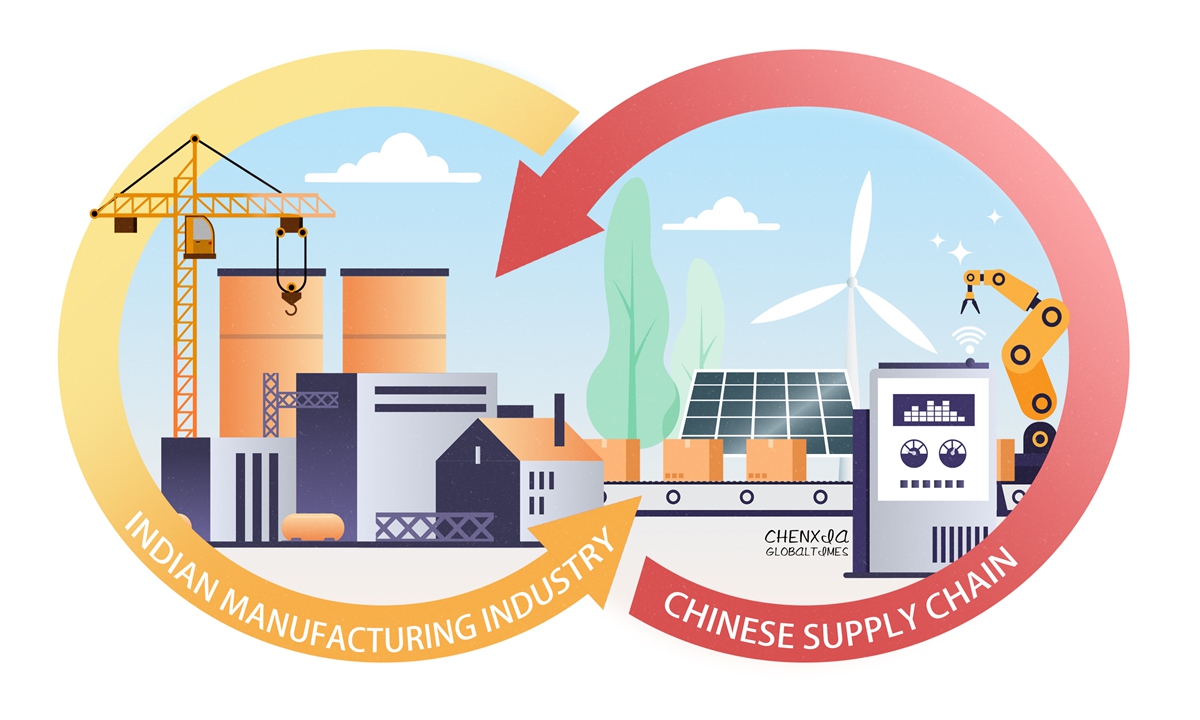
India China Illustration: Chen Xia/Global Times
Can India become a global manufacturing powerhouse while keeping its distance from the world's largest free trade agreement, simply to avoid competition from China? As debate over India's participation in the pact resurfaces, this question is becoming harder to avoid.
Critics of the Regional Comprehensive Economic Partnership (RCEP) in India worry that joining the pact could expose Indian industries to Chinese goods without adequate tariff protection. Yet an interview published by The Indian Express on Monday presented a different perspective. Alan Bollard, former governor of the Reserve Bank of New Zealand, suggested that India should reconsider joining the pact, noting that membership could help the country tap into the supply chains that have made China so competitive.
China is among the members of the RCEP, whose economies account for about 30 percent of global GDP, population and trade. Studies estimate that the agreement could add hundreds of billions of dollars to regional income and create millions of jobs by 2030.
Whether India moves to join the RCEP is ultimately its own decision. But as the country seeks to strengthen its manufacturing base and expand its presence in overseas markets, broadening its network of free trade agreements can bring clear economic benefits.
One such benefit is access to markets. The RCEP brings together dynamic economies in the Asia-Pacific, including China and South Korea, offering exporters easier access to a broad regional market. At a time when rising protectionism is making access to some developed economies more difficult, the pact offers considerable economic value to countries seeking to diversify their export destinations and tap into Asia's growing market opportunities.
Another benefit that is easy to overlook is participation in regional supply chains. Consider a hypothetical example: wool imported from Australia and New Zealand could be processed into fabric in China, then sent to India, where it is made into garments for export to Japan and South Korea. The RCEP could help lower trade costs along this cross-border production chain, making it easier for businesses to organize production across several economies. India's imports of fabric from China would serve as inputs for higher-value garment exports, allowing the country to capture more value through manufacturing and create jobs.
The question is not simply how much India imports from China, but how much it can gain by taking part in regional production networks. This offers a more productive path than remaining outside them.
As technology advances, supply chains in the Asia-Pacific region are becoming more sophisticated, specialized and interconnected. The more efficient these networks become, the higher the cost of remaining outside them. Bollard's remarks offer a useful perspective: part of China's manufacturing competitiveness stems from its effective use of supply chains across Southeast Asia and South Korea. For other economies, participating in these networks can also strengthen their own manufacturing capabilities.
Whether or not India seeks to join the RCEP, the direction of its efforts is likely to be much the same: finding more export opportunities in Asia-Pacific markets and becoming more deeply integrated into the region's production networks, including those linked to China. For a country seeking to expand its manufacturing base and reach more overseas markets, participation in these networks is part of the efforts to build a globally competitive manufacturing sector.
Deeper integration also comes with greater competitive pressure. Greater integration will expose Indian manufacturers to more competition, not only from Chinese products but also from goods made in other RCEP economies. This may create short-term pressure for some industries. But slowing international integration to avoid competition would carry costs of its own. The answer to competitive pressure is not to retreat from regional production networks, but to build stronger capabilities through greater participation in them. Protecting industries from competition cannot substitute for making them more competitive.
India's commitment to developing its manufacturing sector and expanding its global reach is clear. Whether or not it joins the RCEP, closer integration with regional supply chains, including those linked to China, will remain an important part of that journey. The RCEP could offer India a faster route to its destination. The question is whether India is ready to get on board.
RELATED ARTICLES