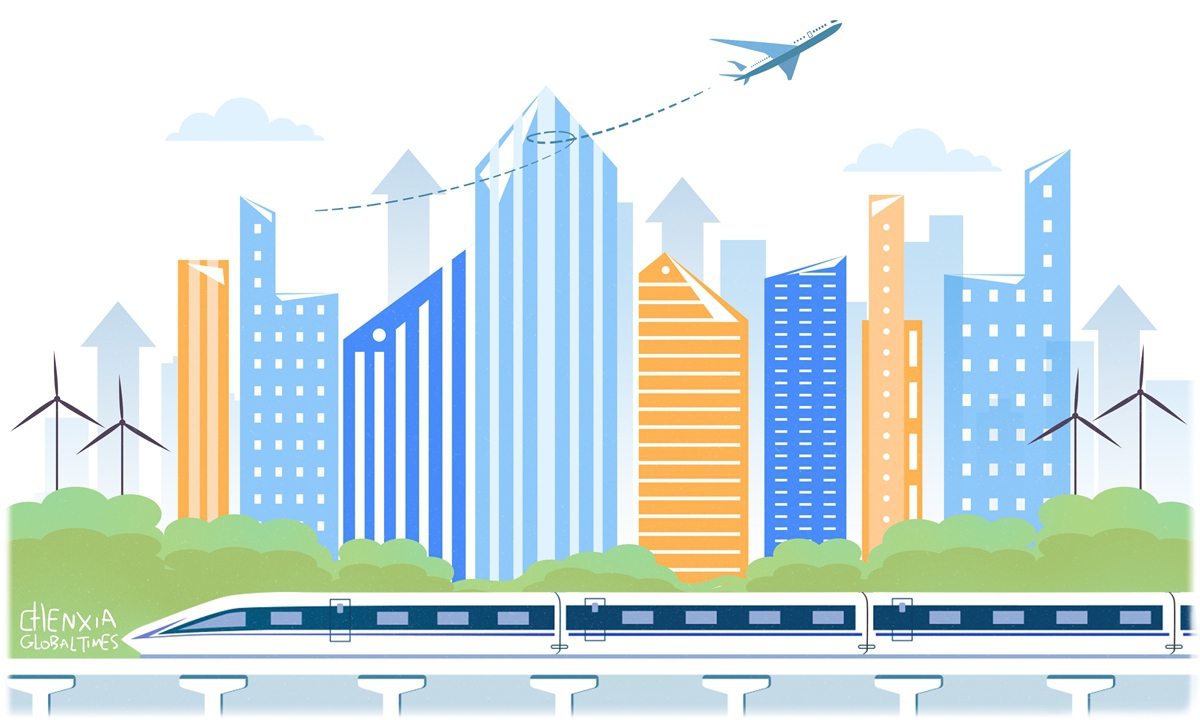
Illustration: Chen Xia/GT
Editor's Note: China's economy is steadily advancing along the path of high-quality development, even as domestic and international circumstances become increasingly complex. Some Western media outlets, whether due to misunderstanding or bias, have repeatedly questioned or even distorted China's economic development. Accordingly, the Global Times is launching the "Q&A on China's Economy" column to present facts and clarify perceptions.
Has China overbuilt its expressways and high-speed rail network? Regarding this question, The Economist, a UK-based magazine, recently published an article headlined "China's investment in transport infrastructure has peaked." It argues that as highways, high-speed rail systems and airports have largely been completed, China's large-scale, high-intensity traditional transport infrastructure investment has peaked, and suggested that long gone are the days when officials would chant the old line, "If you want to get rich, first build roads." This is one of the typical misconceptions circulating in Western discourse.
The conclusion from the article largely borrowed from Europe's postwar experience. After World War II, Europe went through a similar infrastructure boom during its reconstruction and rapid urbanization. From the 1980s and 1990s onward, as networks matured, public investment as a share of GDP fell sharply. Europe later sustained growth through technological progress, consumption upgrading and services, yet overall the shift between old and new drivers was uneven, internal and external strains mounted, and development faced considerable difficulty.
Europe's experience alone, however, cannot summarize every country's path to modernization. Even the US does not fit the narrative. The main construction boom of the US interstate highway system came in the 1950s-1970s and delivered a clear productivity gain, but once the network was largely in place, its incremental contribution to GDP declined. Yet in the 1980s and 1990s, the US found new drivers in a technological revolution. Completing infrastructure and losing growth momentum are therefore not inevitably linked, and what matters is whether an economy can find the new drivers it needs.
China's practice also tells a different story. As of the end of 2025, China's high-speed rail system surpassed 50,000 kilometers for the first time, the expressway network had reached 199,400 kilometers, and the number of certified civil transport airports had risen to 270.
Yet network density by land area remains significantly lower compared with major developed economies. China's railway density is about 1.7 kilometers per 100 square kilometers, below the US (about 2.8 to 3), Japan (about 7.3) and many European countries. China's highway density is likewise lower than US, Japanese and European levels.
The gap is even wider on a per capita basis. With vast territory, complex terrain and uneven population distribution, China still has substantial catch-up needs in the western region, rural areas, connectivity among small and medium-sized cities, intercity commuting and urban renewal.
Under China's plans, the country's total railway operating network is to reach about 180,000 kilometers by 2030, including about 60,000 kilometers of high-speed rail. This means that China's infrastructure is far from having "peaked."
Meanwhile, as the 15th Five-Year Plan (2026-30) continues to be carried out, China's ongoing shift from old to new growth drivers is being manifested in infrastructure construction.
Layouts have moved beyond a single focus on transport networks toward a coordinated "six networks" system. China now has more than 4 million 5G base stations — roughly 60 percent of the global total — and ranks second worldwide in overall computing power. Its new-type power system can already accommodate hundreds of millions of kilowatts of new-energy connections each year.
Meanwhile, the country has established an efficient overarching logistics network, together with comprehensive transportation, forming the foundation for new quality productive forces. Investment in ultra-high-voltage transmission, the "east data, west computing" project, smart warehousing and low-altitude logistics have already reached the trillion-yuan scale. Judging the development of China's entire infrastructure system by using transport investment alone will inevitably produce a partial, one-sided cognitive bias.
The deeper integration of "investing in things" and "investing in people" has also been reshaping where infrastructure investment goes. The same money that once mostly poured into embankments and pavement now increasingly funds intelligent dispatch systems, vehicle-road coordination, and multimodal logistics hubs that unlock the value of stock assets. It flows into skills training, public-service facilities and new-type urbanization, translating into real human-capital accumulation.
Infrastructure has a long depreciation cycle, and network effects keep releasing value as usage scales up. Advancing coordinated regional development, city-cluster integration and a unified national market all contain substantial new investment space. In a broader context, the Asian Development Bank has estimated that developing Asian economies alone need about $1.7 trillion in infrastructure investment per year through 2030 when climate change mitigation and adaption costs are incorporated, while the worldwide financing gap runs into the tens of trillions of dollars.
After projects such as the China-Laos Railway and the Jakarta-Bandung High-Speed Railway entered operation, China's infrastructure know-how, equipment capacity and industry standards have increasingly been recognized as international public goods.
Once China's underlying infrastructure logic is understood, the "peak" narrative collapses of its own weight as this perception is out of touch with today's realities.
European Parliament member Martin Sonneborn, after taking China's high-speed rail last year, remarked that "we're slowly losing touch with reality," a comment that sparked wide discussion on overseas social media. We hope that more friends in Europe would do well to come and see China's fast-changing landscape for themselves, and to rethink what "development" truly means.
Global Times
RELATED ARTICLES