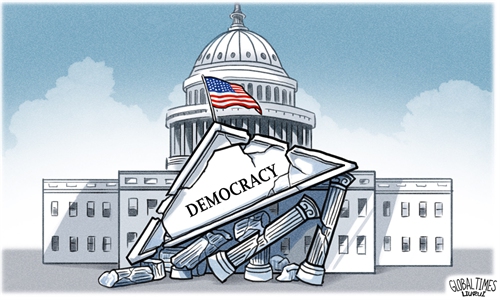
The ‘myth’ of Western-style democracy is losing its appeal even in the West: Global Times editorial
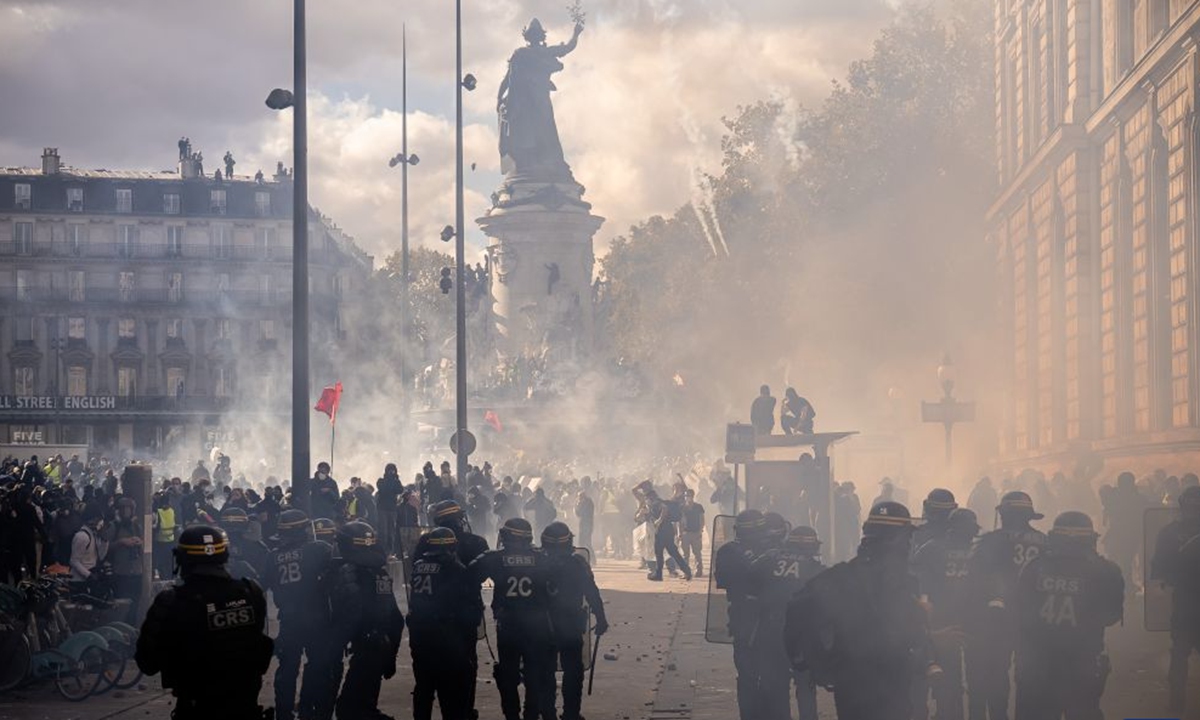
Demonstrators face off with law enforcement officers during a protest in Paris, France, on October 17, 2026. Photo: Xinhua
The most fundamental and significant standard for evaluating whether a democracy is good is whether it can consistently provide the populace with stable livelihoods, clear expectations, and hopeful prospects.
A poll released by the Pew Research Center this year shows that public satisfaction with how democracy works in their own countries is declining dramatically. Dissatisfaction rate stands at 69 percent in France, 68 percent in Spain, 62 percent in Italy, 47 percent in Poland and 69 percent in the US. In fact, sustained tracking by several other prominent Western polling organizations, including Ipsos and Gallup, points to the same trend: Dissatisfaction with the functioning of democracy in Western countries is evolving from isolated discontent into a widespread public sentiment.
This dissatisfaction is not merely reflected in polling figures; it is also visible on the streets across the Western world. Each Western country has its own set of problems. Some are plagued by frequent changes in political leadership, while others remain mired in the challenges of immigrant integration. Some are grappling with the painful effects of the energy transition and the steady decline of traditional industries, while others are struggling to contain increasingly intense social divisions. Yet polling data reveal a common thread running through public sentiment: More and more people no longer believe their governments genuinely represent the interests of ordinary citizens, or that existing political systems are capable of delivering meaningful change.
Calls for fighting corruption, strengthening accountability, making public policies more responsive and ensuring that ordinary people's voices are genuinely heard have become shared demands across party lines and social classes in Western societies.
Many once believed that voting was the entirety of democracy: As long as electoral procedures were followed, the outcome was legitimate and the popular will would naturally find its way into policymaking. But a growing number of people in Western countries are now realizing that voting is more like a periodic ritual. Making a choice once every few years does not guarantee that people will continue to have a say in public affairs in their daily lives between elections.
According to a relevant OECD survey released this year, 68 percent of respondents believe that voting in an election has a significant or moderate influence on what government does, but only 31 percent are confident that people like them have a say in what government does. When people seeking to have their concerns addressed find that their votes often fail to translate into policy responses, their confidence in democracy naturally erodes in the face of reality.
Current discussions among some Western elites about "what has gone wrong with democracy" often veer toward two one-sided explanations: either blaming all the problems on agitation by populists or attributing public dissatisfaction to a "loss of patience" with democracy. Both explanations evade a basic fact: The dissatisfaction with democracy in Western countries does not stem from misunderstanding, but from the failure of existing democratic institutions to respond effectively to public demands and meet societal needs.
Following the end of the Cold War, Western countries experienced a period of relative social stability. At that time, the legitimacy of Western democracy did not derive from the so-called "end of history," but rested on the West's dominant advantages across multiple fields. As globalization accelerated, capital mobility increased, and industrial production was restructured, Western governments found their ability to redistribute wealth increasingly constrained by systemic pressures.
Meanwhile, institutional corruption has increasingly permeated political processes, further exposing the inherent flaws of Western democratic systems.
At its core, the dissatisfaction among Western populations is not a denial of democratic values, but rather a profound disappointment with the practice of democracy in the West. Some political parties in the West are increasingly leaning their policymaking toward capital interests, while the livelihood issues of ordinary people are being set aside. Electoral politics is gradually deteriorating into a power struggle between different elite factions, with partisan conflicts, veto politics, and policy flip-flops becoming the norm. The gap between political promises and reality continues to widen. The discontent from the grassroots is continuously questioning the practical adaptability of Western democratic systems, sowing further uncertainty for the future trajectory of Western politics.
For most countries, the truly beneficial insight from the Western reflection on "what has gone wrong with democracy" is that there has never been a one-size-fits-all institutional form, nor is there a democratic model that can operate independently from its local soil and the genuine needs of its people. If votes are long treated as the entirety of democracy, if party interests are placed above the public good, and if slogans replace actual governance, then no matter how glossy the institutional facade, it will ultimately be discarded amid the repeated disappointments of the populace.
The most fundamental and significant standard for evaluating whether a democracy is good is whether it can consistently provide the populace with stable livelihoods, clear expectations, and hopeful prospects.
Unfortunately, some Western politicians and media continue to use democracy as a political instrument for export, seeking to arbitrarily draw ideological dividing lines, form blocs and provoke ideological confrontation on the international stage.
This approach not only fails to truly respond to the demands of their own citizens but also exacerbates the disconnection between democracy and reality. As a result, the credibility of Western democracy continues to erode under the dual pressures of domestic livelihood crises and external hegemonic actions, ultimately leading to a trust crisis both at home and abroad.
RELATED ARTICLES