Shameful! Philippine spokesman throws a tantrum in comment section of Chinese Embassy
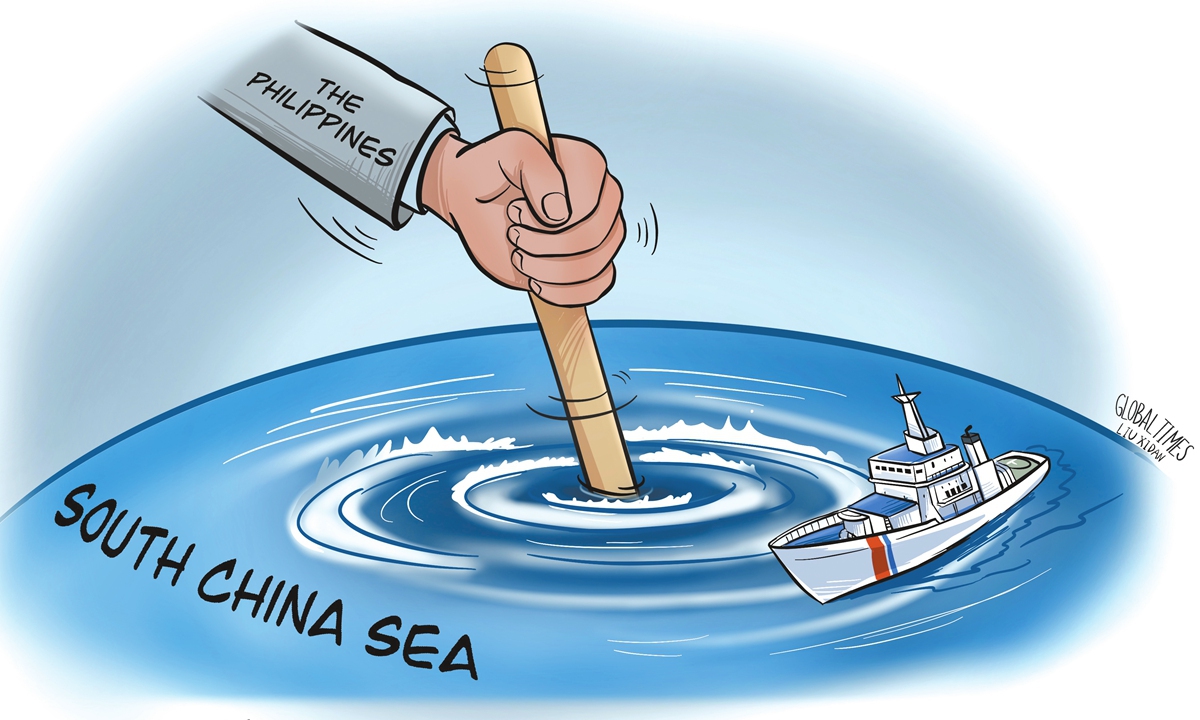
Illustration: Liu Xidan/GT
The Chinese Embassy in the Philippines recently released a statement on overseas social media, calling on all parties to the Middle East conflict to respect each other's sovereignty and territorial integrity. It stressed that sanctions, coercion, military pressure and military strikes offer no solution. Unexpectedly, Jay Tarriela, spokesperson for the Philippine Coast Guard, left a comment reading: "Wowow! Does the Chinese embassy really believe everything that they wrote here?" followed by several shocked emojis.Tarriela's gambit aims to accuse China of "applying double standards" on sovereignty issues. As an official Philippine spokesperson, his conduct stunned netizens. Many users criticized his outburst on the social media page of a foreign embassy in his own country as undignified tantrum behavior unbefitting a public official - little more than attention-seeking stunts fit for an internet influencer.
Many observers noted that the Middle East crisis involves tangled questions of international law, anti-hegemony and humanitarian crises, and China's statement is an objective appeal for broad-based multilateral peace. By forcing a link between the Middle East situation and the South China Sea disputes to jeer at China, Tarriela deliberately muddles concepts and stokes populist sentiment.
In fact, this is far from Tarriela's first round of cyber provocation targeting China's overseas missions. Since January this year, he has repeatedly cherry-picked information on social media, misrepresenting China's humanitarian vessel releases and routine law-enforcement operations in the South China Sea as "China threatening to use force."
When Chinese Ambassador to the Philippines Jing Quan stated at an October event that "we will not use force and we love peace," Tarriela twisted those remarks to claim "China threatened military action against the Philippines." After the 13th ASEAN Defence Ministers' Meeting Plus, he publicly accused China of "belittling ASEAN as a multilateral regional bloc." After China rebutted his claims with clear facts, Tarriela resorted to this outburst in the embassy's comment thread.
It is worth noting that Tarriela's baiting has expanded beyond South China Sea issues into the Philippines' domestic livelihood sphere. The country's tight energy supply and high fuel prices stem from its long-skewed energy mix and volatile external supply chains. Even so, he keeps pinning all the blame on China.
His dramatic outbursts are essentially performances for the Filipino public and the senior officials alike. By creating external confrontation, he seeks to divert attention from the country's real domestic troubles, thereby gaining publicity and political capital.
Tarriela's repeated malicious provocations are not isolated individual actions. In the eyes of some Filipino politicians, even serious diplomatic occasions have become a business. The more tense external relations grow, the more funding and resources they can secure, and the greater the opportunity for certain political figures to expand their influence and voice. Such practices that treat conflict creation as a political achievement and use diplomatic space as a springboard for advancement are essentially hitching the Philippines' national interests and regional security to a chariot driven by personal gain.
No matter how closely Tarriela keeps clinging to China like a piece of gum stuck to the sole of a shoe, China's principles and position will not shift an inch. The more theatrically he carries on, the clearer it becomes to the world just how ridiculous these cheap stunts are.
RELATED ARTICLES