Ability and adaptability: Ancient Chinese wisdom anchors China’s modern governance
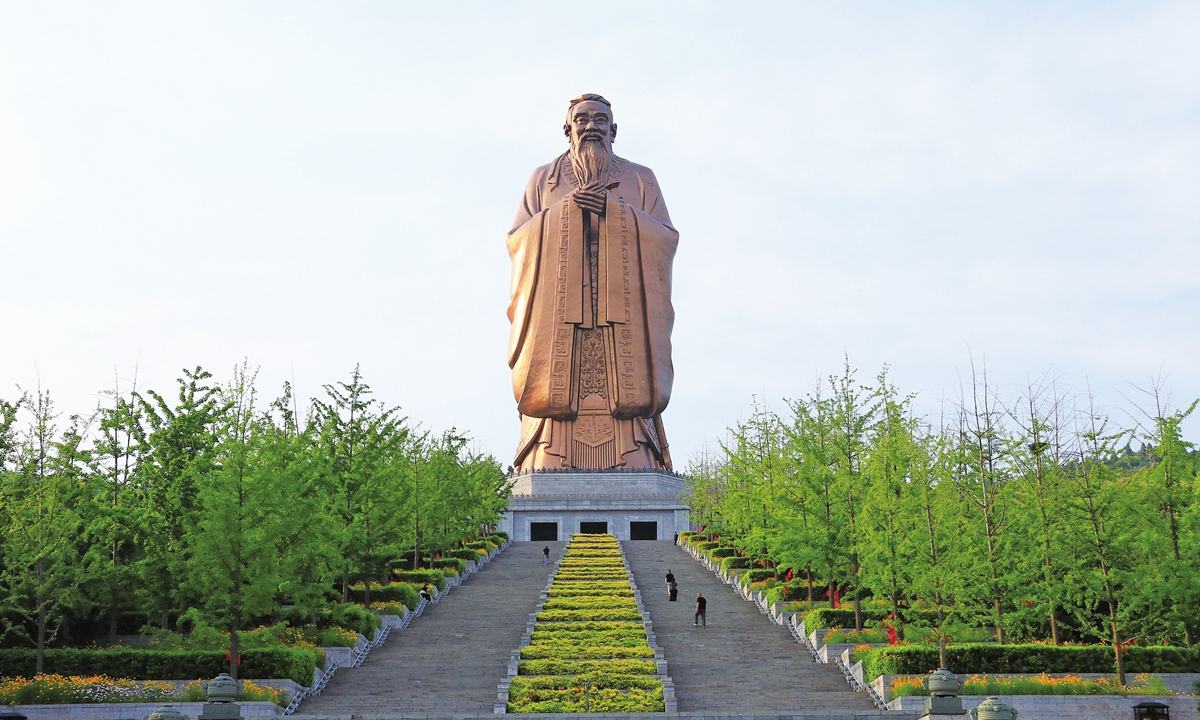
A Confucius statue at Confucius Square, Nishan Sacred Land, Jining, East China's Shandong Province Photo: VCG
Editor's Note:Why should we care what ancient Chinese philosophers thought? Daniel A. BELL, a leading Canadian political theorist at the University of Hong Kong, gave the answers in his new book, Why Ancient Chinese Political Thought Matters. Bell brings Confucius, Mozi and others into contemporary China through imaginative dialogues. The result is a compelling case that these thinkers still speak directly to today's pressing questions - about governance, justice, and the good life. In an interview with Global Times (GT) reporters Wang Wenwen and Xu Jiatong, Bell explains why understanding ancient Chinese political thought is essential for grasping China's present and future.
GT: To answer the question posed by the title of your book in just a few brief sentences, what would you say?
Bell: I think it matters in three senses. The first is that there are debates from the Spring and Autumn and Warring States period (770-221 BC), which are fascinating from the point of view of great political theory. They're as fascinating as debates in ancient Greece between Plato and Aristotle. Second, many of these debates set the terms for political thinking and subsequent Chinese history, whether it's debates between Confucians and Legalists or Taoists or Moists. Much has happened in the last 2,000 years, but many of the recent ideas have been built upon those foundations from this era. And finally, these debates are still highly relevant today. I picked four areas of discussion from the Warring States period (475-221 BC), such as what is just war, how to reduce corruption in government, what is a proper family law, and also to what extent the government should subsidize culture rather than provide for the material well-being of people. These debates were argued about in the Warring States period and are still highly relevant today.
GT: You have long dedicated yourself to the study of comparative political philosophy and Confucian thought. How has ancient Chinese political thought significantly influenced you personally - for instance, your way of life, your perspective on things, and your mindset?
Bell: There are some values in Chinese political thinking, especially Confucianism, that are largely absent from Western political theory. Once I studied them, I realized that these are fascinating ideas and they influence, to a certain extent, the way that I live. I just give two examples. One is the idea of ritual, or li. It's not so prominent in Western political theory. When it comes to solving social conflicts or providing a sense of community or solidarity, the people in the West don't usually think of ritual or li as highly relevant. But in the Confucian setting, they're highly relevant. Now I'm much more accommodating of rituals. When I was about 25, I would kind of think they were empty rituals and just going through the motions. For example, I didn't bother attending a graduation ceremony when I graduated from Oxford, because I thought it was just an empty ritual, but now I realize those rituals are so important to generate a sense of community and harmony among people. My learning about the importance of ritual in Confucianism changed my outlook.
Another example would be the value of harmony, or he. Again, it's not really essential to Western political thinking. And when I was younger, I would always try to pursue truth regardless of how it would affect the social relation of the person that I was engaged in the argument with. But now I would think first and foremost I want to maintain a kind of relatively harmonious relation. And then within that context, we can trust each other more, and then we can have useful and productive arguments and disagreements without poisoning the whole social relation. It's kind of obvious in retrospect, but had I not studied the value of he and Confucianism, I wouldn't necessarily have thought that way.
GT: You wrote in the book, "Political theory in the Anglophone world is still too West-centric. [T]here's this image in much of the world of China as a kind of monolithic political entity where political elites all think and act alike, and I wanted to counter this stereotype." What do you hope Western readers will take away from your book?
Bell: Those who study political theory, including me, didn't really think there was serious or good political thinking outside Western debates. We used to say it's Plato to NATO. But then I realized there were fascinating debates in China. That is at least as interesting as what we had learned in the West. And that's really not so well known. So I just wanted to let readers in the Anglophone world know that China has these debates in political theory on issues like international relations, as they engage with realist and idealist traditions that are often traced back to ancient Greece.
The other view in the West is a kind of stereotype that Chinese political thinking is all about just blindly following the leader or just the government. But actually, China has really diverse debates. So I wanted to let the Western readers know that China has not just great debates, but also very diverse and sometimes very opposing and conflicting perspectives.
GT: What are the benefits for Western nations to move beyond the democracy-versus-autocracy dichotomy and gain a deep, accurate understanding of the diversity and richness of Chinese history, culture, and political thought?
Bell: In the West, there's this view that there are two kinds of political systems. One is democracy, meaning that the leaders are elected by means of "one person, one vote" and the other is authoritarian or autocracy, where they're not electoral democracies. Some people in the West don't differentiate between military dictatorships or family-run monarchies and the kind of China-style political meritocracy, in which becoming a senior public official requires a very difficult and lengthy process. If you want to understand China, you have to move beyond this dichotomy. No political system is perfect, but we first have to understand the ideals that inspire the political system before labeling it.
GT: In your view, is traditional Chinese political wisdom the key to China's current political system?
Bell: The traditional ideas have great influence on the current Chinese political model. For example, the idea of xian neng zheng zhi (political meritocracy) still highly influences how public officials are selected in China today. Theoretically, it's by means of a political meritocratic selection process that is meant to select public officials with above-average ability and virtue. And that's a very old idea that you had not just in Confucianism, but also in Moism as well. There are always changes throughout Chinese history. If we want to understand the Chinese political system, we have to understand its foundation. But it is not just about ability; it's also about adaptability. Maybe the idea of xian neng zheng zhi hasn't changed much. But as a practice or as an institution, there have been tremendous changes. Whenever there was a serious problem with the practice, there was a kind of new way of thinking about institutionalizing this particular political meritocracy. If we look at Chinese history, in some periods, public officials were selected because of their commitment to values like filial piety; then in a later period, because of success in the examination. In the past 30 or 40 years, officials succeeded in promoting economic growth and reducing poverty. But now many other issues, such as environmental sustainability and scientific innovation, matter. These ideas are not just abilities, but adaptability, which I think is also key to the current Chinese political system.
RELATED ARTICLES