CPC’s ‘people-oriented’ philosophy delivers concrete results across all governance sectors
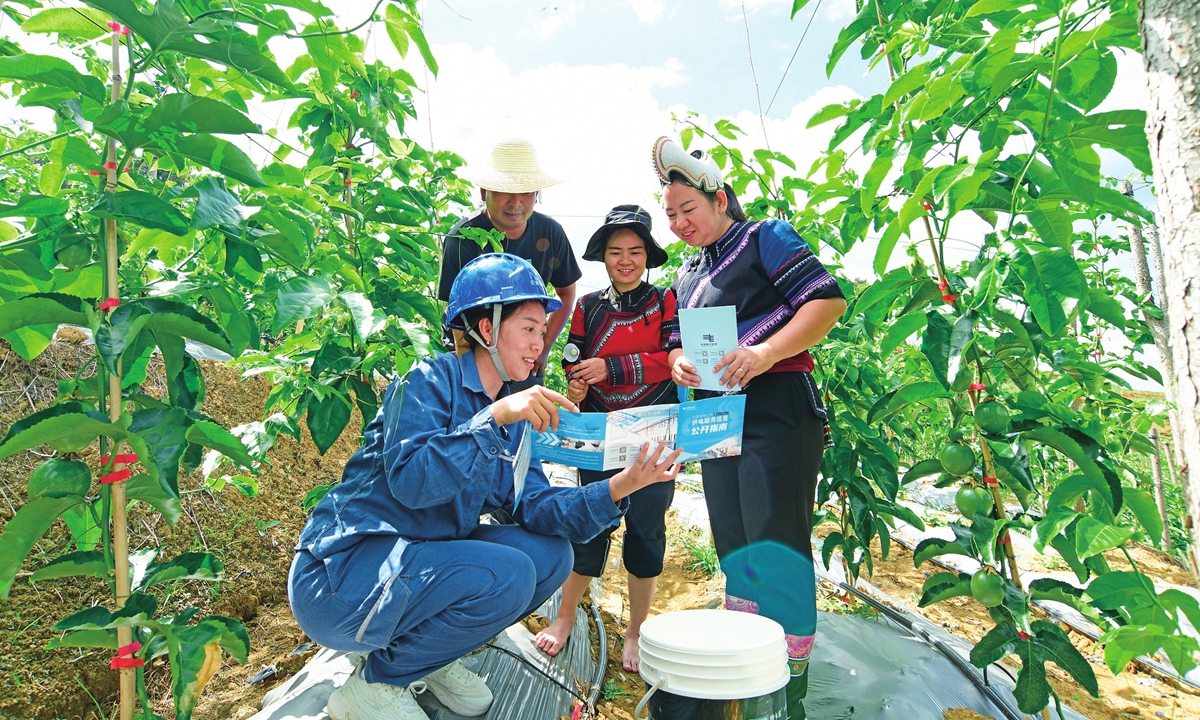
A Party official of Honghe County Power Supply Bureau shares electricity safety tips with local residents at a passion fruit farm in Honghe Hani and Yi Autonomous Prefecture, Southwest China's Yunnan Province, on June 2, 2026. Photo: VCG
Editor's Note:This year marks the 105th anniversary of the founding of the Communist Party of China (CPC). Over the past century and more, the CPC has carried forward its revolutionary traditions while forging new achievements in response to the demands of each era. Anchored in its enduring mission to serve the people, the Party has demonstrated a remarkable capacity for self-reform, an indomitable fighting spirit and an open, adaptive mindset that enables it to navigate changes and steer the nation forward.
On this significant occasion, the Global Times (GT) presents this special series of interviews with international scholars. Through their diverse lenses, we invite global observers to contemplate the journey of this century-old Party - its enduring historical legacy, governance logic and its dynamically evolving role in an ever-changing world.
In the first installment of the series, GT reporter Li Aixin talked to Josef Gregory Mahoney (Mahoney), who is a professor of politics and international relations at East China Normal University in Shanghai and a senior research fellow with the Institute for the Development of Socialism with Chinese Characteristics at Southeast University in Nanjing. In his analysis, the "people-oriented" principle of the CPC has led to tangible actions across all fields of governance.
GT: In your view, what is the core characteristic of the CPC?
Mahoney: The people-oriented nature of the CPC represents one of the most fundamental and consistently emphasized principles in its theoretical system and political practice. Rooted in Marxist historical materialism, refined across successive generations of leadership and woven together with the CPC's century-long revolutionary practices and China's time-honored traditional people-centric wisdom, this concept stands as both the ideological cornerstone underpinning the Party's governance and guiding its policy direction, as well as the defining feature that sets the CPC apart from all other political parties worldwide.
GT: Why are the CPC's goals and the fundamental interests of the people considered highly consistent?
Mahoney: The CPC's people-oriented nature originates from classical Marxist theory, particularly the concept that the masses are the creators of history. Marx and Engels argued that the working class must emancipate itself through its own efforts, establishing the theoretical premise that political parties must serve rather than dominate the populace. This orientation was the original and unchanging mission of the CPC since its founding in 1921, seeking happiness for the Chinese people and the rejuvenation of the Chinese nation. During the revolutionary era, (Chairman) Mao Zedong elucidated the principle "serve the people," coupled with the mass line "from the people, to the people."
These values remain sacrosanct, with the "people's interests" being accorded "absolute supremacy." Meanwhile, Chinese President Xi Jinping has clearly stated that his governance philosophy can be summed up as "serving the people, and assuming the responsibilities that I ought to shoulder," and he has emphasized on multiple occasions that "the most fundamental interests of the country are the people's happy life."
In fact, the Chinese leader has often emphasized the Party's people-oriented nature and the necessity of putting people first as both a theoretical doctrine and a political practice. He has stated, "Our people are the country's solid foundation and our main source of confidence to govern." At the first press conference after the 18th CPC National Congress, speaking for the CPC Central Committee, he said, "To meet their desire for a happy life is our mission." At the 19th CPC National Congress, he affirmed that "The original aspiration and mission of Chinese Communists are seeking happiness for the Chinese people and rejuvenation for the Chinese nation." Another well-known quote emphasizes that this principle has always been a mainstay of the CPC: "To lead the Chinese people in their pursuit of a better life is an unswerving goal of the Communist Party of China."
GT: How is this people-oriented philosophy concretely reflected in the Party's governance practices?
Mahoney: This doctrine has led to tangible actions across all fields of governance. It serves as the basic value orientation, starting point, ultimate goal and measurement standard for China's modernization path. Well-known and historically unequaled outcomes exemplifying this doctrine include the landmark poverty alleviation campaign that lifted hundreds of millions of people out of extreme poverty.
In fact, the CPC's achievements have won widespread public recognition, support and appreciation from the Chinese people. In the words of the Chinese leader: "The Party has won the people's wholehearted support because it has always served the people with heart and soul and striven for the well-being of all ethnic groups."
GT: Could you share a few examples that have left a deep impression on you, showing how the CPC has always put the people first in its governance?
Mahoney: One of the most famous examples is the "Story of Half a Quilt," which occurred during the Long March (1934-36). When the Red Army passed through Shazhou village in Hunan Province, three female soldiers shared their only quilt with a poor local villager named Xu Jiexiu, who had nothing. Before leaving, they cut the quilt and gave half to her. If you've stood before the Long March relics at Beijing's Military Museum of the Chinese People's Revolution - the woven grass sandals, the half-eaten belt consumed during starvation in Sichuan and the patched blanket shared by Dong Zhentang, Zhu De and Zhou Enlai - you walk away with a visceral sense of the suffering the CPC endured, and how that suffering fused their fate with the very people they sought to free. Thus, the "Story of Half a Quilt" continues to resonate with the people, and tells how the CPC would even cut half of its only quilt to share with ordinary people.
Another famous story related to Zhang Side, a Red Army soldier who dedicated his life to serving the people, and died while saving a comrade when a charcoal kiln collapsed in Yan'an in 1944. His example inspired Mao deeply, and he attended the memorial service and delivered his famous "Serve the People" speech. Subsequently, "serving the people wholeheartedly" was formally written into the Party's Constitution.
In 2013, China put forward the concept of "targeted poverty alleviation" in the once remote, impoverished Miao ethnic village, Shibadong. By 2022, the per capita income of local residents had surged from 1,688 yuan ($249) in 2013 to 23,505 yuan, and the village's collective economy grew from zero to 3.8 million yuan, with industries including rural tourism, mineral water production and Miao embroidery thriving. This model has been studied by political parties from Laos, Spain, Namibia and other countries for their own poverty reduction work.
Finally, let's recall the flood rescue operation in 2025. When extreme rainfall triggered severe floods in eastern, northern and northeastern China, more than 2,000 officers and soldiers were dispatched to assist with disaster relief operations, evacuating more than 4,100 residents and delivering over 3,000 boxes of relief supplies. The Chinese leader gave instructions and called for all-out search and rescue of the missing and trapped, and immediate relocation of those in danger to help minimize casualties.
RELATED ARTICLES