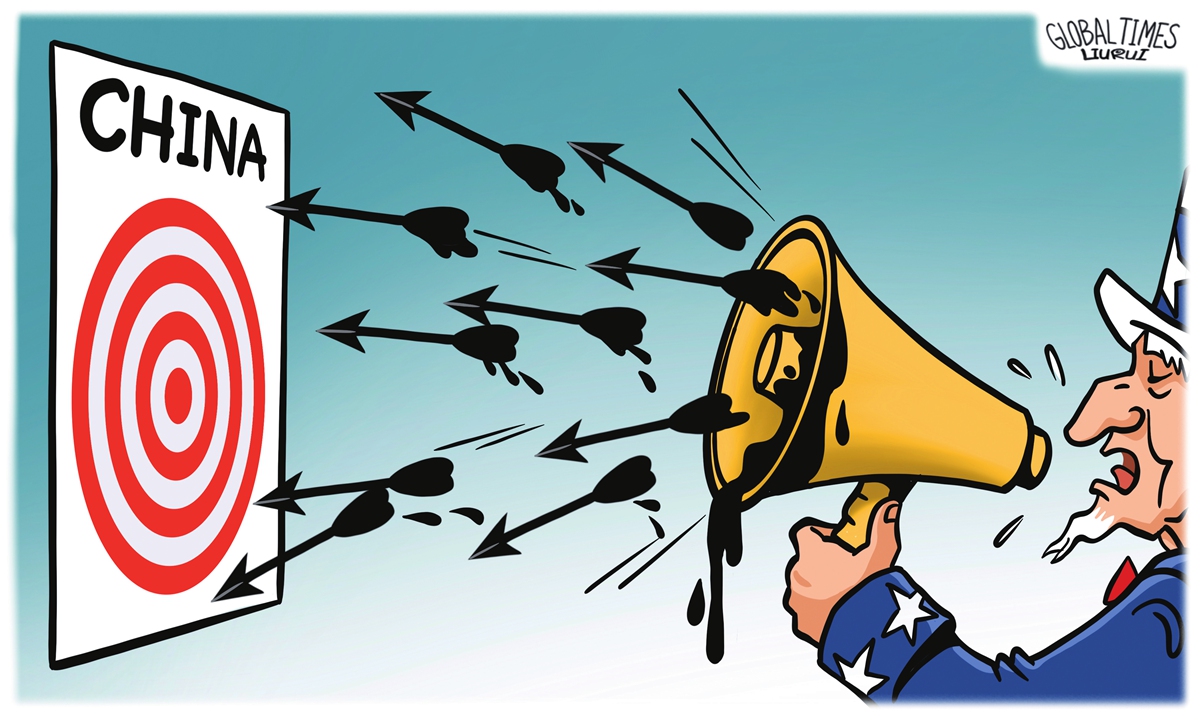
The hopeless fault-finder. Illustration: Liu Rui/GT
Western media and frequently quoted "experts" often love to ridicule or ignore Chinese political concepts and the Chinese self-perception. Instead of using China's official terms, such as socialism with Chinese characteristics, socialist market economy or whole-process people's democracy, they prefer to label China "state capitalist," or "fractured authoritarian." There are two possible reasons for this: One is to prevent their own people from asking questions in the West, and the other is to attempt to destabilize China.The first reason is obvious: If Western people became aware that other political systems, like China's, not only achieve outstanding economic results but also manage to foster much higher levels of trust and happiness among the population, they would instantly increase pressure for reform of their political systems. Whether it's the US two-party system, which features two utterly corrupt sides of the same coin financed by the same oligarch, making billionaires rich while leaving the masses near the "kill line" and the government impoverished and unable to spend money on anything other than war, or an ineffective, chaotic EU with dubious democratic legitimacy that acts in the interest of the US and big corporations rather than the European citizens, Western voters are waking up to the fact that their votes have little to no impact on where their countries are headed. In such a situation, the mere suggestion that democracy could mean something other than a voting ritual every four years becomes revolutionary and threatens the status quo.
But eventually, reality always wins against narratives. Western media and social media channels may continue to smear China and label it a "dictatorship," but this comes at a very big risk for the West: People are noticing the superior technology, infrastructure and speed of progress in China, regardless of how Western media describe its political system. The more Western countries continue to decline, the louder the calls will grow from Western voices wanting to emulate China's form of governance in order to become successful.
China's success is due to its whole-process people's democracy, which integrates the views of all parts of society, balances the needs of the weak and voiceless minorities with the urgent needs and hopes of the large majority, and allows everyone to make suggestions that can be heard by the National People's Congress. China incorporates views from experts in all fields and various political outlooks. It evaluates all suggestions from a scientific perspective, objectively, with the shared goal of improving the country. This is what the West should learn but cannot, unless Western media and experts start to ask: How does China really do this?
On the other hand, if the intention was to destabilize China by using derogatory language and juxtaposing it with positive narratives about the West, then that ship has long sailed. In the 1980s, many Chinese people were unaware of the world outside China. They weren't accustomed to the level of propaganda in Western narratives, and they had no means to see the West for themselves. One could tell them stories about a land of milk and honey because nobody knew any better.
Nowadays, not only can people see on social media how Western countries are doing in recent years, but they can also read about social strive and the widespread dissatisfaction of people with their governments. Moreover, more and more Chinese citizens have the means to travel abroad. By the millions, they visit Paris, London, New York, and Berlin, among others, witnessing the dilapidation of infrastructure, poverty and social decay. Once people see these things for themselves, no amount of media spin can convince them that Western systems are better at providing decent lives for their people.
Misreading, smearing and deliberately ignoring China's self-image and the debates within China about its continued political and social reforms is not a danger to China; it's a threat to the West itself.
The author is the founder of Buchmann CultureTech (Shanghai) Co. Ltd. opinion@globaltimes.com.cn
RELATED ARTICLES