From unattended packages to thriving nightlife activities, is the West ready to learn from China’s model of trust?
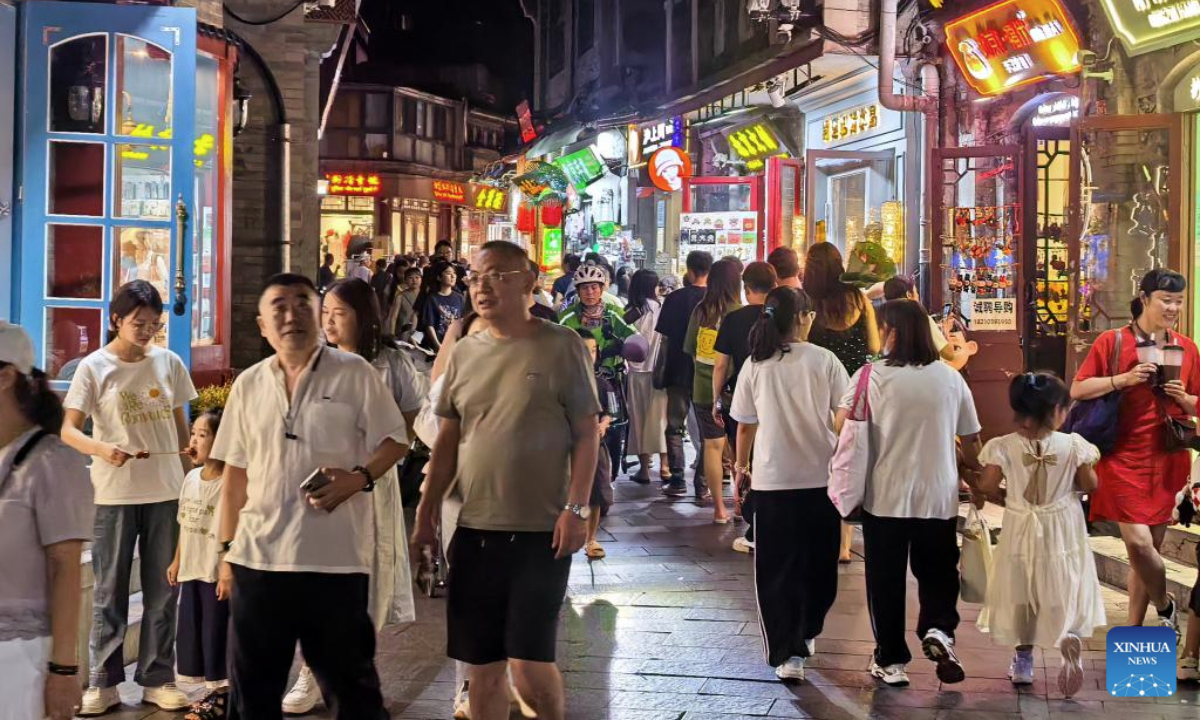
People walk at a pedestrian street near Shichahai scenic area in Beijing, capital of China, July 30, 2025. Beijing has vigorously developed its night economy since the beginning of this summer, featuring local cuisine, outdoor films, music festivals, and night markets. Photo:Xinhua
As a Portuguese citizen who moved to Beijing this year, some of the most striking sights for me - alongside the Summer Palace, the Forbidden City or the Great Wall - have been shelves of packages and rows of food delivery bags. Simple cardboard boxes and sacks with barcodes left unattended outside places closed to traffic, such as university campuses, pedestrian quarters and offices. At lunch time or after work, people here simply leave their classes and workplaces, to find their package or bag and take it away without touching what is not theirs.
At my local coffee shop or library, fellow customers and readers make it a habit to leave their laptops and other important items at their table while they go for lunch, in order to secure their seat in their absence. Where I have lived, they would be lucky to keep their belongings, much less their seat. At night, parks are filled with dancing senior citizens, young people playing sports, and pedestrian streets filled with families late into the night.
Back home in Portugal, as well as in Italy, where I have also lived, just in the past three years, I have witnessed several thefts of personal property and been the victim of bicycle theft myself. In addition, illicit drug dealers and visibly intoxicated individuals are a common sight back home, whereas here they are functionally non-existent. It is worth spending quite some time reflecting on how our societies, on opposite ends of Eurasia, have evolved so differently, perhaps to draw lessons from the Chinese development experience. There is no monofactorial explanation for this development, as there can hardly be in questions of social governance.
The topic of my undergraduate thesis in Comparative Law was precisely China's proactive approach to resolving social conflicts under the heading of "The Fengqiao Experience", which can succinctly be explained as resolving local issues when they are small and preventing them from festering into generalized social disruption and crime. Part of this approach has been the deployment of alternate resolution mechanisms such as "people's mediation", thus seeking to resolve conflicts by agreement and compromise, rather than judicial conflict. The aforementioned data points contrast with the Western prejudice that China has only achieved generalized social peace with a heavy hand. China has become safer and less prosecutorial at the same time.
Thus, it can be said that China has shown itself to be smart on crime, taking a holistic approach to social governance while cutting at the roots of social dysfunction. This has clearly produced positive outcomes.
In addition to the aforementioned decrease in violent crimes, China now ranks among Nordic nations in interpersonal trust, with 63 percent of adults stating that "most people can be trusted," according to World Values Survey and European Values Study research. In terms of perception of safety, the Chinese mainland ranks even above Hong Kong and the region of Taiwan. Thus, it becomes evident that many explanations quickly offered up by some Western commentators fail to get to the core of the matter or miss key factors.
Finally, and perhaps most importantly, Chinese governance has emphasized the actual delivery of material wealth to its population, in its quest to basically realize socialist modernization from 2020 through 2035 and build China into a great modern socialist country in all respects by the middle of this century. By 2021, China had managed to provide its citizens with the assurances of adequate food and clothing and guarantees of access to compulsory education, basic medical services and safe housing for impoverished rural residents. In the West, homelessness and deep poverty are seen as inevitable facts of life or even appropriate punishments for sloth and other vices, rather than as social problems that can realistically be eliminated. Desperate poverty breeds desperate individuals and communities and ultimately fosters a reified culture of crime as a way of life, a social vortex of bad incentives.
Perceived social dysfunction affects all our lives, from the most important decisions - where to live, where to study, where to spend moments of leisure - down to the most basic of our day-to-day choices - what mode of transport we take or even which pocket we put our wallet in. Societies that actively tackle all sources of such dysfunction are bound to prosper, whereas those that do not are forced to cope with the aftermath of the collapse of social trust. Given these divergent civilizational paths we have embarked on, the level of culture shock as regards social trust and public safety experienced by Western visitors to China, as well as many from the Global South, is only bound to grow.
The author is a comparative legal jurist currently studying Chinese at Beijing Language and Culture University. opinion@globaltimes.com.cn
RELATED ARTICLES