What are Western Gen Z seeking behind viral ‘Chinamaxxing’ trend? : Global Times editorial
Listen
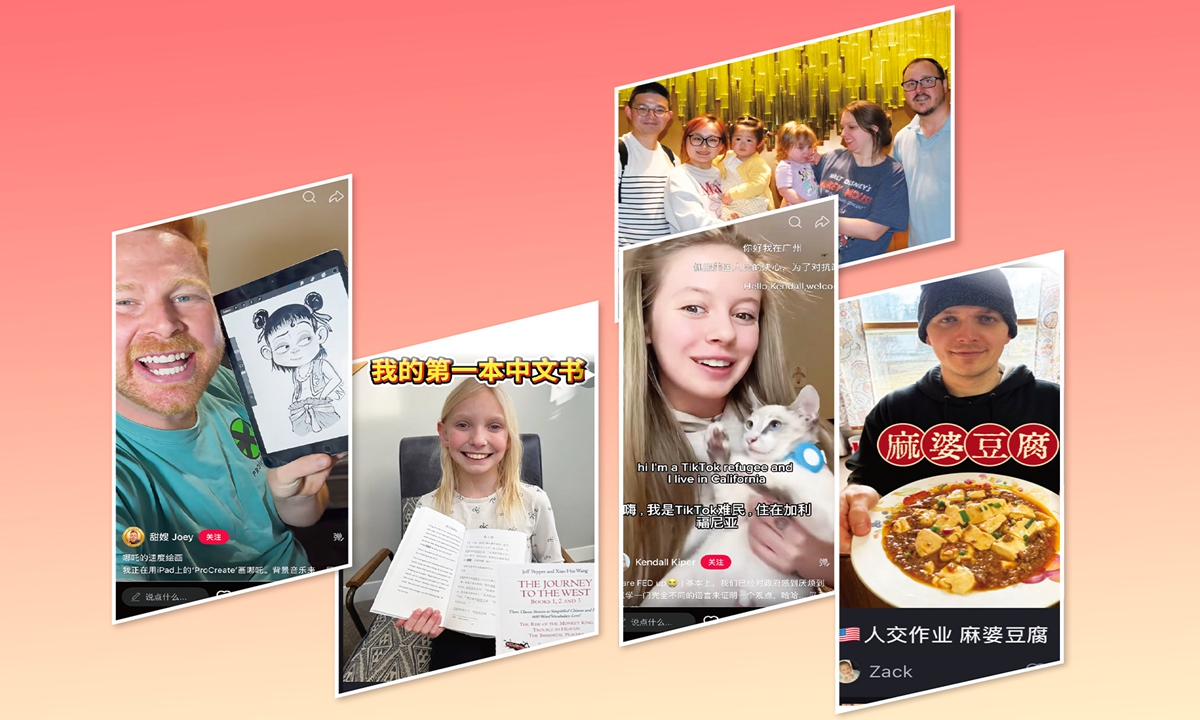
Screenshots of different American netizens sharing their life moments on Xiaohongshu, a Chinese social media platform
Recently, the term "Chinamaxxing" has exploded across overseas social media. The newly coined phrase - combining "China" with "maxxing" (derived from a gaming slang meaning maximizing or taking something to the extreme) - has become the latest trend pursued by foreign netizens, especially young people. From "very Chinese" at the start of last year, to "becoming Chinese" by the year's end, and now to "Chinamaxxing," this wave of "China fever" spreading overseas - particularly among Western Gen Z - has only grown stronger. Even conservative outlets such as the New York Post have had to admit: "America is out. China, of all things, is in."
Why China? Many traditional Western media commentators seem puzzled. Among the various attempts to explain the phenomenon, the most common argument is to blame it on "America's failure." The New York Post article suggests that "it's about Gen Z's desperation to shed their American identity." Somewhat resentfully, the article even claims that this "ludicrous" trend may appear "perfectly innocent" but that many of its followers have already aesthetically, morally and politically "defected." Meanwhile, the well-known US magazine Wired attributes the trend to the "decay of the American dream," arguing that it has paved the way for a "Chinese century." An article by the Australian Broadcasting Corporation contends that amid the current context of China-US rivalry, more and more people are betting that China will emerge "as the winner."
These discussions capture some new dynamics, yet they have not fully broken free from the ruts of ideology and geopolitics. Why is it taken as perfectly natural when South Korea's K-pop or Japan's One Piece becomes popular in the West, but it can't be accepted when cultural symbols with Chinese elements gain traction? In fact, there were times in the past when certain Chinese cultural elements reached Western audiences after being packaged as Japanese or Korean culture. Today, the global rise of Chinese culture, with its deep historical roots, is due in part to the West's still insufficient understanding of China.
The popularity of cultural memes such as "drinking hot water" rests on at least four hard-core foundations of China's social development. First, safety: The latest 2025 Global Safety Report released by the well-known US polling firm Gallup shows that Chinese residents rank third worldwide in their sense of safety, far ahead of all Western major powers. Second, infrastructure convenience: The extensive, well-connected high-speed rail network leaves a strong impression. Third, ease of daily life: Technological innovation is widely applied in everyday living. Fourth, overall governance capacity: Many foreigners are surprised by the efficiency and user-friendliness of local government service systems.
For a long time, Western publics tended to understand China mainly through political issues, economic statistics, or ideological debates. As people-to-people exchanges, digital platforms, and modes of content distribution have evolved, China has come to be seen in a more everyday, authentic way. In particular, younger people who grew up in the era of globalization take a more independent view of foreign things. When ordinary Westerners encounter the everyday reality of Chinese social life, it is inevitable that it will gain traction on social platforms popular with younger audiences.
These tangible realities undermine the so-called public opinion "iron curtain" manufactured by Western elites. As American journalist Taylor Lorenz recently noted in an interview, the US public is often told that things like trains would "make country not thrive." When they discover that these supposedly "impossible" ideas are in fact operating smoothly in China, seeds of seeking truth begin to take root. Rather than asking "why China?" some in the West would do better to set aside entrenched ideological prejudices, engage with China's development, and try to understand the values of its younger generation; otherwise they risk stagnation and being left behind.
Whether it's "becoming Chinese" or "Chinamaxxing," these trends aren't exclusionary as they are expressions of cultural blending. Many overseas creators who imitate Chinese lifestyles also weave elements of their own cultures into their content - often with a humorous, playful, cross-cultural experimental bent. Chinese American comedian Jimmy O. Yang, for example, mixes US streetwear with a Chinese tang jacket and talks about combining tai chi with gym aerobics, drawing wide attention. Other examples include an American vlogger serving Chinese congee in an American-style coffee cup and a British blogger adding goji berries to traditional English afternoon tea - different cultural elements collide and spark delightful, highly shareable moments.
The growing "China fever" shows that Gen Z abroad are, in their own way, reaching for a real, vibrant, warm image of China, freely selecting fragments of life and cultural symbols they like within a multicultural context. When prejudice is broken and misunderstandings cleared up, those everyday Chinese cultural elements and life scenes that showcase China's dynamic development naturally cross oceans and resonate with people. This is the key to the vigorous vitality of Chinese culture in the new era, and the kind of civilizational exchange and dialogue we should aspire to.
RELATED ARTICLES