China expresses ‘serious concern’ over UK's unfounded ‘cyber challenge’ claims regarding Chinese AI; politicizing tech competition harms global AI governance: expert
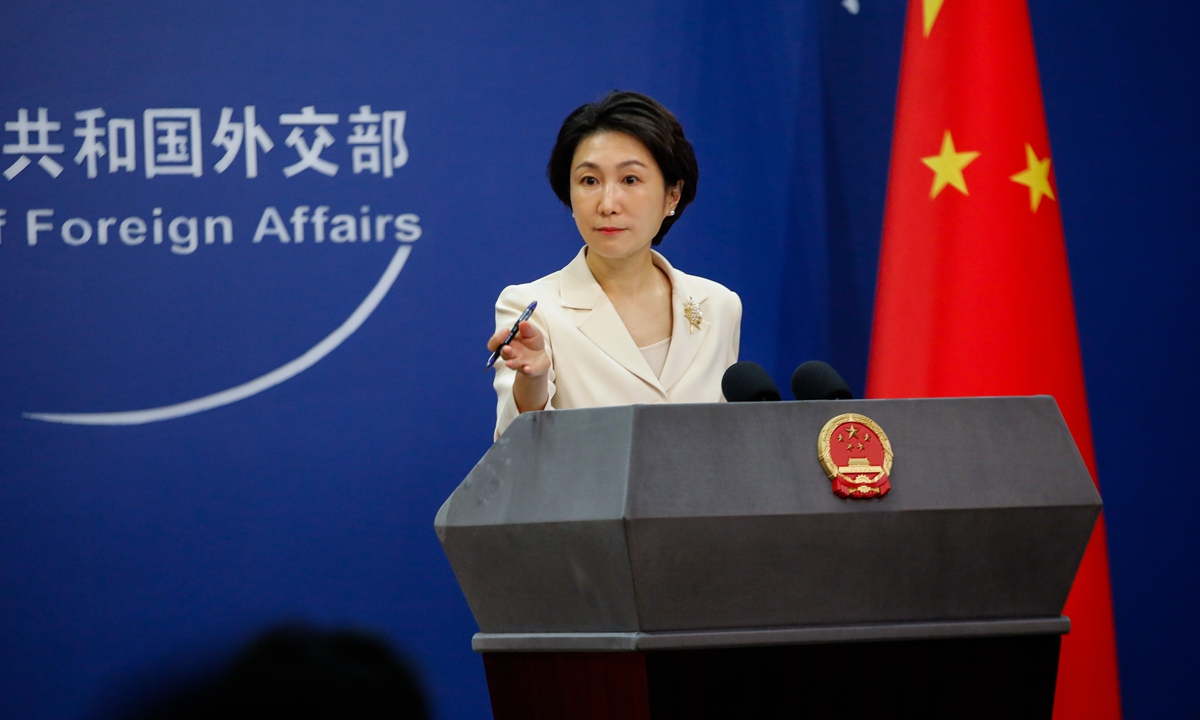
Chinese foreign ministry spokesperson Mao Ning
China expresses grave concern over the UK's speculative accusations against China despite the absence of evidence, Chinese Foreign Ministry spokesperson Mao Ning said on Wednesday, warning that such actions hurt the UK's credibility when it comes to cooperation on global AI security governance.
At a regular press briefing, Mao was asked to comment on reports that Britain's National Cyber Security Centre, part of the Government Communications Headquarters, had claimed that China is a leading developer of AI-cyber capability and that by 2028, it is "highly likely" that China will routinely use AI-cyber to carry out hacking activities, representing the "most sophisticated and sustained" cyber challenge facing the UK.
"We noted the relevant reports. China expresses grave concern over the wanton speculative accusation brought by the UK despite the absence of evidence," Mao said.
"Regrettably, the UK, having long politicized the cybersecurity issue, is now rehashing hacking allegations as a pretext to curb China's AI development," Mao said.
This type of action is not helpful for increasing mutual trust between China and the UK, and hurts the UK's credibility when it comes to cooperation on global AI security governance, Mao said.
AI-generated cybersecurity risks are a global challenge and require new rules formulated at the UN to form a global response, Mao said.
"China believes that the development of AI should be open and for progress, for good and for all, aim at both security and advancement, and ensure it is safe, reliable and controllable," the spokesperson said.
The UK's attempt to link China's rapid AI development with alleged cybersecurity threats reflects a tendency to politicize technological competition, which risks undermining international cooperation in addressing common security challenges, Hu Qimu, a professor at the Maritime Silk Road Institute of Huaqiao University, told the Global Times on Wednesday, noting that AI-related cybersecurity risks are a global challenge and should not be used as a pretext to target the technological development of any particular country.
"China's growing capabilities in AI, particularly its expanding open-source ecosystem, have created new opportunities for international technological cooperation," Hu said. Attempts to frame China's technological advances primarily as security threats could deepen mistrust and make it harder for countries to develop common rules for the safe development and application of AI, the expert said.
China has continued to promote international cooperation on AI governance. In July 2025, the Global AI Governance Action Plan was released at the World Artificial Intelligence Conference and High-Level Meeting on Global AI Governance. The plan called for stronger international scientific and technological cooperation, enhanced policy and regulatory coordination, and greater support for developing countries in strengthening their capabilities in AI innovation, application and governance.
In another step toward strengthening global AI cooperation, 29 countries in July 2026 signed an agreement in Shanghai on establishing the World Artificial Intelligence Cooperation Organization, according to the Chinese Foreign Ministry.
Addressing AI-related security challenges requires greater international cooperation and commonly accepted rules, rather than geopolitical confrontation, Hu said, noting that China's efforts to advance global AI governance reflect this approach.
RELATED ARTICLES