China's inland cruise travel runs in vogue as seniors, foreign tourists fill cabins
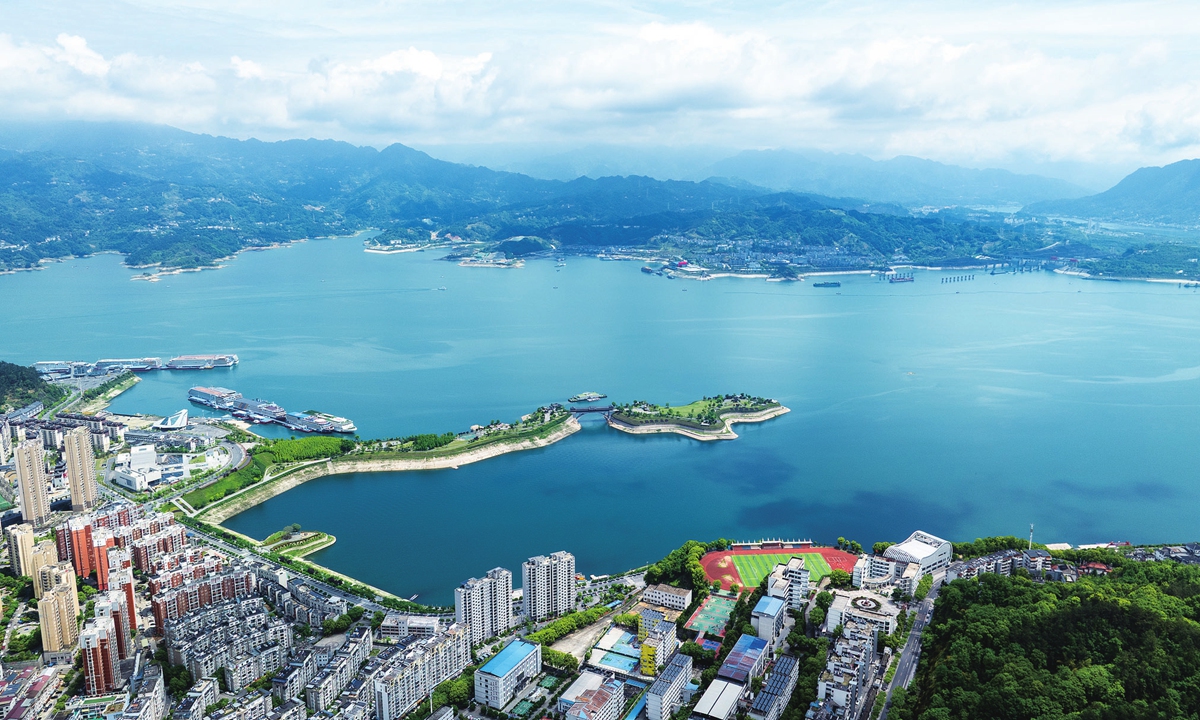
A view of the cityscape and river scenery in the Three Gorges reservoir area in Zigui County, Central China's Hubei Province, on April 22, 2026. Photo: VCG
China's inland cruise market is becoming a hotspot in the nation's culture and tourism consumption landscape.
According to a recent industry report, the market is characterized by three features, with senior travelers forming the core customer base, young and middle-aged passengers representing significant growth potential, and inbound tourism expanding rapidly.
A leisurely five-day cruise along the Yangtze River has become an increasingly common way for Chinese families to spend their holidays — and the industry behind it is charting a course for rapid expansion.
When Yu, a traveler from Northwest China's Xinjiang Uygur Autonomous Region, boarded the Yangtze Gold 3 in Yichang, Central China's Hubei Province, for a five-day, four-night voyage to Southwest China's Chongqing, she had done little advance research. A month earlier, she had simply compared prices, photos and reviews on online travel platform Ctrip before booking a fourth-deck balcony deluxe room with an extra bed — about 24 square meters, comfortable enough for herself and her two septuagenarian parents.
The journey did not disappoint. The vessel, carrying some 400 passengers, offered a gym, cinema, foot-massage services and shopping streets on its lower decks, plus a billiard room, swimming pool, bars, cafés and an open-air terrace above.
"The gentle rocking felt like the cradle bed I slept in as a child," Yu told the Global Times on Wednesday.
Out of consideration for her parents' limited mobility, she limited the family to one paid shore excursion per day. The total cost came to 8,055 yuan ($1,206) for three people, or 2,685 yuan per person — personal shopping aside.
Stories like Yu's are becoming emblematic of a broader consumption trend. According to the China Inland River Cruise Development Report 2026, released by China Tourism Academy, the country's inland cruise sector is entering a fast-growth period, powered by a silver-haired domestic clientele and a rapidly rising inbound market, Chinese travel portal ctnews.com reported on Tuesday.
As of August of this year, 47 inter-provincial cruise ships were operating on the Yangtze trunk line with a combined 21,351 berths, while the Pearl River ranked second nationwide with 39 vessels and 10,690 berths, the industry report noted.
Inbound tourism is emerging as a striking new growth engine. Yangtze River cruises welcomed 117,600 overseas visitors in 2025, surging 56.8 percent year-on-year, with overseas passengers' share of total traffic leaping from 1.5 percent in 2023 to 9.8 percent. The Pearl River market is recording similarly brisk growth in international arrivals.
Domestically, older travelers dominate the decks: passengers over 60 accounted for 56.31 percent of Yangtze Three Gorges cruisers in June 2026, while those aged 45-60 made up 24.64 percent. Data from Douyin shows strong interest in "cruise" and "Three Gorges cruise" among younger and middle-aged users, suggesting a large reserve of future passengers.
According to industry analysts, inland cruises are shifting from mere sightseeing carriers toward comprehensive leisure-vacation products, with travelers now prizing cabin quality, dining, entertainment and cultural experiences above itinerary length or price.
"Inland cruises offer a slow-paced, one-stop travel experience — no frequent transfers, no long walks, no repeated hotel changes," analysts noted, adding that the format fits demand for relaxed yet immersive trips.
According to domestic media reports, the year 2026 is the busiest year for new inter-provincial cruise launches since 2014, with five 150-meter, 650-berth luxury vessels entering service. The market now spans sight-seeing cruises, vacation-style vessels and hybrid products.
Travelers are placing growing emphasis on high-quality experiences, the report said. When selecting an inland cruise product, passengers prioritize onboard accommodation, dining quality, entertainment facilities, performances and cultural activities, as well as the vessel's class and overall quality, the report found.
Shore excursion content and the cruise brand's standard of service also rank high on travelers' lists, while itinerary duration, routes and scenery, pricing, and boarding convenience are considered secondary factors.
Global Times
RELATED ARTICLES


