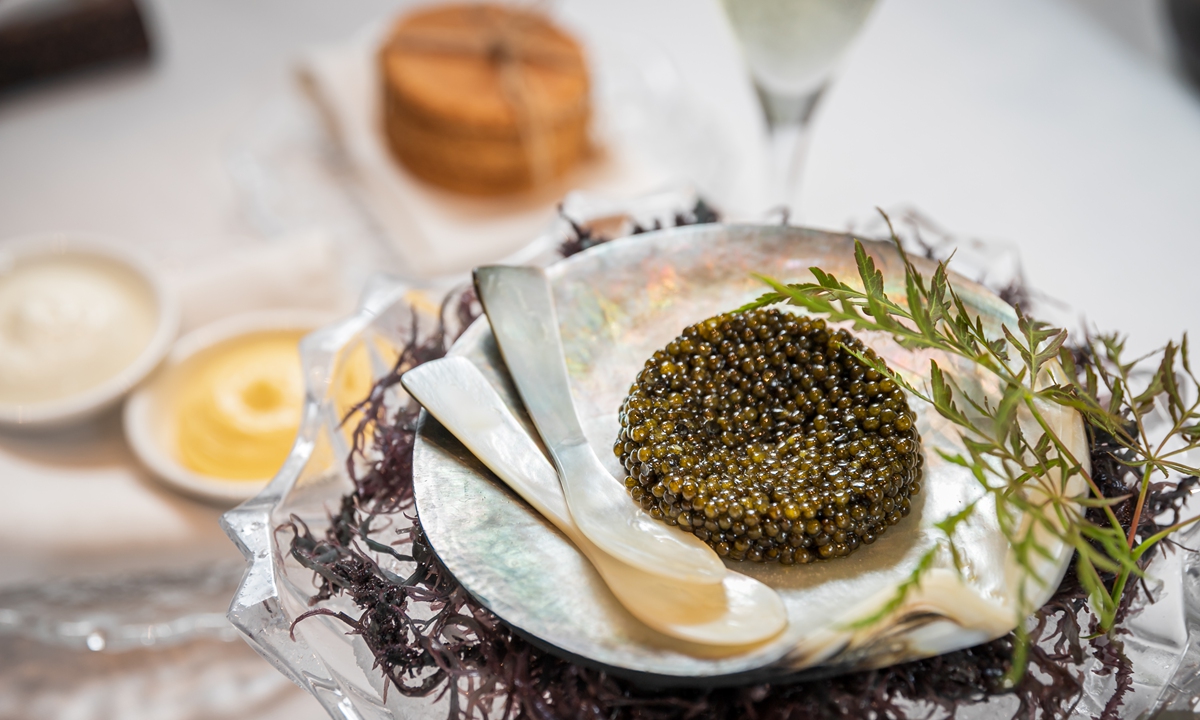
caviar Photo: VCG
Caviar, black truffles, foie gras - delicacies that the West once kept firmly to itself - are now storming the global stage at Chinese scale, Chinese speed and Chinese prices. Yet the bigger story is not merely the industry's expansion but the challenge posed to long-established Western definitions of what "premium" and "luxury" in food actually mean.
In 2025, China's restaurant-ingredients market was worth 2.45 trillion yuan ($367.3 billion), of which premium ingredients accounted for more than 367.5 billion yuan, or 15 percent, according to industry estimates. Commerce-ministry figures show that in 2025, retail sales of consumer goods surpassed 50 trillion yuan for the first time. The supply side has responded emphatically. Chinese researchers have cracked the key technologies of fully artificial sturgeon breeding, recirculating aquaculture, and roe extraction and processing. In Zhejiang, Anhui, and Yunnan provinces, full-chain clusters running from breeding through scientific farming and deep processing to cold-chain logistics have taken shape at speed.
Caviar, foie gras and truffles were long packaged by the West as emblems of aristocratic living. By producing them at scale, China has ensured that these ingredients are of excellent quality and always readily available. This price edge is not the result of dumping; it is a compound product of technological progress, supply-chain coordination and economies of scale, and it is changing how consumers everywhere judge value. This economic shift also carries cultural implications, with the potential to strengthen China's voice and cultural influence within the global high-end food consumption market.
Every fast-growing industry has its growing pains, and this one faces three glaring problems.
The first and softest spot is standards and the international clout that goes with them. The industry started late; most categories lack unified national quality standards or whole-chain traceability, and product consistency still has room for improvement. When the EU abruptly changed its certification rules for the category, mismatches between domestic and international standards left large volumes of product without market access.
The second issue is the risk of a race to the bottom. As technology diffuses and capacity expands, firms continue to cut prices to grab market share, locking the sector into a vicious cycle of low prices, low profits and low investment. The third problem is the glaring absence of brand narrative and cultural cachet. Chinese fine foods largely lack brand stories of their own that resonate emotionally with international consumers.
Genuine high-quality development requires government, industry and firms to pull together, focusing on standards, competition and branding all at once.
First, accelerate the standards regime to anchor trust in quality and secure a seat at the rule-making table. National whole-chain standards should be piloted first in the core categories of sturgeon, foie gras and black truffles, ending the fragmentation of firm-level and local standards. An export risk-warning platform should dynamically track certification changes in Europe, the US and other major markets, and domestic standards revisions should incorporate interfaces for international mutual recognition.
Second, pursue a strategy of quality and price together to discipline competition and enhance value-added. Industry alliances anchored by leading firms should cooperate on technology sharing, price coordination, joint brand-building and overseas expansion, turning a zero-sum brawl into constructive competition.
Third, systematically build a canon of "Chinese terroir stories" to restore the cultural premium behind the brands. Leverage the ecological wisdom, climate and farming heritage of specific producing regions, fuse them with modern science and technology, and tell a dual narrative of Chinese terroir and Chinese technology. Support firms' presence at top international food fairs and platforms such as Michelin culinary competitions, and use overseas Chinese cultural centers and diplomatic gifting to widen exposure.
The rise of China's premium foods industry is the joint product of manufacturing scale, technological grit and a vast home market. It has already broken the West's long cultural monopoly and put fine ingredients within reach of many more people. However, the real test is whether a temporary dividend of scale can be converted into a durable commanding height of value. Only when industry alliances pull in one direction, and when the story of Chinese terroir combined with Chinese technology resonates with consumers worldwide, will Chinese fine foods complete their historic passage from challenger to leader. Chinese fine foods can't just be abundant and excellent. They must be truly valued. That is the ultimate answer to industrial upgrading and the only path by which China earns respect and standing in the world of high-end consumption.
Mao Keji is an associate researcher and head of the Strategic Research Division, International Cooperation Center of the National Development and Reform Commission. Duan Dingyun is a research assistant and PhD in economics. opinion@globaltimes.com.cn
RELATED ARTICLES