Mahjong’s ‘American moment’: When Americans and Chinese enjoy the same table game

Mahjong Illustration: Liu Xidan/GT
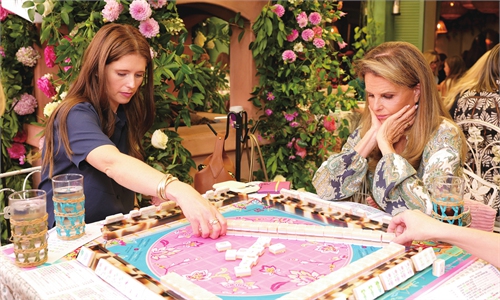
Scrolling through TikTok, I came across videos of groups of Americans gathered around tables in New York parks, clicking mahjong tiles and calling out their moves. I had to do a double take: Was this really New York, or had I stumbled upon a scene from Shanghai People's Park?
It appears that mahjong, the tile-based Chinese board game I've known all my life, is enjoying a growing "American moment."
American trader Joseph Park Babcock brought mahjong to the US in 1920 and simplified its rules for Western audiences. A century later, the clatter of mahjong tiles is echoing across a wider region of the country, no longer as a niche pastime confined to Chinese immigrant communities or older generations.
According to Yelp, searches for mahjong clubs surged 4,467 percent between September 2024 and August 2025, while searches for mahjong lessons rose over 800 percent. Once dismissed as "grandma's game," mahjong is becoming a much-needed third space for US generation tired of digital overload. To meet growing demand in the US, Chinese manufacturers have even overhauled their craftsmanship to make smaller, more colorful acrylic tiles.
This cultural story carries an interesting twist: Mahjong has not merely crossed the Pacific; it has been reshuffled along the way, absorbing American cultural traits. Chinese mahjong, with its many regional variations, allows greater flexibility in forming winning hands. American mahjong, by contrast, follows a more structured system, with players matching their 14 tiles to winning combinations listed on an annually updated National Mah Jongg League card. In China, people often pick up mahjong around the family table or from friends. In the US, many learners turn to community clubs, beginner classes and social meetups, creating new job opportunities for professional mahjong instructors.
This is two-way cultural exchange in action: Rather than simply importing a foreign tradition wholesale, Americans have adapted mahjong to their own lifestyles. American mahjong has developed its own rules, rituals and even a growing business ecosystem.
A cultural trend truly takes root when it becomes part of local everyday life and speaks to shared human needs. More than a game of luck and strategy, mahjong reflects a Chinese philosophy of balance and give-and-take, alongside the age-old tradition of reunion and togetherness. Winning matters, but so do companionship, harmony and the simple joy of being together.
In an age of information overload and endless scrolling, mahjong offers a refreshing alternative: no phones, no algorithms, just the familiar clatter of tiles, four people sitting face to face, lighthearted competition, and hours of undistracted time together. Its growing popularity in the US speaks to a shared desire among Chinese and American people alike for genuine human connection.
From China's everyday habits of drinking hot water and bathhouse culture gaining fans in the US, to the American sport of pickleball taking root in China, cultural exchanges between the two countries are moving beyond superficial cultural products and symbols, and into lifestyles. What people on both sides are embracing is not simply the exotic appeal of Asian culture or the novelty of an American trend, but shared ways of relaxing, socializing and enjoying everyday life.
The rising popularity of mahjong in the US also shines a light on a lesser-noticed facet of China-US relations that rarely grabs headlines. Bilateral ties are usually framed around negotiating tables dominated by trade, technology and geopolitical wrangling. But at the mahjong table, there are only bams, dots, craks, pungs, kongs and quints. And mahjong is just one of countless "tables" where the two societies intersect.
At the dining table, Chinese milk tea and hot pot have won over an increasing number of American fans, while American coffee and burgers have long been part of everyday life in China. At the game table, Werewolf - the social deduction game - brings young Chinese people together to bluff, debate and test their wits, while some Americans have taken up traditional Chinese mahjong and put their own spin on it.
These many "tables" show that cultural exchange rarely looks like a one-way export. It travels, mutates, and finds new meaning wherever it lands.
Cross-cultural connection often blooms on ordinary tables, whether laden with hot pot, board games or mahjong tiles. A group of New Yorkers learning mahjong in a park is not trying to solve trade disputes. They are simply chasing that simple pleasure: face-to-face fun away from phone screens.
That is the quiet power of these cultural trends. They remind us that beneath national labels, people share basic human wants - friendship, playful competition, a few hours of unrushed joy. Cultural traditions can cross borders, change shape, and enrich new communities, without anyone having to abandon who they are.
So shuffle the tiles. The next hand waits. One more round?
The author is a reporter with the Global Times. liuxuandi@globaltimes.com.cn
RELATED ARTICLES