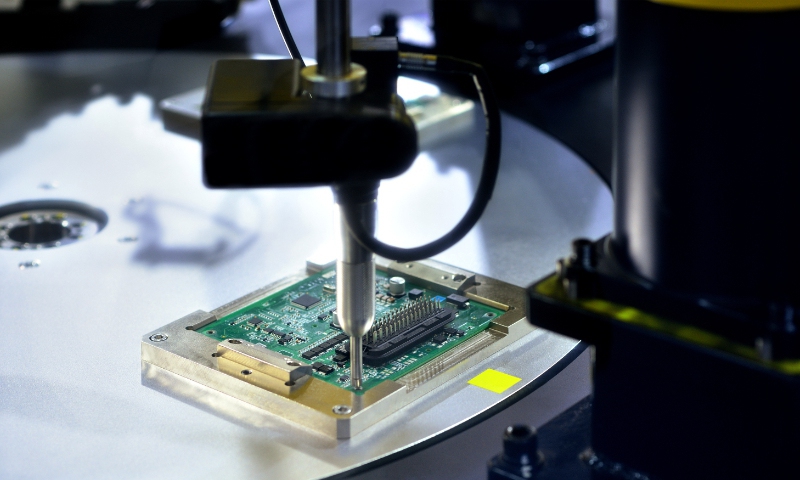
Production of semiconductor chip File photo: VCG
Washington's efforts to attract South Korean chip investment risk being undermined by its own restrictions. Reuters reported, citing people familiar with the matter, that US officials have held up approval for American chipmaking equipment needed by SK hynix to expand its production in China, complicating the South Korean chipmaker's plans for new memory-chip plants in the state of New York.
According to Reuters, SK hynix is seeking US export licenses to equip its plant in Dalian, Northeast China's Liaoning Province, arguing that increased production there would help fund its planned US expansion.
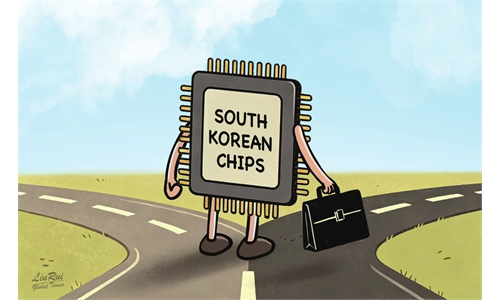
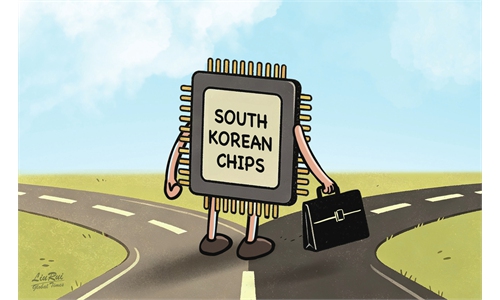
Negotiations are ongoing, with the outcome uncertain. But the episode already exposes tension in US-South Korea chip "cooperation." Washington wants to attract more South Korean investment and manufacturing capacity to the US, while its export controls constrain South Korean chipmakers' ability to expand its production in China. This reveals a divergence of interests: Washington is seeking to strengthen its own semiconductor industry, even at the potential expense of South Korean companies' commercial interests.
For a fuller picture of the pressure facing South Korean chipmakers, a September report by The Korea Herald is worth revisiting. It said that Washington had revived its push for targeted semiconductor tariffs, raising pressure on Samsung Electronics and SK hynix to expand US production or face duties on chips made overseas.
If South Korean chipmakers expand their US operations under such pressure, a growing share of investment, advanced manufacturing capacity and high-value jobs could accrue to the US rather than South Korea. This raises a question about whether such "cooperation" truly serves both sides' interests.
Washington stands to gain new investment and jobs, while South Korean companies face constraints on their global operations and risk seeing more of their industrial capabilities move overseas. The arrangement appears to put US industrial interests first, leaving South Korea to bear much of the commercial and strategic cost.
On its US investment plans, South Korean media outlet AJP reported on Wednesday that SK hynix had yet to finalize any specific plans for new semiconductor manufacturing facilities in the US.
SK hynix also said that it was continuing to bring US-made semiconductor manufacturing equipment into its Dalian plant under an existing export license, while negotiations over next year's authorization remain underway, AJP reported.
Why are these Chinese factories so important to South Korean chipmakers? The Korea JoongAng Daily reported in August that SK hynix's plant in Wuxi, East China's Jiangsu Province, accounts for 40 percent of its total dynamic random-access memory output, while its Dalian plant accounts for 30 percent of its total NAND output.
At a time of strong global demand and tight memory-chip supply, China's production capacity is a valuable asset for South Korean chipmakers. Retaining access to this capacity is plainly in the commercial interests of these companies.
China's value also lies in its mature industrial ecosystem. Its extensive supplier networks and manufacturing capabilities have long supported South Korean chipmakers' global operations. This has been a mutually beneficial arrangement, with South Korean companies drawing on China's industrial base while contributing investment to the wider supply chain.
Yet Washington is putting South Korean chipmakers in a difficult position. While seeking to attract their investment to the US, it is also trying to limit their ability to expand production in China. In doing so, Washington is putting its geopolitical objectives ahead of South Korean companies' commercial interests. South Korean chipmakers should not accommodate US demands at the expense of their global operations. They have every reason to preserve the flexibility to make investment and production decisions based on commercial considerations.
China's semiconductor industry is advancing rapidly, creating new competitive pressures for South Korean chipmakers. But competition does not preclude cooperation where interests remain aligned. The question is whether South Korean chipmakers can withstand US pressure without sacrificing the global reach and commercial flexibility on which their competitiveness depends. That balance will have consequences well beyond their operations in China.
RELATED ARTICLES