Illustration: Liu Xidan/GT
Samsung Electronics' job cuts and relocation plan in the US have drawn widespread attention this week. The South Korean tech giant said on Sunday in a statement that 739 roles in Englewood Cliffs, New Jersey, have been affected by plans by Samsung Electronics America (SEA), which is focused on consumer electronics and does not include chips, to move its headquarters to Texas, Reuters reported.Samsung's job cuts - though linked to the headquarters shift - also reflect broader industry changes, including rising competition in consumer electronics and surging chip costs, according to Reuters. Meanwhile, the adjustments come as Washington escalates efforts to build a US-centered semiconductor supply network and seeks to draw South Korean chipmakers deeper into US-based production.
In recent years, in the name of supply chain security, the US has continuously urged South Korean semiconductor manufacturers to expand their manufacturing footprints on American soil. As one of the core hubs of Washington's push for semiconductor localization, Texas offers favorable policies, alongside substantially lower costs for land, utilities and factory construction compared with other traditional tech hubs.
Regardless of what may have prompted Samsung's move, the hand of US industrial planning is unmistakably present - and its impact is by no means confined to Samsung, because it bears directly on South Korea's semiconductor sector as a whole.
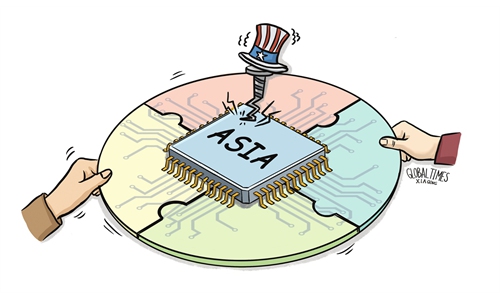
In recent months, Washington has escalated its efforts to embed South Korean chipmakers more deeply into the US-centric supply network - not merely through subsidies and tax incentives, but through increasingly direct pressure. According to South Korean media reports, Deputy US Trade Representative Rick Switzer told South Korean Trade Minister Yeo Han-koo in a recent meeting that US companies' large-scale purchases of South Korean semiconductors had directly contributed to the record earnings of SK Hynix and Samsung Electronics, and that the US therefore deserved a share of the profits.
In July, US Commerce Secretary Howard Lutnick publicly urged the same two companies to expand memory chip manufacturing in the US, Bloomberg reported.
While some in South Korea may view deeper cooperation with the US as a valuable opportunity for domestic chipmakers to expand their market share and secure more stable access to the American market, many fear otherwise. Simply following the US strategic priorities will inevitably steer South Korea into an awkward and vulnerable position: as Seoul's semiconductor sector grows more dependent on Washington's strategic priorities, it risks becoming subordinated to US interests. Given that the US consistently places its own interests above all else, South Korea's industrial interests are all too easily marginalized, or even sacrificed.
Even more alarming is that this deepening external dependency risks accelerating the hollowing-out of South Korea's manufacturing base. To answer Washington's calls for localized production, South Korean firms may transfer substantial manufacturing capacity and core engineering talent to US facilities. Over time, as more advanced production capacity, top-tier talent and core business decision-making power continue to flow to the US, South Korea's domestic semiconductor research and development foundation, mature industrial employment ecosystem and interconnected full supply chain resilience will inevitably face sustained erosion.
It is particularly notable that the South Korean government and industry leaders have made clear their commitment to consolidating and growing the core semiconductor sector at home. Last month, South Korean Industry Minister Kim Jung-kwan said that the country plans to develop a new semiconductor production base in its southwestern region through 800 trillion won ($540 billion) in corporate investments that will create four memory chip fabrication plants.
This clear aspiration for indigenous development stands in stark contrast to the reality of the industry being pushed offshore by external forces. How to consolidate domestic industrial foundations amid complex external pressures and maintain its own development trajectory has emerged as a long-term challenge for South Korea's semiconductor sector in the decade ahead.
RELATED ARTICLES