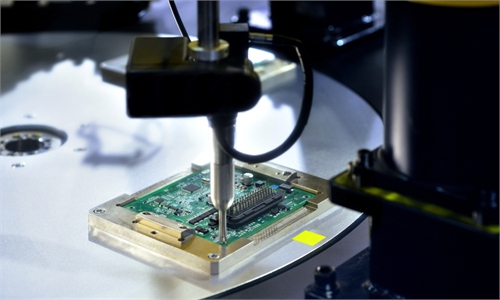
chip Photo:VCG
Samsung Electronics on Thursday estimated that its fourth-quarter operating profit surged 208.2 percent year-on-year to a record high, according to the Yonhap News Agency, as a surge in artificial intelligence (AI)-driven demand stoked prices for conventional memory chips.As a major player in the semiconductor sector, Samsung's impressive growth serves as a microcosm of the entire industry's broad vitality in 2025. Data from the Ministry of Trade, Industry and Resources of South Korea showed that in 2025, exports of semiconductors, South Korea's largest export item, rose 22.2 percent year-on-year to an all-time high of $173.4 billion, significantly driving the country's overall export growth.
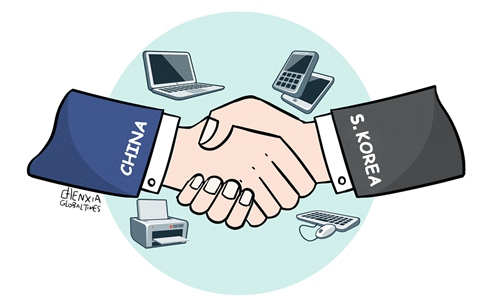
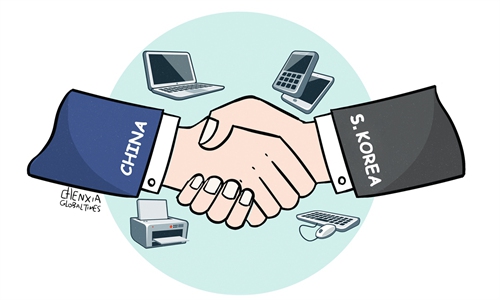
China has long been a crucial semiconductor trading partner for South Korea. With annual bilateral trade exceeding $300 billion, semiconductor intermediate products account for a substantial proportion. Growing Chinese demand for DRAM and NAND flash memory has provided strong impetus for South Korean semiconductor companies.
Notably, South Korean President Lee Jae-myung brought a huge business delegation, which included executives of four major conglomerates, including Samsung, on his state visit to China. Among them, the participation of semiconductor executives drew widespread attention, which fully reflects the high importance South Korea's semiconductor industry places on the Chinese market.
This focus is neither new nor transient; rather, it reflects a persistent drive to deepen collaboration within the China-South Korea semiconductor supply chain - a drive grounded in years of accumulated and deepening industrial interdependence.
Although US export controls on China's semiconductor sector in recent years have forced China to accelerate its self-sufficiency drive, creating a competitive dynamic with South Korean companies, China remains South Korea's largest semiconductor export market, with the Chinese mainland alone accounting for about 30 percent of South Korean semiconductor exports in 2024, according to media reports.
Beyond trade, China's vast market and manufacturing ecosystem provide support for the operational advancement of South Korean companies. Samsung's NAND flash memory chip production facility in Xi'an accounts for about 40 percent of its total global NAND output and is being upgraded to a more advanced 286-layer process, according to a report from Business Korea.
SK Hynix has a DRAM fab in Wuxi, East China's Jiangsu Province, which produces about 40 percent of the company's total DRAM chips, and a NAND flash manufacturing plant in Dalian, Northeast China's Liaoning Province, which produces about 20 percent of its memory chips, according to The Korea Herald. These examples fully illustrate the depth of integration and the mutually beneficial outcomes of existing industrial chain cooperation.
While cooperation has yielded remarkable results, the global semiconductor landscape is undergoing profound changes. The US export controls have spurred the development of China's domestic semiconductor industry, fueling competition with its South Korean counterparts.
Nevertheless, the complementarity of their industrial chains renders cooperation indispensable. South Korea retains leading-edge capabilities in high-end memory chips and advanced materials, whereas China offers an unrivaled complete industrial support system and the world's largest application market for end products.
The objective demands of the industrial chain cannot be overshadowed by short-term fluctuations. For China, continued access to advanced process technologies and global industry expertise remains vital on its path to technological advancement. For South Korea, maintaining global competitiveness and production agility is inextricably linked to its presence in China's market and manufacturing base.
Consequently, establishing and reinforcing robust industrial dialogue and coordination mechanisms is increasingly essential for stakeholders on both sides. Enhanced cooperation will empower both to navigate the ongoing restructuring of global supply chains more effectively, mitigate shared external risks, and achieve a higher level of mutual benefit.
In the long run, through pragmatic collaboration in areas such as technological research and development, talent development, market expansion, and the management of shared external risks, the close China-South Korea semiconductor partnership can evolve into a more resilient and innovative industrial chain. Strengthening this regional supply chain is not only critical to both nations' semiconductor sectors but also key to preserving the industrial efficiency and competitive edge of the region.
RELATED ARTICLES