Unitree G1 robot’s ‘heatstroke’ during Mount Taishan race sparks debate over humanoid endurance
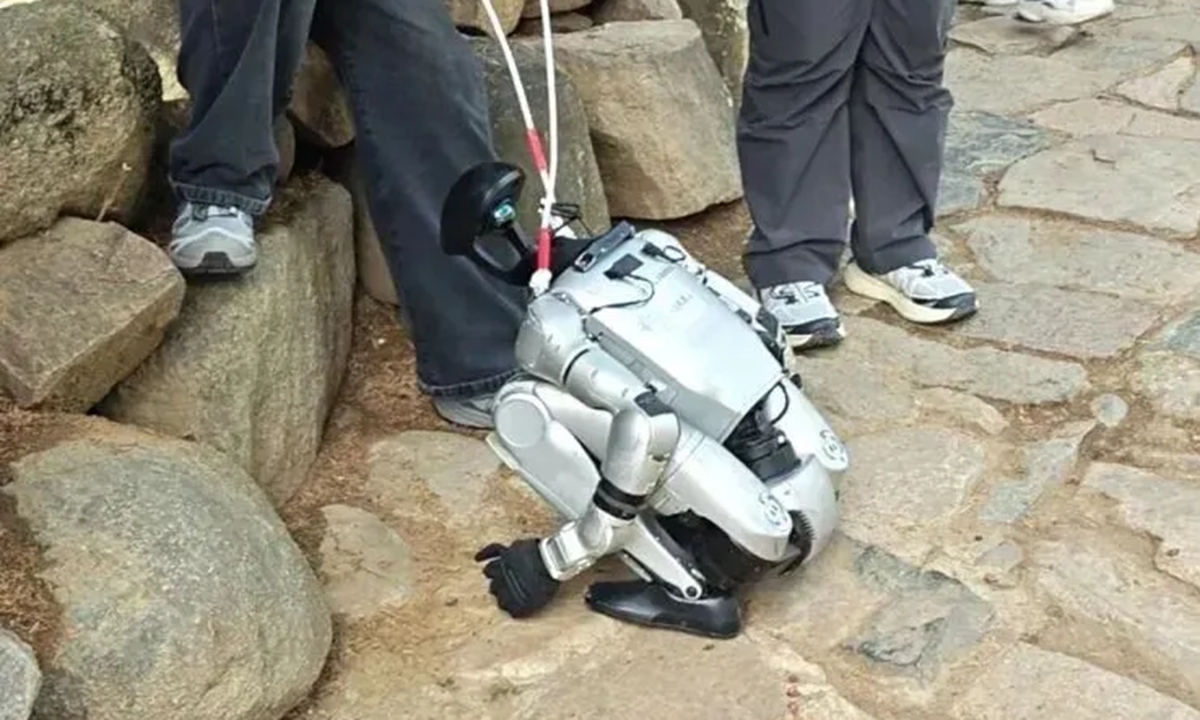
Photo: Screenshot from website
A Unitree G1 humanoid robot being carried down Mount Taishan on a stretcher after overheating during a robot competition in East China's Shandong Province has drawn widespread attention online. Some netizens joked that the robot had suffered "heatstroke," prompting discussion over the endurance and real-world performance of humanoid robots.
In response, Unitree said the robot may have entered the competition with no tuning.
The incident occurred during the inaugural CMG World Robot Mount Taishan Competition in Tai'an, East China's Shandong Province, on November 2. The G1 development version - the same model used in China's Spring Festival Gala - overheated during the race. Its operator withdrew for safety reasons before staff placed the robot on a stretcher and carried it down the mountain, Science and Technology Daily reported.
The course presented a demanding real-world test. Stretching about 3.9 kilometers from Hongmen to Zhongtianmen, it included more than 3,100 steps and an elevation gain of about 600 meters, testing robots' balance, endurance and ability to operate on complex mountain terrain.
An industry expert said that the event was less a conventional race than a stress test of whether humanoid robots could translate short bursts of mobility into sustained operation. The overheating was caused by heat generated within the machine faster than its systems could dissipate it, rather than simply by high outdoor temperatures.
The episode quickly became a talking point on Chinese social media. Some users jokingly described the G1 as having "heatstroke" and found the scene of it being carried on a stretcher amusing, while others saw the incident as a reminder that eye-catching demonstrations do not necessarily translate into reliable performance in demanding real-world environments.
Some also argued that such failures are precisely what open-field tests are designed to expose, providing developers with data to improve thermal management, endurance and control systems.
As robots move from controlled demonstrations into factories, public spaces and more complex outdoor environments, reliability, endurance and environmental adaptability are becoming increasingly important benchmarks. The Mount Taishan race, despite the malfunction, offered another example of how demanding real-world scenarios can expose weaknesses that may be difficult to identify in laboratory testing, Chinese experts noted.
Global Times
RELATED ARTICLES