ARTS / CULTURE & LEISURE
Millennia-old Dunhuang connects civilizations past and present, as discussions turn to heritage and AI
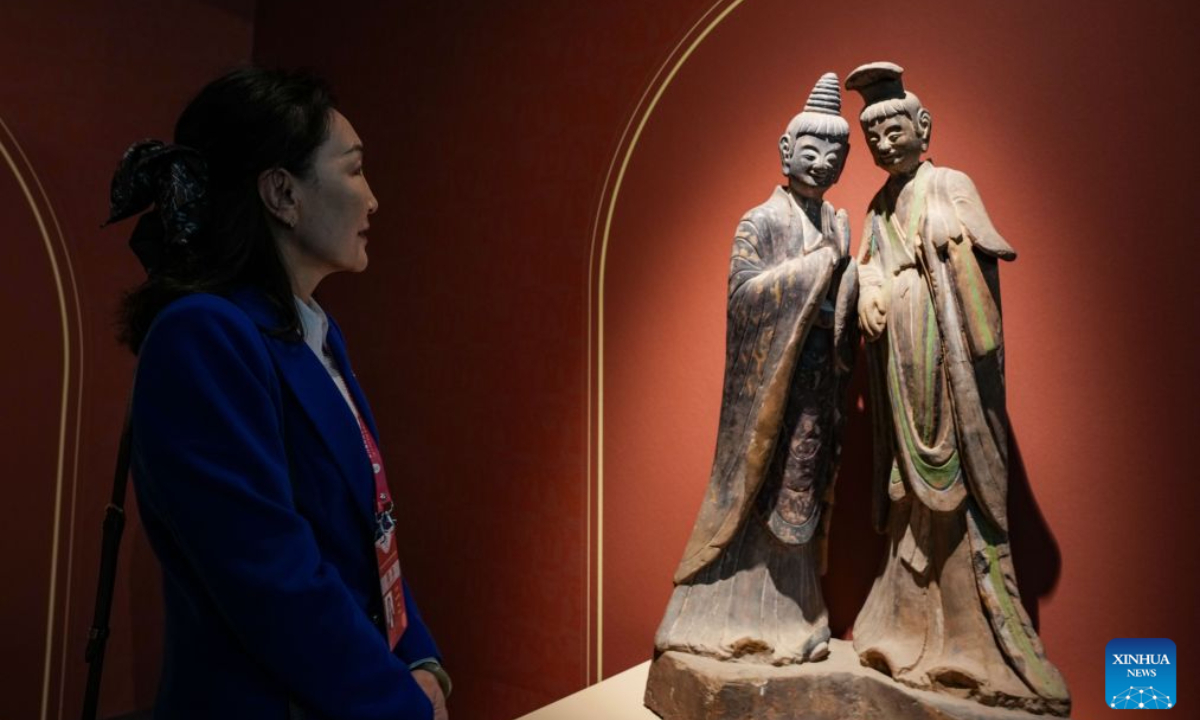
A participant visits an exhibition on development achievements from Dunhuang Academy at the 9th Silk Road (Dunhuang) International Cultural Expo in Dunhuang, northwest China's Gansu Province, Nov. 3, 2026.
"They could not have known where their ideas would eventually travel, or how encounters between people from very different worlds would produce a cultural legacy capable of speaking to us so many generations later," World Intellectual Property Organization Director General Daren Tang said at the opening of the Ninth Silk Road (Dunhuang) International Cultural Expo, while reflecting on the enduring legacy of the artists who created the numerous murals and statues found throughout the Mogao Caves in Dunhuang, Northwest China's Gansu Province.Themed "Strengthening Cultural Exchanges and Promoting Mutual Learning Among Civilizations," this year's expo has attracted around 1,200 participants, including 307 international guests from 58 countries and international organizations.
In Tang's view, digital technologies have given today's cultural exchanges an unprecedented reach, but technological advances have also raised new questions: How can creators' rights be protected while embracing innovation? And how can technology truly serve human creativity?
"Human creators must remain at the heart of the intellectual property (IP) system, and technology must serve and support human creativity, not weaken it or replace it," Tang said. He noted that artificial intelligence is already reshaping music, film, art and design, and that making good use of the technology has become an issue facing the global creative industries.
While technology is opening up new possibilities for cultural preservation and transmission, Dunhuang itself stands as a historical testament to exchanges among civilizations. Professor Shahbaz Khan, director and representative of the UNESCO Regional Office for East Asia, told the Global Times during the expo that more than 1,000 years ago, Dunhuang was a thriving hub along the ancient Silk Road, where cultural and commercial exchanges between East and West flourished and Chinese, Indian, Greek and Islamic civilizations converged.
"Dunhuang not only preserves cultural relics of exceptional rarity and safeguards intangible cultural heritage of exceptional value, but also offers invaluable historical lessons for modern nations: seeking common ground while respecting differences, learning from one another's strengths and coexisting in peace," Khan said.
The exchanges among civilizations witnessed in Dunhuang are not confined to ancient murals and manuscripts. They also live on in the shared historical memories of people across countries today. Huot Hak, Cambodia's minister of tourism, shared a story during the expo about the 13th-century Chinese scholar Zhou Daguan, who traveled to Angkor and left behind a valuable account of the prosperity, customs and everyday life of the Khmer Empire.
"This account is not merely a valuable historical record. It is also one of the earliest people-to-people links between Cambodia and China, bearing witness to the mutual understanding, appreciation and exchanges between two ancient civilizations," Hak said. He described the Dunhuang Expo as an important platform for countries along the Silk Road to bring their peoples closer together and promote cultural exchanges and tourism cooperation.
With an exhibition area of about 18,000 square meters, the expo features 18 activities across seven categories. Its five exhibition zones showcase achievements in heritage conservation and Dunhuang studies, Gansu's cultural innovation, traditional Chinese medicine, people-to-people exchanges among Belt and Road countries, and Dunhuang art. The main exhibitions are scheduled to run until Sunday.
RELATED ARTICLES