EU approval of JD.com-Ceconomy acquisition shows dialogue works, but concerns over FSR targeting Chinese firms remain: experts
Analysts say 'talk while fighting' raises costs for Europe, erodes trust
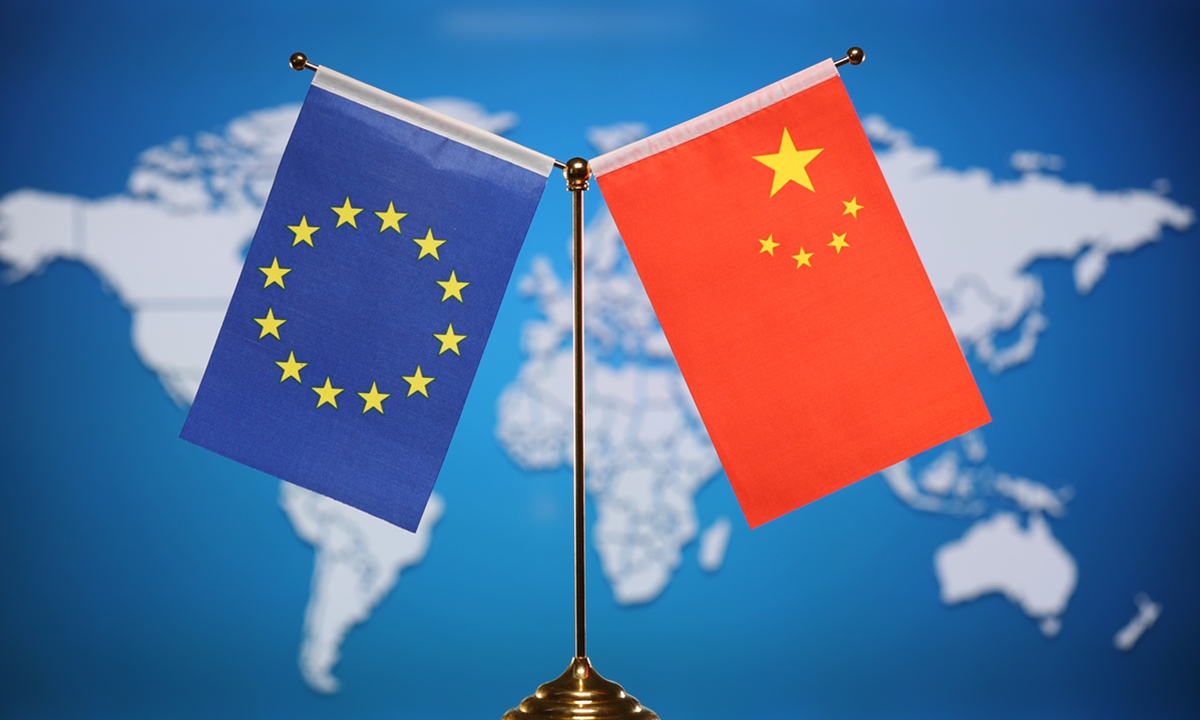
China EU Photo:VCG
The EU conditionally approved JD.com's acquisition of Germany's Ceconomy under the Foreign Subsidies Regulation (FSR) on Tuesday local time, the first Chinese deal cleared after an in-depth probe. Chinese experts said the move shows that both sides can resolve issues through constructive communication, demonstrating that commercial interests continue to overlap.However, the EU is reportedly working on targeted changes to single market rules on foreign subsidies and vehicle type approval to diversify supply chains and reduce reliance on China, according to a Bloomberg report on Tuesday.
Analysts noted that these two developments emerging in parallel clearly reflect the EU's current economic policy toward China - retaining a degree of flexibility for specific commercial projects that meet certain conditions, while advancing "de-risking" at the regulatory level. Using "security" as a pretext for protectionism will ultimately only raise Europe's own costs and further erode mutual trust and the foundation for China-EU cooperation, they warned.
Acquisition approved, FSR questions remain
The European Commission (EC) on Tuesday announced to approve, under the FSR, the acquisition of Ceconomy by JD.com. It marks the first case in which an acquisition by a Chinese company has been approved by the EC following an in-depth investigation under the FSR.
Ceconomy CEO Dr Kai-Ulrich Deissner said that "With JD.com's outstanding retail, logistics, and technology capabilities, we can further accelerate our successful growth trajectory and go beyond our current strategic goals." JD.com CEO Sandy Xu noted "This partnership with Ceconomy will build Europe's leading next-generation consumer electronics platform," according to the information JD.com shared with the Global Times on Wednesday.
The China Chamber of Commerce to the EU (CCCEU) said on Wednesday that it welcomes EC's approval. It said that the decision, reached after extensive engagement with both parties and a comprehensive assessment of the proposed commitments, underscores the importance of constructive dialogue between regulators and businesses in addressing regulatory concerns.
Zhang Jian, a vice president of the China Institutes of Contemporary International Relations, told the Global Times on Wednesday that the EC's latest move has a positive significance, demonstrating that the importance of constructive dialogue between regulators and businesses in addressing regulatory concerns and the proper handling of the case is conducive to the win-win commercial cooperation between companies from both sides.
After entering the European market, JD.com will bring in new capital, technology and industrial elements, which will help boost the performance of local manufacturers and retailers, driving the development of the consumer goods sector, Jian Junbo, director of the Center for China-Europe Relations at Fudan University, told the Global Times on Wednesday.
However, whether this will set a template for future FSR cases involving Chinese companies remains to be seen, since the underlying logic of the EU's trade and economic policy toward China has not changed, Zhang said. He noted that it is important for the bloc to keep its market fair and objective and avoid discriminating against Chinese companies operating in the EU given their contribution to the EU's growth and job creation.
The FSR started to apply in 2023. The EC claimed the FSR enables the Commission to address distortions caused by foreign subsidies and thereby allows the EU to ensure a level playing field for all companies operating in the internal market.
However, since the FSR came into force, the vast majority of investigations launched by the EC under the FSR framework have targeted Chinese companies. A growing number of ex officio investigations have also focused primarily on Chinese firms, spanning sectors including wind turbines, security screening equipment, new energy vehicles and e-commerce.
"The FSR is not inherently indefensible, but if its enforcement continues to display country-based selectivity, its credibility will be eroded," Jian said.
The CCCEU said that the FSR and its implementation remain a key concern for Chinese companies investing in Europe. "Regulatory measures should be tailored to the circumstances of each case, with due regard for businesses' legitimate rights and interests, and should not create unnecessary barriers to legitimate commercial investment or market cooperation," it said.
EU's dual-track dilemma
China and Europe held high-level talks in Beijing in October that produced positive outcomes, yet the EU has continued to roll out or is brewing new restrictive measures. Bloomberg reported Tuesday that the EU is working on targeted changes to its single market to help domestic companies diversify supply chains away from countries including China, according to people familiar with the plan.
The move is part of a broader package of measures the bloc is set to unveil by mid-December. Other plans for the package include a diversification instrument that will aim to nudge businesses toward alternative supplies. In parallel, the EU is reportedly planning to use safeguard measures to cut imports of products from sectors including chemicals, furniture and machinery from China.
According to Bloomberg, the EC will seek to amend laws on motor vehicle-type approvals and foreign subsidies to better address economic security risks from some imports while reducing regulatory friction for like-minded foreign suppliers. It will also amend forced labor laws and the trade secrets directive, making it easier for European companies to diversify supply chains within the bloc's internal market and harder for riskier suppliers to access it, according to the report.
Jian said that on the one hand, the EU is raising barriers to entry for "high-risk suppliers"; on the other, it is reducing regulatory friction for suppliers from "like-minded countries." But feasibility does not hinge on Brussels' political will - it hinges on whether Europe can build replacement capacity within acceptable time and cost. For now, the answer is no, the expert said.
European industry has bristled at EU plans to force businesses to diversify their supply chains away from China. According to a report by The South China Morning Post, the European Automobile Manufacturers' Association said in a submission to the commission's request for evidence for DiversifyEU that "For rare earths, magnets, battery materials, displays and some semiconductors, there is little or no alternative supply base, and Europe lacks the ecosystem to provide one." "The objective should be realistic: Europe will not match Chinese costs or become fully independent of China, nor does it need to…" it noted.
China-EU trade and economic consultations produced positive outcomes, which provide a stable environment for the bilateral trade and economic outlook. Yet the EU's "talk while fighting" approach exposes Brussels' short-sightedness, hypocrisy and self-contradiction in its China policy, Zhao Chen, senior research fellow at the Institute of European Studies under the Chinese Academy of Social Sciences, told the Global Times on Wednesday.
"Europe needs to face a reality: the deep interdependence of China-EU supply chains cannot be undone through regulatory maneuvering alone, and the cost of forcing such a breakup will fall first on European businesses and consumers," Zhao said.
By talking cooperation on one hand while tripping the other side up on the other, the further this "dual-track" approach goes, the deeper the foundation of China-EU mutual trust will be eroded, and the narrower Europe's own room for development will become, Zhao warned.
RELATED ARTICLES