Chinese commercial space firm partners with Indonesian provider on satellite internet trial
By and Tao Mingyang Published: Nov 05, 2026 05:47 PM


A stimulation of GalaxySpace's low-orbit satellite network Photo: Courtesy of GalaxySpace
China's private satellite company GalaxySpace conducted its first low-Earth-orbit (LEO) satellite internet application demonstration in Indonesia on Thursday, enabling a high-definition video call between its team in Indonesia and colleagues in Beijing, the company said.
The demonstration, conducted with Indonesian telecommunications service provider PT Nusantara Star Connect (NSC), used GalaxySpace's independently developed Mini Spider broadband communications test constellation. Besides the video call, the team demonstrated web browsing, live-stream viewing, remote site monitoring and remote file transfers.
The test used GalaxySpace's newly developed lightweight satellite communications terminal, designed for rapid deployment overseas. The terminals were deployed at two locations in Jakarta and West Java, enabling end-to-end communications between the two sites, the company said.
Indonesia's geography creates demand for satellite communications in remote-area connectivity, maritime communications, energy and mining operations, and emergency communications, according to the statement. Satellite communications can complement terrestrial networks as the country develops its digital infrastructure, said the company.
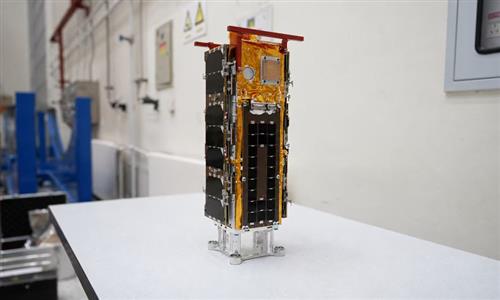
The Indonesia demonstration follows an earlier satellite project involving Thailand. On August 25, GalaxySpace's Lingzhi-09 Thailand CubeSat was launched aboard a Long March-6C rocket. According to the company, the satellite will collect remote sensing data for land management, agriculture and environmental monitoring, and support teaching at Thai universities.
Meanwhile, China is continuing to deploy satellites for its domestic internet constellations. On Tuesday, a Kinetica-2 Y2 carrier rocket launched 18 Qianfan constellation satellites from the Dongfeng Commercial Space Innovation Experimental Zone, according to the Innovation Academy for Microsatellites of the Chinese Academy of Sciences.
Yang Haoliang, chief designer and commander-in-chief of the Kinetica-2 rocket program, told the Global Times that China's low-orbit satellite internet development is generating substantial demand for launch services. Frequent, reliable and affordable launches are essential to the steady development of satellite internet infrastructure, he said.
Beyond launch services and application demonstrations, recent international agreements also cover local satellite infrastructure and training. Chinese commercial space company STAR.VISION said that it signed a space artificial intelligence agreement with Oman Lens on November 2, covering satellite constellation development, a satellite assembly, integration and testing center in Oman, and training and joint research programs.
RELATED ARTICLES