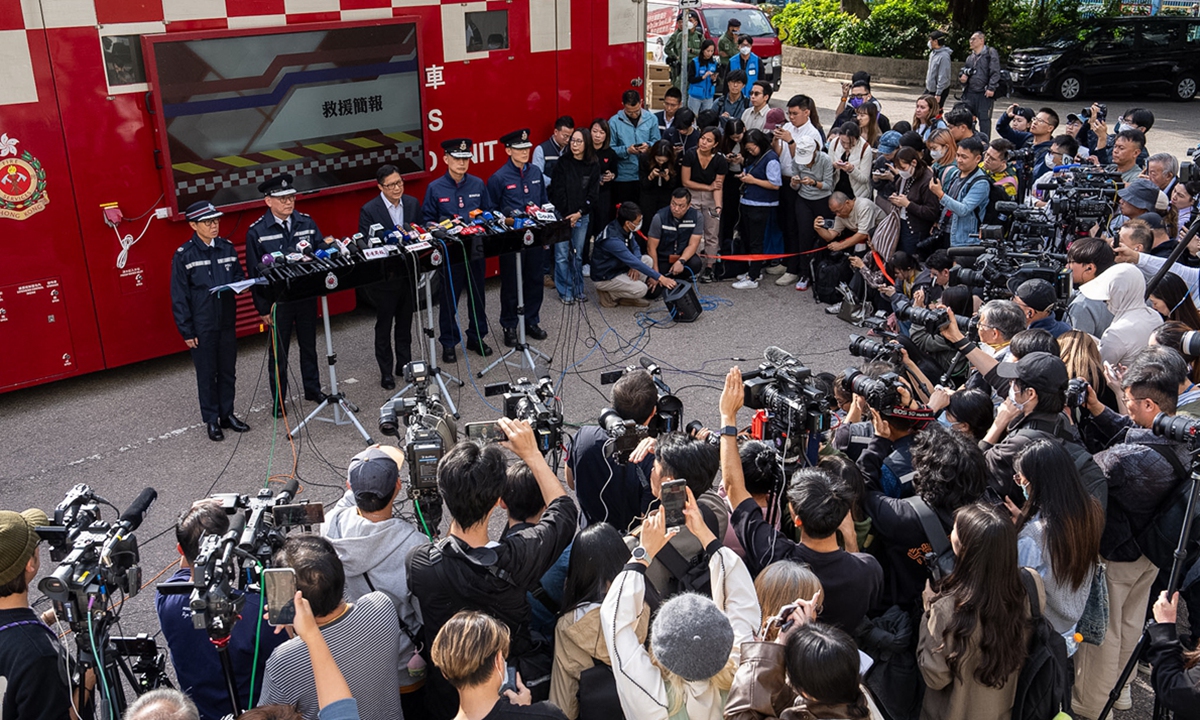
Chris Tang Ping-keung, secretary for security of the Hong Kong Special Administrative Region (HKSAR) government, speaks to members of the media after the deadly fires at Wang Fuk Court, a residential estate in the Tai Po district of HKSAR's New Territories on November 28, 2025. Photo: VCG
The fire in Wang Fuk Court in November 2025, which claimed 168 lives, is one of the heaviest urban public safety tragedies in recent years in the Hong Kong Special Administration Region (HKSAR) and an important test for "patriots administering Hong Kong."
We should offer genuine mourning for the deceased; responsibility should be thoroughly investigated in accordance with the law; and those accountable must be held to account. At the same time, related stigmatizing reports that seek to use the governance lapses in a single public safety incident to negate an entire set of constitutional practices violate the basic norms of legal reasoning and, at the moral level, show disrespect for the lives lost.
Urban fire safety and building maintenance fall within the local governance affairs under the scope of the HKSAR's high degree of autonomy. Autonomy is both a power and a responsibility. The HKSAR bears primary administrative and regulatory responsibility for local affairs, and this is unquestionable. But acknowledging the responsibility of autonomy does not mean requiring autonomy to achieve an absolutely perfect state of "zero risk" and "zero accidents." Any modern high-density city faces structural constraints such as a stock of historically legacy buildings, limitations of earlier building codes and long urban renewal cycles. To directly blame the prevention shortcomings exposed by a single specific accident as either "institutional failure" or "governance failure" is to stealthily substitute a professional proposition with a constitutional one, and, logically, it does not hold.
In fact, the HKSAR government's accountability efforts this time have proceeded along multiple parallel lines: At the criminal level, it had arrested those involved and thoroughly investigated illegal acts in bid-rigging and maintenance works; at the administrative level, the investigation is conducted at a standard far higher than an ordinary internal inquiry, with Chief Executive John Lee deciding to launch a two-tier administrative accountability investigation mechanism and refer the matter for investigation under the Public Service Commission Investigation Regulations; at the level of political responsibility, politically accountable officials bearing relevant duties voluntarily resigned. Together, these three form a complete, layered and lawfully ordered chain of accountability, the core of which is that punishment fits the responsibility and that authority corresponds to responsibility, rather than infinitely expanding and escalating accountability to satisfy public sentiment.
Hong Kong's independent investigation committee completed its report in only about 10 months, and on the day the report was made public, disciplinary investigations of civil servants were launched, with clear completion deadlines set, advancing political accountability and administrative accountability in tandem. The speed, levels and transparency of Hong Kong's accountability this time are not inferior even when placed in the horizontal coordinates of urban governance in the West.
Some overseas media are keen to use Hong Kong's local governance issues to carry out discursive intervention and to smear the new electoral system and the fundamentals of "patriots administering Hong Kong." Foreign media ignore the investigation conclusions and the effectiveness of reforms, deliberately amplify partial controversies and play up a narrative of institutional decline.
Based on the objective report of the independent committee, the HKSAR government has rolled out cross-departmental, systematic reforms. It has amended ordinances to strengthen building maintenance and fire safety, legislated to criminalize bid-rigging, established a building maintenance support and service body, reformed the regulatory architecture to strengthen regulation of existing buildings, set up a cross-departmental data system to monitor complaint handling, and assigned the chief secretary for administration to lead and oversee implementation. These measures are not scattered responses; rather, with courage and resolve, they establish an integrated plan to curb bid-rigging at the source, strengthen regulation through institutional architecture, and consolidate responsibility in enforcement. The courage to tackle deep-seated, long-accumulated contradictions in Hong Kong such as old building maintenance and works supervision is precisely a manifestation of the HKSAR advancing good governance and enhancing governance effectiveness under the condition of "patriots administering Hong Kong."
Discussion of the causes of and responsibility for the fire has always been ongoing in Hong Kong society. Rational and constructive opinions should be respected and effectively protected by Hong Kong's rule of law. However, the dissemination of false information, and even disinformation, through tragedy, the incitement of social confrontation and hatred toward the HKSAR government, and the words and deeds intended to throw Hong Kong into chaos have gone beyond the scope of normal criticism. Any society governed by the rule of law will handle illegal acts that endanger public order in accordance with the law, and this is completely different in nature from "suppressing freedom of speech."
Tragedies should be mourned, responsibility should be pursued in accordance with the law and institutions should be improved through them.
We should likewise remain vigilant and insist: Hong Kong's governance can only be understood and judged within the constitutional framework of "One Country, Two Systems," and only according to the fair standards of the rule of law and democracy, and cannot be preemptively condemned and deliberately stigmatized by any external standards, any political narrative or any opposing forces.
Tian Feilong is a professor at the School of Law, Minzu University of China. Wang Meiqing is postgraduate student at the School of Law, Beijing Institute of Technology. opinion@globaltimes.com.cn
RELATED ARTICLES

