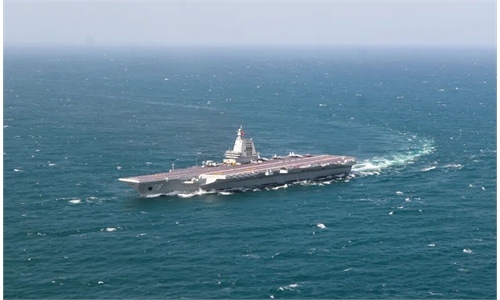
One year on, Fujian carrier pushes toward full combat readiness
Vessel’s debut year sees cross-theater drills and steady system integration

The commissioning and flag-presenting ceremony of the Fujian, China's first aircraft carrier equipped with electromagnetic catapults, is held at a naval port in Sanya City, South China's Hainan Province, on November 5, 2025. Photo: Xinhua
November 5 marks the first anniversary of the commissioning of China's third aircraft carrier Fujian.
Officially inducted on November 5, 2025, the Fujian is the first catapult-equipped carrier fully designed and built by China, and the world's first conventionally powered carrier with electromagnetic catapults.
In its first year, the Fujian sailed south through the Taiwan Straits to the South China Sea, then north to the East China Sea and Yellow Sea, completing cross-theater trials and training, showing it can operate across sea zones in the far seas, with coordination with escorting vessels reaching a certain level, CCTV News reported on Thursday.
CCTV reported that 2026 has been a critical year for the Fujian's transition from initial combat capability to full combat capability. Military affairs experts told the Global Times that the Fujian has completed its leap from platform validation to system integration in its first year, and is pushing toward "full combat capability" through high-intensity training, propelling the PLA Navy into an era of three-carrier rotation.
Initial combat capability
Before the Fujian entered service, its activities were already being closely watched.
On June 17, 2022, China's third aircraft carrier was launched and named the Fujian, with hull number 18. On May 1, 2024, the Fujian completed its first eight-day sea trial, testing propulsion, electrical and other systems, meeting expected targets. On September 22, 2025, the J-15T heavy fighter jet, the J-35 stealth fighter jet, and the KJ-600 early warning aircraft - all displayed at the 2025 V-Day parade - completed their first catapult takeoffs and landings aboard the Fujian, reported CCTV.
After being officially commissioned, within half a month, it formed a carrier group with multiple vessels for its first live maritime training, with multiple carrier-based aircraft completing numerous catapult takeoffs and landings, validating the Fujian's electromagnetic catapult, recovery and deck operations, CCTV reported.
Zhang Junshe, a Chinese military affairs expert, told the Global Times on Thursday that the Fujian now has cross-theater far-sea operational capability, with coordination with escorting vessels reaching a certain level, meaning it has basically formed combat capability.
"Basically formed combat capability" means the Fujian can sail normally; its aircraft can take off and land on deck, and it can conduct basic formation training with escort vessels. "Full combat capability" requires a leap from "can sail, can take off and land, can fight limited battles" to "can conduct high-intensity, all-weather, system-based, sustained operations." At the same time, all ships in the group must coordinate closely to ensure the carrier strike group can sustain system-based operations in the far seas, Zhang said.
The Fujian is now tackling these requirements one by one through high-intensity training. Zhang said three points of interest should be observed: first, full-deck, full-load sortie generation, upgrading from "can use catapult" to "can use catapult continuously at high intensity"; second, takeoffs and landings under complex conditions. Nighttime and severe sea states are recognized difficulties, and pilots must obtain night qualifications; third, deep integration of the formation system, achieving integrated command and information sharing between ships and aircraft.
Far-sea training
Far-sea training is the final piece of the puzzle for full combat capability, Song Zhongping, another Chinese military affairs expert, told the Global Times on Thursday.
Since October 14, the PLA Navy's Liaoning carrier group has been training in relevant waters of the Western Pacific, a routine mission under the annual plan, aimed at testing and improving combat-oriented training and continuously enhancing mission capability. It complies with international law and practice and does not target any specific country or target, according to China's Ministry of Defense.
Against this backdrop, Song said that given the past year's progress, the Fujian may soon be able to conduct similar far-sea training.
Song explained that the Fujian has grown in three ways over its first year. First, after prolonged trial service, its hull lines, internal structure, electrical and propulsion systems and electromagnetic catapult support systems have all been effectively tested. "This is China's first large carrier with a flat deck. The Fujian's first year shows its design is sound and meets China's actual needs for developing large carriers."
Second, ship-aircraft coordination has produced substantive results. The Fujian has initial aviation combat, support and sustained operation capabilities.
Third, it has begun building out the carrier strike group system. Over the past year, the Fujian has conducted multiple compatibility drills with escort vessels, practicing formation navigation, command coordination and joint ship-aircraft support. "This step is laying the foundation for a complete carrier strike group," Song said.
Within a year, the Fujian jumped from "multiple carrier aircraft catapult takeoffs and landings, initial full-deck capability" to "live formation training, cross-theater maneuvers", with escort coordination reaching a certain level and initial combat capability achieved. "This pace is rare in the history of global carrier development, completing in one year what other countries took years to do."
Song said the next step may see the Fujian carrier strike group head into the Western Pacific, or even more unfamiliar and complex waters, for far-sea deployments and combat-oriented trials, testing sustained operations, logistics support and adaptability to complex sea conditions.
Value of three carriers
With the Liaoning, Shandong and Fujian, the PLA Navy has entered the three-carrier era.
"The real value of the three-carrier era is not the visual impact of three ships in one frame, but the system of rotation among 'on duty - training - maintenance'," Zhang stressed. Three carriers form the minimum threshold for sustained maritime presence: one on duty, one in training, and one in maintenance. Once rotation runs smoothly, carriers upgrade from scarce resources "pulled out when needed" to strategic tools "ready at any time."
It's also possible the Fujian will conduct dual- or even triple-carrier group exercises with the Liaoning and Shandong, Song said. Such drills would be significant: they would show that China can mobilize multiple large carriers simultaneously, and dual- or triple-carrier drills with other services would be more targeted and closer to real combat.
This means the Fujian strike group's deployment will gradually shift from "validating performance" to "fulfilling missions", and from "training the platform" to "training for the mission", Song said.
RELATED ARTICLES