ICBM DF-61 enters routine training with PLA Rocket Force; rapid transition highlights faster-than-usual development: expert
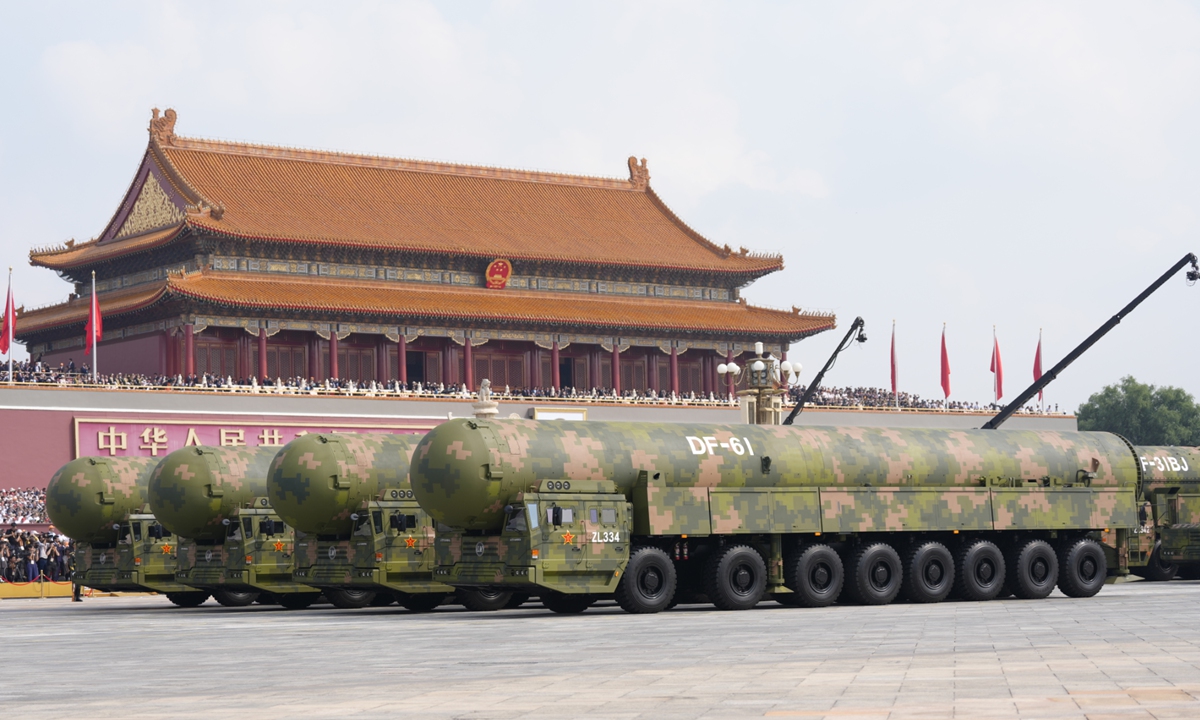
DF-61 Photo: VCG
China's new DF-61 intercontinental ballistic missile, which first debuted at the September 2025 military parade, has been inducted into the People's Liberation Army Rocket Force and is now a part of routine training, according to a report by state broadcaster China Central Television (CCTV) on Thursday.A military expert said the pace at which the DF-61 moved from its public debut to routine training was much faster than the traditional combat-capability development cycle for intercontinental ballistic missiles.
The disclosure came as China marked the 66th anniversary of the successful launch of its first domestically manufactured short-range surface-to-surface missile, the DF-1.
The rapid transition indicates that the missile had already completed required procedures before its public unveiling, according to military commentator Shao Yongling.
"Firstly, this shows that it had already completed development, finalization, trial deployment and reliability verification before its appearance, indicating a high level of technological maturity," Shao was quoted as saying in the CCTV report.
The military commentator attributed the progress to the Rocket Force's established equipment support and training systems.
The DF-61 is compatible with existing command, communications and logistical support networks, while the Rocket Force's accumulated experience in organizing and conducting training for intercontinental ballistic missiles has enabled units to become familiar with the new equipment more quickly after receiving it, Shao noted.
This has helped shorten the process of generating combat capabilities and reflects the progress made in the Rocket Force's development under the strategic requirement of being capable of both nuclear and conventional operations and conducting deterrence across all domains, she added.
According to Shao, the DF-61's participation in routine training means it has become part of practical training exercises involving field mobility, position changes and launch procedures.
Its induction into service represents an upgrade to China's land-based nuclear counterstrike capabilities, strengthening the force's mobile survivability and penetration capabilities, she said.
The DF-61 made its first public appearance during the military parade in Beijing on September 3, 2025, marking the 80th anniversary of the victory in the Chinese People's War of Resistance Against Japanese Aggression and the World Anti-Fascist War.
It was displayed in the strategic strike formation alongside other advanced strategic missile systems, including the air-launched Jinglei-1, or JL-1, the submarine-launched Julang-3, or JL-3, and the DF-31BJ land-based intercontinental ballistic missile.
The latest disclosure comes 66 years after China's first domestically manufactured short-range surface-to-surface missile, the DF-1, was successfully launched.
On November 5, 1960, China's first domestically manufactured short-range surface-to-surface missile, designated 1059 and later named the DF-1, was successfully launched at the Jiuquan missile test site.
Although the DF-1 was a reverse-engineered version of the Soviet Union-made short-range R-2 missile and was never deployed as an operational weapon, its successful test marked a foundational step in China's missile development, Shao noted.
Shao added that the DF-1 occupies a pioneering position in the country's missile and defense science and technology history, as it laid the groundwork for subsequent advances.
More importantly, the program enabled China to accumulate essential expertise, infrastructure and institutional experience, which directly supported the subsequent "Eight Years, Four Missiles" development plan, she said.
The experience laid the groundwork for the independent development of the DF-2, the integration of nuclear warheads with missiles, and subsequent efforts to develop intercontinental and submarine-launched missiles, Shao added.
From the first successful launch of the 1059 missile in the Gobi Desert to the induction of the DF-61 into the Rocket Force, China's strategic missile development has undergone more than six decades of evolution, the expert noted.
RELATED ARTICLES