ARTS / CULTURE & LEISURE
Chinese word ‘duanju’ enters English lexicon
Entry highlights success of China’s short drama industry globally: expert

duanju Photo: VCG
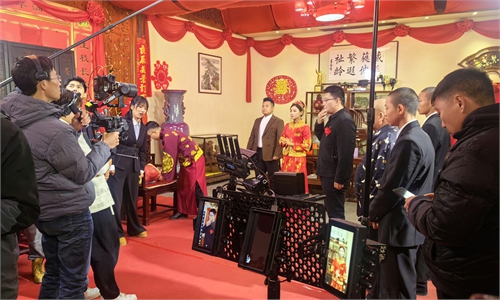
When overseas audiences search for micro dramas on Wikipedia, they can now find not only the English term "microdrama," but also a word borrowed directly from Chinese: duanju, literally short drama.The encyclopedia has established a dedicated English-language entry for the term, describing it as a type of short form web or television series originating in China that features fast-paced plots and heightened melodrama, with common themes including revenge, organized crime, wealth and status, and romantic relationships. The entry is available in 14 languages in total.
The appearance of duanju as a standalone entry highlights the success of the Chinese short drama industry globally, and offers an interesting glimpse into how languages absorb new cultural concepts. Rather than translating the term entirely into English, the entry retains its Chinese pronunciation in pinyin, giving international readers a direct linguistic link to the format's country of origin, Zhang Peng, a cultural researcher and associate professor at Nanjing Normal University, told the Global Times.
In linguistics, the adoption of a foreign word can reflect the emergence of a cultural product or concept that existing vocabulary does not fully capture, he noted. While "short drama" and "microdrama" describe the format, duanju also carries a reference to its Chinese origins and the distinctive production model that has developed around it.
Its inclusion in an English-language entry in the encyclopedia gives the term a searchable reference point and may help introduce the Chinese format to readers in other languages, he added.
As Chinese short dramas reach more international audiences, the use of the original term could also become a meaningful part of their cultural presence overseas. For future viewers, encountering duanju may be another way to discover the format and understand where it came from, noted Zhang.
The growing visibility of the term comes as Chinese short dramas gain rising popularity to dominate overseas markets.
The overseas market is expected to exceed $6 billion in 2026, showing an increase of 67 percent year-on-year, according to a report released by China's National Radio and Television Administration. Chinese-backed platforms account for all of the 10 most-downloaded overseas micro drama apps and nine of the top 10 by in-app purchase revenue from January to September 2026.
The composition of overseas content is also changing. The share of locally produced dramas rose from 5 percent in May to 11 percent in September, while translated Chinese productions declined from 95 percent to 89 percent.
Zhong Hui, head of content at a short drama platform targeting overseas audiences, told the Global Times that overseas production now encompasses high-volume scripted dramas, narrated stories and premium productions. Live-action dramas account for a relatively small share of new productions, while AI-generated dramas have become more common. Local capital has also begun entering the market.
The sources of stories are becoming more diverse, ranging from Chinese short dramas and popular Chinese online novels to popular overseas fiction. The visual quality of AI-generated content has already surpassed that of many existing productions, Zhong said.
However, despite the growing role of AI, she said Chinese companies will remain important drivers of large-scale production in the near future, given their accumulated experience and established production capabilities.
FlickReels, the overseas platform of Chinese short drama company Tinghuadao, is available in more than 220 countries and regions and is actively soliciting scripts from overseas creators to develop locally produced content.
Productions are increasingly filmed in local cities and feature actors familiar with their cultural settings. Dialogue and character development are also being adjusted, Zhong told the Global Times.
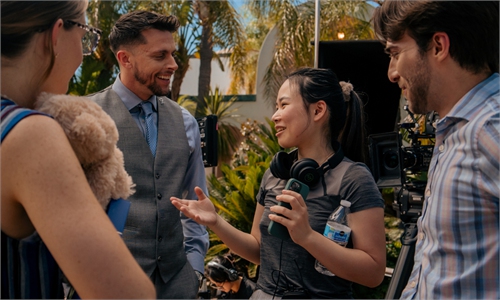
Local production is also bringing Chinese short drama companies closer to the established US entertainment industry. ReelShort, a platform operated by California-based Crazy Maple Studio, planned to produce more than 400 shows in 2025, up from 150 in 2024, CEO Joey Jia told the Los Angeles Times. The shows were filmed in the US, mostly in Los Angeles. The company also planned to build a studio in Culver City to adapt some popular micro dramas into films.
As Hollywood also looks to enter the short drama market, Zhang told the Global Times that the industry still has major advantages, including world-class IP assets, distribution networks and established brand credibility.
In his view, as AI-generated short dramas risk becoming increasingly homogeneous, high-quality content with recognizable brands and strong IP could become even more valuable, creating an opportunity for Hollywood.
The key, Zhang said, is whether Hollywood can move beyond its traditional long-form production mindset and adapt to a short drama business model that requires rapid production cycles, locally grounded storytelling and global distribution.
RELATED ARTICLES