Chinese rapper Lanlao gives a concert. Photo: Courtesy of Lanlao
Editor's Note:
Among the many descriptions of China seen from the outside, the country has gained an increasingly prominent image for itself in 2025 as a "cool" place to visit and live, as reflected in multiple global surveys and in foreign vloggers' videos and comments.
As the year draws to a close, the Global Times is launching the "Cool China" series to approach the most iconic events and phenomena of the year through the five senses.
In this installment, we trace China's immersive cultural currents through music, short dramas, and games as they circulate globally. Centered on the experiences of overseas audiences, these works move beyond screens to become lived worlds - felt, explored, and reinterpreted through emotions and storytelling.
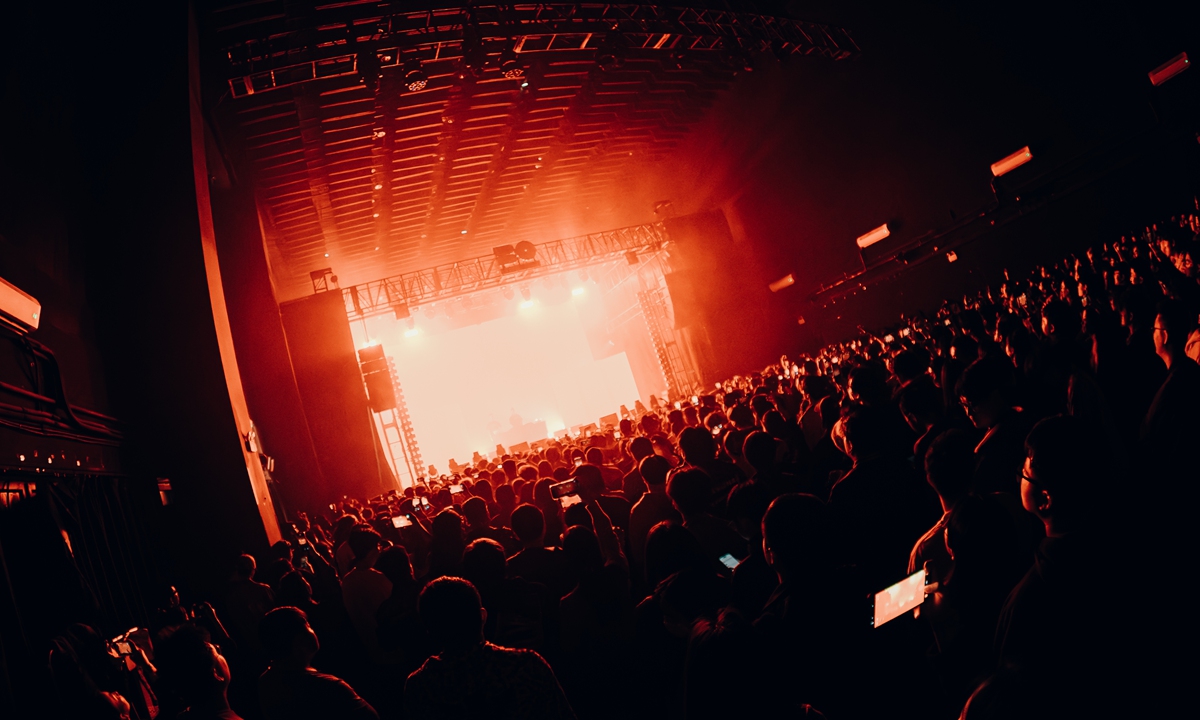
Chinese rapper Lanlao gives a concert. Photo: Courtesy of Lanlao
In 2025, When "Da Zhan Hong Tu" (Blueprint Supreme) topped the streaming charts in multiple countries and passed 20 million views on YouTube, overseas listeners began engaging with contemporary Chinese culture through sound rather than understanding. Reused and remixed across short-video platforms, the track became a shared global audio experience.
A similar shift has taken place in the visual and interactive fields. This year, Chinese short dramas entered steady release cycles on platforms in North America and Europe, with fast-paced storytelling transforming fragmented viewing moments into immersive screen worlds. That same sense of immersion has even extended beyond the screen through games, with some overseas players traveling to China to see the real temples, mountains, and city streets they first experienced virtually.
Chinese creative content is increasingly being encountered not as distant symbols, but as immersive worlds that global audiences step into, and, in some cases, travel through.
Glocal rap flow
Living and studying in Beijing, 23-year-old South Korean student Lee Yuga is a fan of China's hottest rapper Lanlao (aka Skai Isyourgod). Next week, she will finally have the chance to see him perform live in the city. "He's a truly special artist. I'm gutted I didn't snag a VIP ticket to meet him in person," Lee told the Global Times.
Lanlao is "special" as he fuses Chinese Lingnan region's street narratives with the raw groove of Memphis art from Tennessee. His style is described as "Lanlao-style Memphis" and has made him become pop culture icon of the year, especially to foreign fans.
Besides the upcoming Beijing show, the rapper has already brought his music to countries like the US, Thailand and more during the year. Earlier this summer, he broke the record on Spotify's Mandopop chart, hitting over 3.022 million monthly listeners.
And international fans' passion shows no sign of fading, as Lanlao's monthly listeners have stayed at nearly 3.88 million.
Other platforms like YouTube and TikTok are where you can find his overseas fans. Lee is one of them on TikTok. She told the Global Times that though she has long been following South Korean and Western rap music, hearing Lanlao's "Ba Fang Lai Cai" (lit: Stacks from All Sides) for the first time still struck her as refreshingly novel.
"I never knew Chinese hip-hop had such incredible work,'" said Lee. She also added that she loves how Lanlao's lyrics are "folksy but compelling."
Born in Huizhou, a city that merges the Hakka, Cantonese and Chaoshan, also known as Teochew, cultures in Guangdong Province, Lanlao's lyrics are imbued with different facets of common life. He told the Global Times that even his stage name "Lanlao" came from observing passersby. It describes a man who has street smarts and is shrewd at navigating relationships to carve out a path for survival.
Some of his lyrics such as "sitting on rosewood stools," "double-cup herbal tea," "a three-dimensional Guanyin statue," and "carrying a bottle of medicated oil" all vividly portray local people's everyday habits and cultural beliefs.
Such imagery appears not only in his recent viral hits "Da Zhan Hong Tu" and "Ba Fang Lai Cai," but also his earlier works like "Huoluo You," (lit: Medicated Oil), revealing the artist's long-standing observation of grassroots culture.
"I always believe the folksiest things are the coolest," the rapper told the Global Times. He added that if an artist "lacks reflection on their own cultural roots," it's hard for them to "find his or her style, let alone win over so many fans."
Neither copying the guns-drugs-girls narrative of Western rap, nor losing himself in hollow imitation, it is precisely his local-oriented stance that leads cross-cultural listeners like Lee to regard Lanlao as the artist "who truly brings Chinese culture overseas," even if they do not fully understand his lyrics.
Anne, a French student studying in China, told the Global Times that earlier this year, when her French friends introduced her to Lanlao, none of them could fully understand what he was singing. But she quickly realized that the rapper was not singing in just Putonghua (Standard Chinese). Through the medium of rap, Anne's discovery allowed her to see the cultural charm of the diverse dialects within the Chinese language.
"I think I resonate with the song, one because the vibe is great, two because it is a good rap song in Chinese," she told the Global Times, adding that she feels music can definitely break down cultural barriers as the song has helped her create "a sense of closeness" with her Chinese friends.
While overseas listeners like Lee and Anne immerse themselves in Lanlao's beats and lyrics, fans like B Dowling follow the star as a case study to gain clearer insight into China's pop culture.
As a graduate student researcher in Chinese linguistics at the University of Wisconsin in the US, Dowling told the Global Times that his thesis focuses on Chinese hip-hop music and that he has already taught courses on the subject to students at the university.
Including Lanlao, Dowling found that many rap artists in China have discovered a pattern of success that involves incorporating "local customs, language and music with global hip pop."
Unlike literature, which relies on concrete textual expression, "music is defined by sound," the researcher said.
"If you hear something that sounds good to your ear, it probably sounds appealing to others as well." 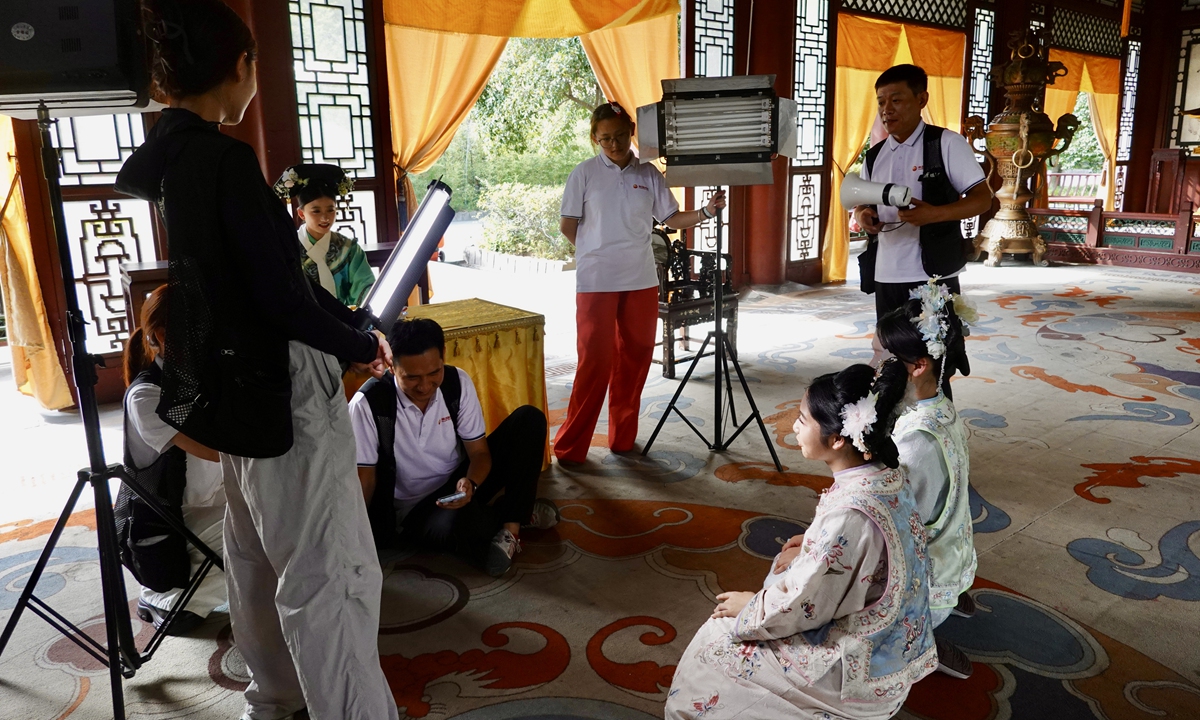
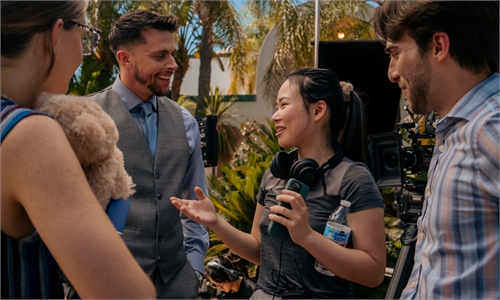
Crew members shoot a short drama. Photo: VCG
Short-drama boom Promotional material for Chinese video game Where Winds Meet Photo: Courtesy of Everstone Studios
As "Da Zhan Hong Tu" was frequently covered, remixed, and reused across various short-video platforms, Chinese short dramas were showing similar cross-cultural reach.
According to the Micro-short Drama Industry White Paper (2025) released by the China Netcasting Services Association, from January to August, the overseas micro drama market generated a total revenue of $1.52 billion, a year-on-year increase of 194.9 percent. During the same period, the total downloads of overseas micro drama apps reached about 730 million, up 370.4 percent year on year.
The data highlights the rapidly growing global appetite for Chinese short-form storytelling.
Mark Pontarelli, a 33-year-old short-drama actor based in Chicago, is one of the witnesses to this trend. He told the Global Times that international audiences are drawn to these dramas not because of their complex narratives, but because their concise and entertaining format allows viewers to step into another world even during fragmented moments in their day.
"Overseas audiences aren't attracted by complicated plots; it's the way that these short dramas let them escape into another world during spare moments," he said, adding that the fast pace makes it "hard to stop watching."
Having acted in short dramas in the US for a year and a half, Pontarelli said most of the projects he has worked on are produced by Chinese apps or companies, and that the majority of the crew, including directors and producers, are Chinese.
His perspective highlights not only the industry's overseas footprint but also how these productions resonate with international viewers.
Jin Kim, a 27-year-old South Korean working at a service trade company on the US West Coast, is also a fan of Chinese short dramas. Watching these dramas takes up a large portion of her leisure time, and she finds them particularly captivating.
"I think the reason Chinese short dramas are so popular overseas isn't just that they're short," Kim said. "In such a brief time, they can lay out an emotional conflict, character relationships, or even a climax."
She explained that this "dense and compact" storytelling allows her to watch one or two episodes during her commute, lunch break, or while waiting, yet the twists are so engaging that she often ends up bingeing episode after episode and losing track of time.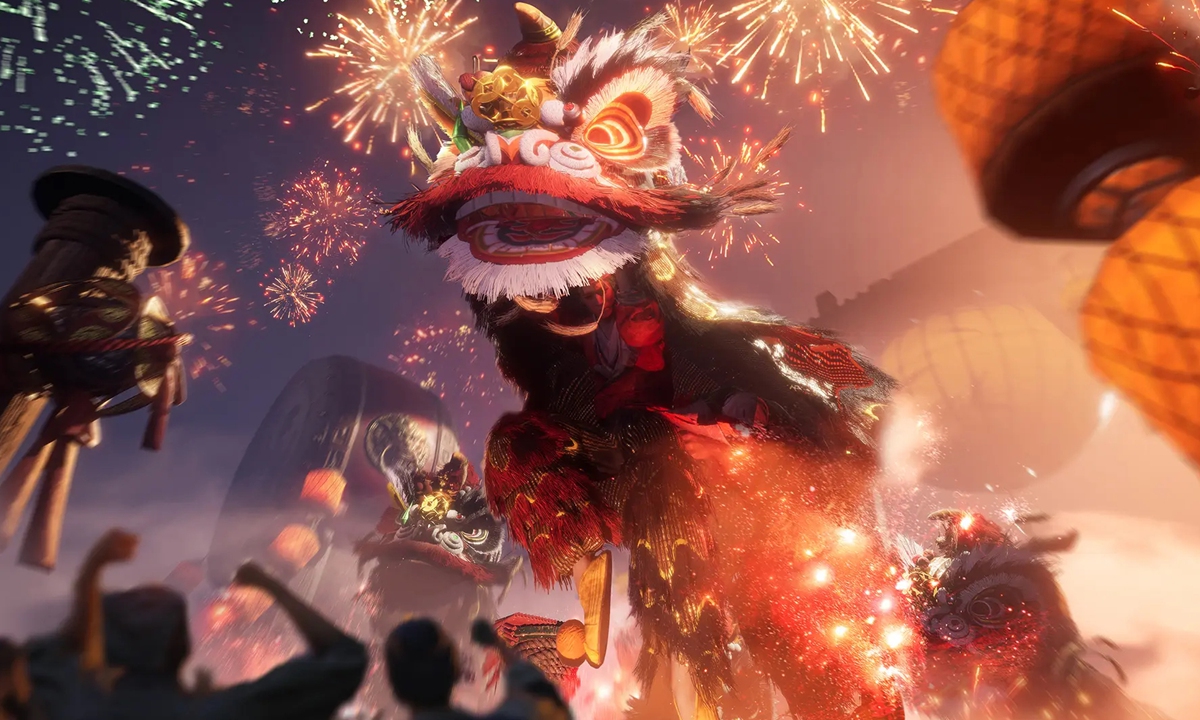
This same sense of immersion and narrative engagement is evident in Chinese video games, where players are drawn into richly detailed story worlds that extend beyond the screen and even inspire real-world exploration.
In December, the promotional trailer for the latest Chinese AAA martial arts game Phantom Blade Zero surpassed 6.6 million views shortly after release.
Portuguese gamer Rodrjgues, who played a one-hour demo at Gamescom, one of the world's largest trade fairs for computer and video games annually held in Cologne, Germany, shared his experience: "It was so good I actually went to the line twice. Combat is fast-paced but always controlled; the parry and dodge system is incredibly fluid, and the animations feel like a martial arts movie. Enemies are incredibly cinematic, and some sections mix in metal music, which makes the game look and sound unbelievably cool."
This immersive experience extends beyond gameplay into offline cultural activities driven by games.
This year, Chinese martial arts games like Where Winds Meet have been especially popular among overseas players, not only topping download and play charts in many countries upon release but also inspiring them to explore real-world locations reflected in the game's narrative and environments.
German blogger Maik Gramalla traveled to Shanxi and other parts of China in mid-December after experiencing this game, during which he documented his visit on video.
He told the Global Times that standing among ancient temples and mountains constantly reminded him of the game's scenes. "It feels like I've stepped out of the screen," he said. The overlap of the virtual and the real is what has drawn him back to China repeatedly.
This wasn't his first visit motivated by Chinese games. He had previously come because of Black Myth: Wukong and Genshin Impact. He has explored Huanglong in Southwest China's Sichuan Province, Zhangjiajie in Central China's Hunan Province, and Yangshuo, South China's Guangxi Zhuang Autonomous Region, seeking real-world counterparts to game locations.
Gramalla emphasized that the appeal of these games lies in how they make foreign players curious about China's living culture.
"Games give context to landscapes and monuments," he said. "They frame them with stories, conflicts, and human emotions. Experiencing them in reality lets me understand the culture behind the visuals - how people live, what they value, and why certain rituals or architecture exist. That's why I keep coming back."
Wang Deyan, director of the Chinese Language Department at the School of Liberal Arts and Law of North China University of Technology, told the Global Times that this shift from virtual worlds to real-life spaces represents a transition of Chinese cultural products from merely exporting content to offering immersive cultural experiences.
"This phenomenon highlights the unique appeal of Chinese culture overseas. It combines distinct national characteristics with modern entertainment formats, allowing international audiences to absorb culture naturally through immersive experiences," Wang said.
According to Wang, this art and cultural trend, centered on immersion, no longer remains at the level of symbolic display. Instead, through continuous participation and emotional engagement, it helps shape a more three-dimensional and relatable image of a "Cool China."